





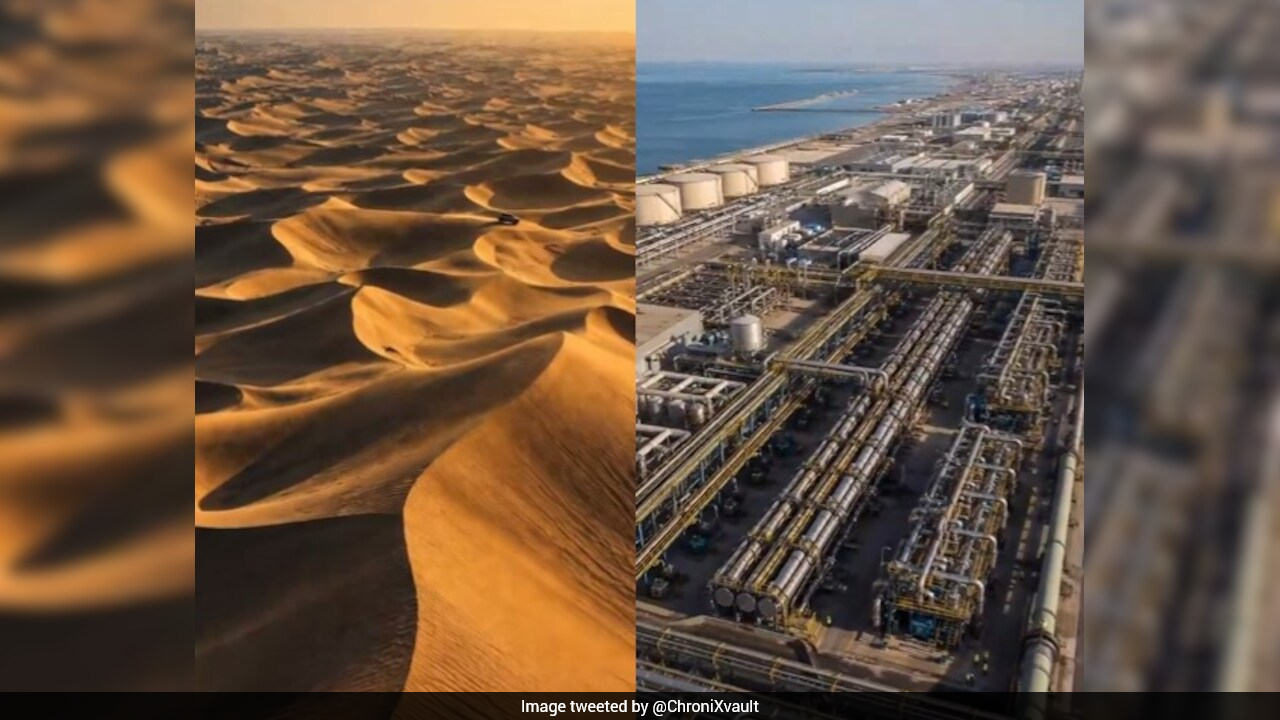
Imagine a country where vast stretches of land are covered by scorching sand, more than 95% of the territory is arid desert, annual rainfall is often below 100 mm, and summer temperatures can soar beyond 45°C. But underneath this unforgiving landscape is one of the largest reserves of wealth in the world. Saudi Arabia has more than 40 trillion litres of crude oil buried beneath its soil. Despite immense oil wealth, the country faces a very different challenge of securing enough fresh water for its people.
Home to more than 37 million people, Saudi Arabia's population is concentrated largely along the Red Sea and the Persian Gulf, while much of the country's interior remains sparsely populated and extremely dry.
To keep this vast nation supplied with water, Saudi Arabia has built an enormous infrastructure network stretching from its coastlines deep into the desert. It consists of massive pipelines that carry desalinated water across hundreds of kilometres, creating an artificial river system across one of the world's driest regions.
Saudi Arabia has no rivers… yet billions of litres of freshwater are produced every day.
— ChroniX (@ChroniXvault) September 1, 2026
So how does a desert country turn the ocean into drinking water?
The answer: massive desalination plants, high-pressure membranes and an enormous pipeline network. #Engineering pic.twitter.com/SU30x6jyxT
Building Strong Pipelines
The first challenge is to build pipelines that can withstand decades of extreme heat, shifting sands and the enormous underground pressure. These are not just pipes. They are constructed from high strength carbon steel, the same material used in oil and gas pipelines. Steel sheets of around 25 mm thickness are fed through multi-axis rolling machines to form huge pipes of around 1.8 metres diameter.
Sections can be 12 to 18 metres long so there are fewer joints required on the route. Pipes are ultrasonically tested and coated with corrosion-resistant coatings before they leave the factory. They are then loaded into special heavy trucks and driven hundreds of kilometres into the desert.
Cutting Through Sand and Rock
Laying a pipeline across a desert is an engineering challenge in itself. Survey teams first map out routes using GPS and advanced surveying equipment, carefully avoiding areas where shifting sand dunes or unstable ground could threaten the pipeline.
Where rocky terrain and mountains stand in the way, controlled blasting is used to break through the rock and create deep trenches. The pipes are then lowered into these trenches and connected section by section, eventually forming a vast network beneath the desert.
But getting the water from the coast to the interior is only half the challenge. The bigger question is where that water comes from in the first place.
Turning Seawater Into Fresh Water
The most remarkable part of the process happens at desalination plants along the coast.
Large intake pipes are installed several hundred metres offshore to draw seawater into the facility. A single 63-centimetre pipe can reportedly transport around 15 million litres of water a day. Protective screens help prevent marine life such as fish, crabs and jellyfish from entering the system.
Treatment Stages of Seawater
The seawater is first passed through gravity sand filters, with chemicals like ferric chloride and sodium hypochlorite added to make impurities clump and settle out. It then goes through ultra-fine cartridge filters that trap particles as small as 1-5 microns. In the main stage, high-pressure pumps force the water through reverse-osmosis membranes at around 60 bar (about 60 times atmospheric pressure) allowing only water molecules to pass through while salts and impurities are left behind). The water may then undergo a second round of reverse osmosis for further purification.
However, there is a catch. Water purified to this extent contains very few minerals and can taste flat. That's why essential minerals such as calcium and magnesium are added back, while the pH is carefully adjusted to make the water suitable and pleasant for drinking.
An Extremely Expensive Solution
Creating such an enormous water-supply system comes at a staggering cost. Pipeline construction can cost millions of dollars per kilometre, while large-scale desalination plants require investments running into hundreds of millions of dollars. Depending on the technology, energy prices and plant efficiency, producing a cubic metre water can cost several dollars.
For Saudi Arabia, however, the calculation is about more than money. In a country where freshwater is naturally scarce and millions of people depend on a reliable supply, desalination has become a critical part of national infrastructure.
Track Latest News Live on NDTV.com and get news updates from India and around the world

