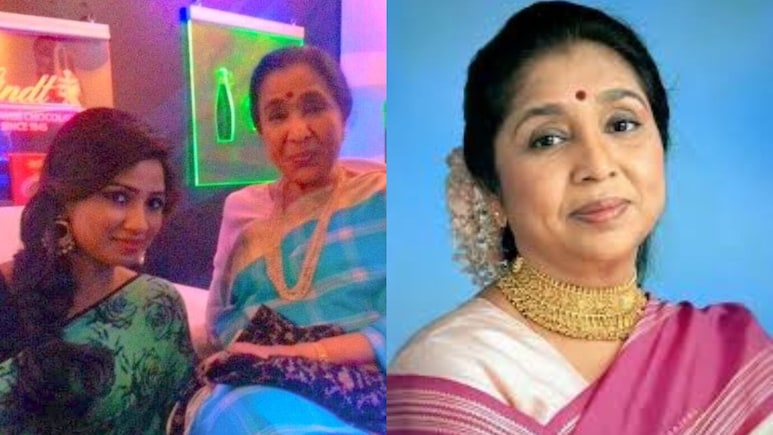
Legendary singer Asha Bhosle is no more. The singer breathed her last on Sunday, April 12. She was admitted to Mumbai's Breach Candy Hospital on Saturday due to a chest infection. She was shifted to the ICU last night.
Shreya Ghoshal took to Instagram to express deep remorse.
She wrote, "Today, we lost a voice that defined generations... a spirit that redefined music itself. Asha Bhosle ji wasn't just legendary; she was limitless."
She continued, "I grew up listening to her, learning from her, being in awe of her effortless versatility... The way she could make every note feel alive, every emotion feel personal. From the most playful melodies to the deepest ghazals to her extraordinary virtuosity in her songs in Marathi, Bangla and innumerable languages, she did it all, like only she could. For so many of us, she wasn't just an inspiration... she was a part of our musical soul. I feel incredibly blessed to have witnessed her greatness in my lifetime. Her voice will echo through time, through every artist she inspired, through every heart she touched."
"Rest in music, Asha tai. Your legacy will never fade," concluded Shreya Ghoshal.
What Made Asha Bhosle Different
Asha Bhosle carved her own niche in the industry as she blended traditional melodies with the modern, Western-influenced sound of the 60s and 70s.
From soulful ghazals to cabaret to foot-tapping rock and roll, Asha Bhosle was crowned with the sobriquet of 'Queen of Versatility.'
She chose to define the 'unconventional' path. It was obvious that early in her career, comparisons would be aplenty with her elder sister, the late Lata Mangeshkar, who had a softer tone. Asha Bhosle implemented a more agile modulation in her vocal chords.
Interestingly, her sharper voice got her playback singing for many more rebellious characters.
She replaced the traditional voice for a Hindi film heroine with a magnetic change-something synonymous with the modern Indian woman-and thus a playback superstar was born.
It is because of her knack for experimentation that she even earned herself a spot in the Guinness World Records as the most recorded artist in music history. She could turn everything into music: a whisper here, a giggle there, a murmur in between.
