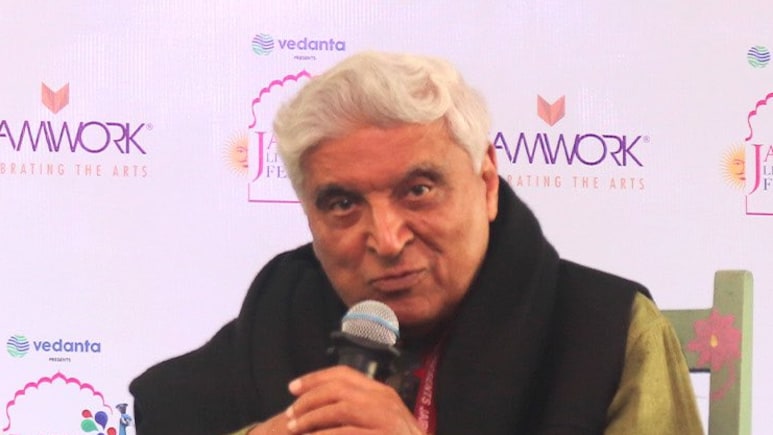
Secularism cannot be taught through crash courses; it is a "way of life" that comes naturally, lyricist-writer Javed Akhtar said at the inaugural day of the 19th Jaipur Literature Festival (JLF) on Thursday.
Akhtar remarked that in recent times, secularism has been reduced to a "four-letter word", but stressed that secular values do not take root through formal instruction or theoretical lessons.
"Secularism should be a way of life because everyone around you is living like this, and then it comes to you automatically. If one day you are given a lecture and you remember points A, B and C after listening to it, that is fake, that is artificial. It can hardly last. But if it is your way of life - the way you have seen your elders, the people you respect and admire, living - then it comes within you," he said, addressing a packed audience in his session titled Javed Akhtar: Points of View.
Reflecting on his childhood, Akhtar, who is an atheist, said he was raised in a household of agnostics and atheists where religion rarely entered daily life.
The only family members he ever saw praying were his maternal grandparents. He shared a personal anecdote about his grandmother, an illiterate woman who nevertheless possessed a sensibility he wished "even one-tenth of today's leaders had."
During his childhood, when his grandfather tried to persuade him to memorise religious verses by offering 50 paise - no less than a "fortune" at the time - his grandmother angrily intervened, insisting that no one had the right to impose religion on another.
"That was the end of my religious education. At the time, I was not very happy with her because I lost the opportunity to earn 50 paise. But in retrospect, I think of her as a woman who could not even write her name, yet had this sensibility. I wish our leaders had one-tenth of it," he said.
Akhtar frequently had the audience in splits with his trademark wit.
When session moderator Warisha Farasat introduced him as someone whose writing carries the finest traits of literary greats, including Shailendra, Shakeel Badayuni and his father Jan Nisar Akhtar, he quipped, "I have nothing of my own." Moments later, when Farasat requested him to recite a poem during a brief pause, Akhtar shot back without batting an eyelid, "Can't you think of the next question?" sending the audience into peals of laughter.
Akhtar also challenged the notion that the younger generation is uniquely flawed, observing that such complaints have existed since time immemorial.
"The golden era is never the present era. You can find it on Google. Even Aristotle was very unhappy with the younger generation. Around 360 or 350 years before Christ, it was written that the younger generation had no concentration, no manners and was completely spoiled. This complaint has always existed," he said.
He added that times keep changing, bringing with them a mix of both good and bad.
To illustrate his point, he referred to the film industry, which is often criticised for not being what it once was.
"Today things in the film industry are far more streamlined than ever. I remember when I was an assistant director, the position was so disrespected. What was our job? 'Bring madam's shoes quickly.' 'Where is the hero's coat?' That was our life. Today's assistants are on first-name terms with stars. I get scared when I see them. The assistant director is calling the hero by his name - we could never have imagined that," he said.
The five-day literary festival will host more than 350 celebrated authors and scholars, including Booker Prize winner Banu Mushtaq, chess legend Viswanathan Anand, British actor and author Stephen Fry, former diplomat-writer Gopal Krishna Gandhi, Sahitya Akademi Award winner Anuradha Roy, veteran film critic Bhawana Somaaya, and authors Manu Joseph, Ruchir Joshi, and KR Meera.
The festival will conclude on January 19.
