
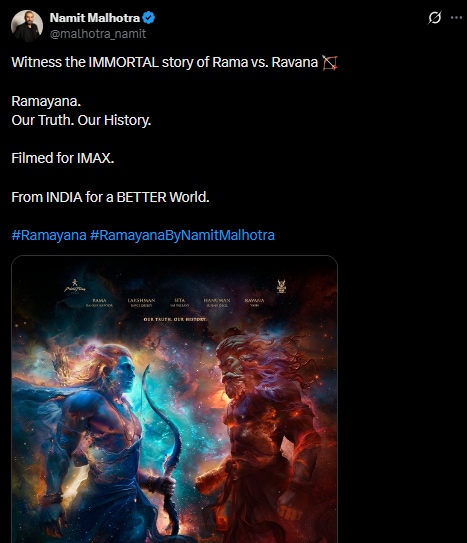
On July 4, 2025, Namit Malhotra took to X to announce that the ambitious retelling of the epic Ramayana would be "Filmed for IMAX".
"Witness the IMMORTAL story of Rama vs Ravana. Ramayana. Our Truth. Our History. Filmed for IMAX. From INDIA for a BETTER World," he wrote.
The announcement hinted at the project's scale and marked a significant moment for Indian cinema. Directed by Nitesh Tiwari and produced by Malhotra, the 4,000 crore, two-part film Ramayana: Rise of a Legend is the first Indian production to receive the official Filmed for IMAX certification.
For a film attempting to bring one of India's most enduring epics to the big screen, the decision makes sense. From sprawling landscapes and elaborate battle sequences to the larger-than-life world of gods, demons and divine interventions, the story lends itself to a format designed to make audiences feel part of the action.
But here's the thing. While Ramayana has been 'filmed for IMAX', does India have the infrastructure to show audiences the full IMAX experience? And what exactly are viewers getting when they book an expensive IMAX ticket? Let's break it down from the very beginning.
What Does 'Filmed For IMAX' Actually Mean?
First things first. IMAX is not simply a bigger cinema screen. Short for Image Maximum, the format combines specialised cameras, image processing, projection technology, screen design and sound systems to create a more immersive viewing experience.
Unlike a conventional widescreen presentation, IMAX can offer a taller aspect ratio, allowing more of the picture to fill the screen vertically. Depending on the theatre and the presentation, this can mean seeing more of a film's visuals than you would in a regular cinema.
For Ramayana, the 'Filmed for IMAX' certification means the production was designed with the format in mind, using IMAX-certified digital cameras and a filmmaking process that considers how the images will eventually appear on IMAX screens.
This is different from simply converting an already completed film into an IMAX presentation. The idea is to consider the format from the filmmaking stage itself, including framing, composition and the final presentation.
However, there is an important distinction worth making: Filmed for IMAX does not mean the film was shot on IMAX 70mm film. It uses certified digital camera technology, rather than the specialised 15-perforation 70mm film cameras associated with some of the format's most celebrated releases.
And that brings us to the format that cinema enthusiasts often consider the gold standard.
IMAX 70mm: A Rare Format
Not all IMAX theatres offer the same experience.
While most commercial IMAX screens today use digital or laser projection (both are projection technologies; however, laser is more advanced), IMAX 70mm film remains a particularly special format.
The difference lies in how much visual information it captures and projects. Traditional IMAX 70mm film runs horizontally through the projector, using 15 perforations per frame. It can deliver an aspect ratio of 1.43:1, producing a significantly taller image than the standard widescreen format.
This is the kind of presentation that filmmakers such as Christopher Nolan have championed in films including Odyssey, Interstellar, Dunkirk and Oppenheimer.
Whosoever made this guide thanks to them… now you all can see how formats don't really matter in Christopher Nolan movies… each frame in this image showing the most important information in a 35mm frame as well, while 70mm does have some extra image… it doesn't really give you anything more substantial to the story compared to 35mm. Crux is, be it scope or IMAX, Nolan movies feel good in every cinema; that's how good his framing is. I have watched #Oppenheimer in two scope screens and two IMAX screens, and I can say I didn't miss out on anything in scope screens. Please don't fall for this format or that format, this cinema or that cinema. Choose whatever is near, choose whatever is at least 4K Laser, and choose whatever is cheaper. Enjoy the movie #TheOdyssey and not formats.
— Parth Chaturvedi (@_mrchaturvedi) July 16, 2026
But maintaining these theatres is no easy task. The projectors are enormous, spare parts are difficult to source, film prints are expensive to produce and transport, and operating the equipment requires specialised expertise. With digital and laser projection offering a more practical alternative, the number of commercially operational 70mm IMAX venues has dwindled.
The rarity of the format becomes clearer when you look at the numbers. According to a worldwide listing updated in August 2026, there are approximately 41 theatres capable of screening IMAX 70mm films. Of these, 25 are in the US, nine in Canada, three in the UK and four in other parts of the world.
India, meanwhile, has a rather complicated relationship with the format.
India Has An IMAX 70mm Projector. But Can You Actually Watch A Film On It?
For years, India had several theatres equipped with IMAX 70mm technology. These included IMAX Adlabs in Mumbai, Prasads IMAX in Hyderabad, Aeren R Multiplex in Ghaziabad and Kolkata, and Gujarat Science City in Ahmedabad.
India used to have multiple 70mm IMAX screens (Mumbai, Kolkata and Hyderabad were the biggest) and now only one at Ahmedabad exists but it is being used only for science documentaries.
by u/sidroy81 in imax
However, as cinema exhibition gradually moved towards digital projection, most of these venues either shut down their 70mm operations or transitioned to other formats.
Today, Gujarat Science City in Ahmedabad is widely identified as the country's only surviving installation of true IMAX 70mm film projection technology.
But having the equipment does not necessarily mean having a theatre where audiences can book tickets for a commercial IMAX 70mm release.
Sources at the Gujarat museum have told NDTV that the facility is currently closed for an upgrade and is not being used for regular movie screenings. We have also reached out to the museum for further details and the story will be updated once we hear back.
Coming back to Ramayana, even if the Ahmedabad facility has the necessary projection technology, it does not automatically mean the film can be screened there in 70mm. A commercial release would require a physical film print, operational equipment and the necessary arrangements for screening. Over the years, the theatre has largely stopped screening Bollywood films and is now primarily used for scientific experiments and educational projections.
In simple terms, an IMAX screen (which we are paying thousands to watch the movie) at a multiplex in Delhi, Mumbai or Bengaluru might offer an excellent experience through digital or laser projection, but that is not the same as watching a film on a true IMAX 70mm system.
So, What Will Indian Audiences Actually Get?
The good news is that India is not entirely short of IMAX infrastructure, even if it lacks commercially accessible 70mm film projection.
PVR INOX, one of the country's biggest cinema exhibition chains, currently operates 27 IMAX screens across its network following the opening of its latest auditorium at Pacific Mall in Jaipur just yesterday (November 5). The new auditorium features 4K laser projection, Dolby surround sound and next-generation 3D technology.
Sanjeev Kumar Bijli, Executive Director, PVR INOX Limited, says the appetite for premium cinema experiences in India has grown considerably.
"The appetite for premium and immersive cinematic experiences in India has grown significantly. Audiences today are looking to experience films on a larger scale, and technology is playing an increasingly important role in shaping that experience. At PVR INOX, we are continuing to expand our IMAX presence and invest in technology that brings these experiences closer to audiences across the country," he shares.
He adds that the company has also upgraded more than 150 screens with 3D projection capabilities in preparation for Ramayana.
"Films like Ramayana, with their visual scale and storytelling ambition, also demonstrate how technology can add to the theatrical experience. This further strengthens our technology infrastructure and gives us greater flexibility in how we present films across our cinemas," Bijli says.
However, there is still a difference between watching Ramayana in an IMAX laser auditorium and watching it in a true IMAX 70mm theatre.
The former will offer the film's specially designed IMAX presentation, with a large screen, immersive sound and the benefits of its digital capture. The latter would offer the distinctive 70mm film projection experience, provided the film had a corresponding print.
And while the latter remains out of reach for Indian audiences at present, that does not mean the IMAX experience itself will be compromised in every respect.
Is India Ready For The IMAX Era?
There is something quite interesting about the situation. An Indian production was made with a global cinematic format in mind, but the country is still working towards building the exhibition infrastructure that can accommodate every version of that experience.
The growing number of IMAX screens, investments in laser projection and the expansion of 3D capabilities suggest that exhibitors recognise the demand. The opening of Jaipur's first IMAX auditorium just ahead of Ramayana is another example of that push.

Ramayana was made with a global cinematic format in mind. Photo: Ramayana
But the bigger question still remains whether this will encourage more Indian filmmakers to think about premium formats right from the beginning of production, rather than treating them as an afterthought.
After all, IMAX is not just about making a film look bigger. It is about how a filmmaker wants the audience to see and experience a story.
For Ramayana, a story that has travelled across generations, languages and geographies, the ambition is clearly to make that experience as expansive as possible.
Whether Indian cinema eventually builds enough infrastructure to match that ambition is a story that is still unfolding.
