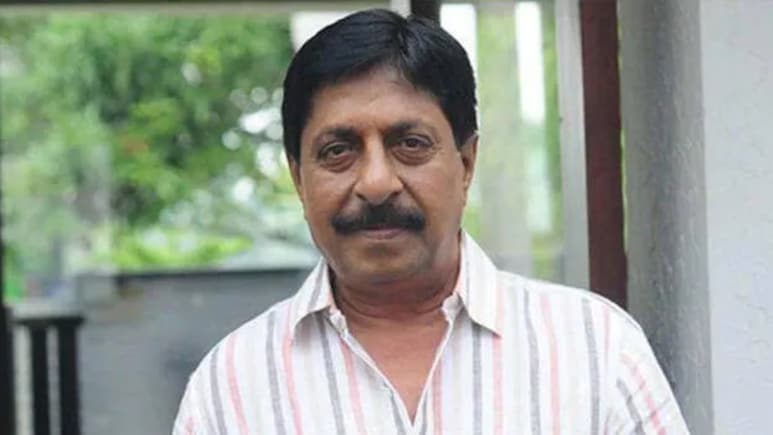
Sreenivasan, one of the most influential figures in Malayalam cinema as an actor, screenwriter and director, died at a government hospital here on Saturday morning, film industry sources said.
He was 69.
He had been facing health issues and had undergone heart surgery in 2022.
Sreenivasan was travelling for dialysis at a private hospital in Kochi when he developed breathing difficulties and was shifted to the Government Taluk Hospital, Tripunithura.
According to hospital authorities, he died at around 8.30 am.
Later, the body was shifted from the hospital to his residence.
The body will be kept at Ernakulam Town Hall for public homage.
The last rite will be held at his residence later.
Sreenivasan, who hailed from Kannur, had been staying at Kandanadu in Tripunithura for the past several years.
Eminent director Sathyan Anthikkad told reporters that Sreenivasan had been unwell for a long time.
"I used to visit him once every two weeks. I spoke to him on Thursday. He had recently undergone surgery and had difficulty walking. Even then, his mind and thought process were very sharp," he said.
Anthikkad said that Sreenivasan had recently told him that he was fed up with frequent ailments.
"I told him not to worry about it and that we would come back," he added.
Born on April 6, 1956, at Pattiam in Kannur district, he graduated in economics from PRNSS College, Mattannur, before moving to Chennai for film studies at the Film and Television Institute of Tamil Nadu.
He made his acting debut in the film 'Manimuzhakkam', directed by P A Backer, in 1976.
Sreenivasan went on to create several memorable characters, often alongside star actors Mohanlal and Mammootty.
Apart from acting, Sreenivasan was widely acclaimed for his screenplay writing, beginning with 'Odaruthammava Alariyam' in 1984.
He later collaborated extensively with noted directors Priyadarshan and Sathyan Anthikkad.
He made his directorial debut with 'Vadakkunokkiyanthram' in 1989, which is considered a classic in Malayalam cinema and won the Kerala State Film Award.
He also directed 'Chinthavishtayaya Shyamala' (1998), which won the National Film Award for Best Film on Other Social Issues. He was the lead character in both films.
'Sandesam' (1991), a political satire written by Sreenivasan and still frequently referenced in political discourse, won the Kerala State Film Award for Best Story.
After settling in Kochi, he was also known for practising organic farming near his residence.
His two sons, Vineeth Sreenivasan and Dhyan Sreenivasan, are also actors in the Malayalam film industry.
He is survived by his wife Vimala and their two sons.
Chief Minister Pinarayi Vijayan, in a statement, said Sreenivasan's passing is an irreparable loss to Malayalam cinema.
He said a versatile talent who rose to prominence in every sphere of filmmaking has left the industry.
"Very few filmmakers have succeeded like him in bringing the life of the common man to the silver screen and, through humour and thought, leading the audience to levels of awareness he desired. Sreenivasan broke many long-standing conventions in cinema as he carved his own path," the CM said.
Vijayan said that, even while fully aware that the ideas Sreenivasan expressed would invite severe criticism, Sreenivasan could present them with ease and grace.
"He was also a filmmaker who successfully presented his social perspectives through satire," Vijayan said.
Many of the characters from his films will remain etched forever in the minds of Malayalis.
"For me personally, Sreenivasan's demise is also a great loss. I recall the occasions when we sat together for an interview and how, through his witty and warm conversations, he secured a special place in my heart. Sreenivasan, with whom I shared a cordial personal relationship, also came across as a symbol of love and friendship," the chief minister said.
CPI(M) State Secretary M V Govindan, in a statement, said Sreenivasan will continue to be an eternal inspiration to the world of cinema.
"Even the last time I met him, despite various ailments, it was evident that Sreenivasan was constantly renewing his thoughts. He had a unique ability to bring the problems of ordinary people to the silver screen with a touch of humour," he said.
Govindan said Sreenivasan's childhood in Pattiam, where reading rooms were active, ignited in him a passion for reading and theatre.
"His creative ability to present profound themes in an extremely engaging manner will be remembered as long as cinema exists," he said.
Leader of the Opposition in the Kerala Assembly, V D Satheesan, told reporters that Sreenivasan was a unique artiste who portrayed, in an extraordinary style, the lives of small people in a big world and the lives of great people in small worlds.
He was a multifaceted genius of Malayalam cinema, turning everything he touched into gold, Satheesan said.
Through his works, Sreenivasan delivered powerful messages to Kerala society.
"There will be no Malayali who does not recall, at least once a day, what Sreenivasan wrote, spoke or showed on screen," Satheesan said.
Farewell to the unparalleled talent I witnessed in Malayalam cinema—to the innocent human being, the lover of humanity and a dear friend, he added.
(Except for the headline, this story has not been edited by NDTV staff and is published from a syndicated feed.)
