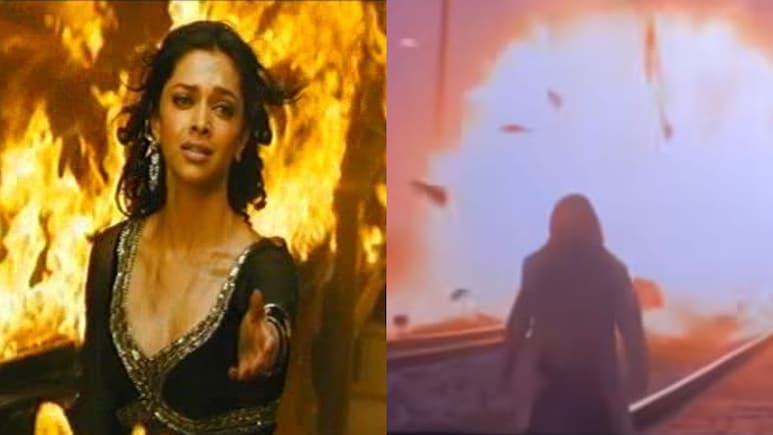
- Om Shanti Om (2007) featured a revenge plot involving a chandelier and fire
- Dhurandhar 2 (2026) shows a fiery revenge by Ranveer Singh’s character on Arjun Rampal
- Both films depict villains killed by fire, symbolizing karmic payback and poetic justice
Spoilers Ahead: This story contains spoilers related to Dhurandhar 2.
There's something about Bollywood that refuses to believe in coincidence. It thrives on circularity, on karmic payback, poetic justice, and the kind of full-circle storytelling that makes audiences sit up and say, wait... haven't we seen this before?
Nearly two decades after Om Shanti Om gave us one of Hindi cinema's most haunting revenge arcs, the Internet is convinced it has just witnessed its spiritual sequel - only this time, reality seems to have rewritten fiction in the most deliciously dramatic way.
And at the centre of this deja vu? A chandelier, a fire, and a revenge that took 19 years to complete.
The Echo Of A Death
In Om Shanti Om, directed by Farah Khan, the death of Shantipriya (Deepika Padukone) is not just tragic, it's operatic in its cruelty. A rising star, secretly married to a manipulative producer, she becomes an inconvenience the moment she threatens to expose him.
Mukesh Mehra (Arjun Rampal), the man who built her career, orchestrates her end with chilling precision. He lures her to a film set under the guise of love and reconciliation, only to trap her inside a burning structure. Flames engulf the set, sealing her fate, or so it seems.
But the horror doesn't end there. The film later reveals that 'pregnant' Shantipriya survived the blaze, only to be buried alive beneath a chandelier, silenced forever, her body hidden as evidence of a crime that would go unpunished.
Her lover Om (Shah Rukh Khan), reincarnated years later, eventually avenges her death. And in a moment of poetic symmetry, Mukesh meets his end under that very chandelier, a visual metaphor for karma completing its arc.
It was cinematic justice at its most indulgent and unforgettable.
The Brutal Payback No One Saw Coming
Fast forward to 2026, and Dhurandhar 2 delivers a climax that feels eerily familiar, yet far more visceral.
Here, Ranveer Singh plays Hamza, an undercover Indian spy navigating a dangerous mission against Major Iqbal (once again portrayed by Arjun Rampal). Their final confrontation unfolds in Muridke, steeped in tension, betrayal, and inevitability.
Much like Mukesh Mehra, Major Iqbal believes he's in control. He knows Hamza's identity and plans to eliminate him. But Hamza flips the script. What follows is not just a kill, it's a spectacle of calculated vengeance.
Hamza dismantles Iqbal piece by piece, literally and strategically. After a brutal takedown, he ties him up and places him inside a kerosene-filled cargo tanker. Then comes the masterstroke: kerosene is released along the tracks, a lighter is dropped, and fire becomes the executioner.
The explosion is decisive. The villain is consumed by the very element he thought he could control.
Fire. Entrapment. A carefully staged death.
Sounds familiar?
"19 Years Later...": The Internet Connects The Dots
It didn't take long for audiences to draw parallels. Within hours of the film's release, social media was flooded with reactions that blurred the lines between reel and real, past and present.
For fans, this wasn't just a coincidence.
The fact that Ranveer Singh, Deepika Padukone's real-life husband, was now enacting a fiery revenge on Arjun Rampal (the man who killed her character in 2007) felt too perfect to ignore.
Social media reactions ranged from amused disbelief to full-blown cinematic worship. A fan wrote, "Finally, after 19 years, Ranveer took revenge for Shantipriya."
"Shantipriya's real-life husband taking revenge from Mukesh the same way he killed her," another wrote.
A post read, "The revenge of Shanti Priya - peak detailing by Aditya Dhar."
The chandelier may have been replaced by a kerosene tanker, but the essence remained the same: a villain undone by fire, trapped in a fate he once inflicted.
When Cinema Remembers Itself
What makes this parallel so fascinating isn't just the similarity in deaths, it's the emotional continuity audiences have imposed on it.
Bollywood rarely operates in isolation. Its stories bleed into each other, carried forward by memory, fandom, and a deep love for drama.
In a way, Dhurandhar 2 didn't just deliver a high-octane climax, it tapped into a cultural memory that audiences have held onto for years.
Because in Hindi cinema, justice doesn't expire. It waits. It reincarnates. It finds new faces, new settings, new flames.
And sometimes, if the Internet is to be believed, it takes exactly 19 years to arrive, burning brighter than ever.
Also Read | Bollywood's Dawood Ibrahim, Stuck In A 40-Year-Old Image, Finally Ages In Dhurandhar 2
