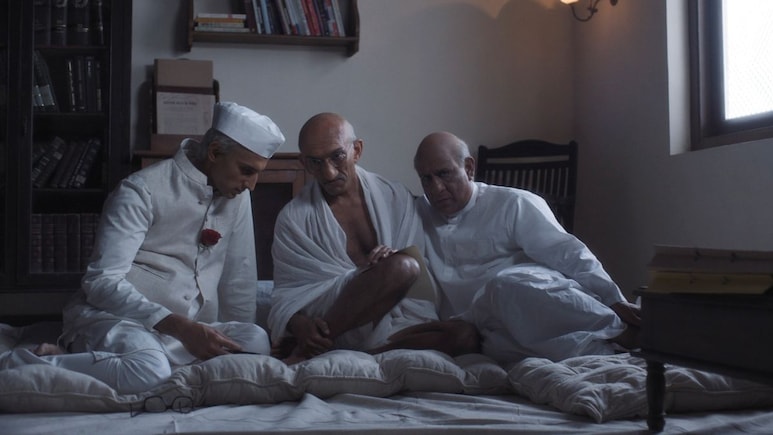
Imagine Jawaharlal Nehru, Sardar Vallabhbhai Patel, Maulana Abul Kalam Azad, BR Ambedkar, and Sarojini Naidu huddled around a table in a room. What could these towering political leaders, who were at the helm of an India counting days to achieve its long-awaited Independence, be talking about? If they were in that room today... They probably wouldn't be in the same room at all if it were about today.
But Freedom At Midnight 2 turns back the clock on the India of 1947 which is days away from having its tryst with destiny. So when these stalwarts get together, they talk about how the National Flag of India must represent the entire country, and not just a political party. Or, that the colours in the Tricolour don't represent different religions; they signify a nation looking forward to courage, peace, and prosperity.
"Iss naye Hindustan mein kuch bhi mazhab ke binaah par nahin hoga. Ek azaad, secular Hindustan ki pehchaan sirf insaaniyat hogi," says Sidhant Gupta's Nehru as he looks across to Patel.
Watching Freedom At Midnight 2 weeks after Dhurandhar and Ikkis is like reading a flipbook that adds something to the larger picture after you turn every page. Freedom At Midnight 2 falls somewhere in the spectrum of patriotism as the high-octane Dhurandhar, which depicts another type of Naya Hindustan driven by revenge, and Ikkis, one of the finest anti-war war films. Where you place this Nikkhil Advani series is between you and your definition of patriotism.
The second season of the Sony LIV series as intricate as the first one and pretty much bingeable. The detailing of the sets and costumes as well as the performances by a masterful cast continue to hold your attention as the show moves like an engaging, fast-paced thriller but not in a hurried pattern.
As days come nearer to the Partition, a mass exodus begins between the two sides of the border, as drawn by Cyril Radcliffe, culling out Pakistan from India. Violence breaks out across the two future nations where angry mobs, targetting people on the basis of their religious identity. People who arson, loot, riot, rape, and murder belong to all religions, and that says a lot.
As trains teeming with people who have hurriedly packed their homes in a suitcase or two leave for India, with many of them dying on the way, Amrita Pritam's iconic poem Aaj Akkhaan Waris Shah Nu plays in the backdrop.
Sidhant Gupta is very believable as the idealist Nehru who wants the country to move forward after years of oppression. Although a champion of scientific temper, Nehru considers the prediction of sages who angrily confront him for ruining the fate of the country that was yet to be born. "Mere alag vishwas hain," he says to them after the sages are happy with Nehru's suggests that India be born at the stroke of midnight between August 14 and August 15, 1947.
Arif Zakaria's Muhammed Ali Jinnah is mostly a one-shaded bitter character but is a revelation when he realises that he will have to leave Bombay, where he spent most of his living years before Pakistan's birth.
He is angry and agitated when he sees the house empty but filled with half-closed cartons. He asks his sister Fatima Jinnah (an effective Ira Dubey) what the hell is happening. She says, they were going home. The emptiness in his eyes about leaving his home for the home of Pakistan's Quaid E Azam in Karachi is just heartbreaking.
Chirag Vohra encapsulates Gandhi, the man, the myth, and the idea that continues to have a bearing on the India of today. One is reminded of Javed Akhtar's song Panchi Nadiya Pawan Ke Jhoke from Refugee when Gandhi says the division of land is possible, but how will you divide lives, friendship, memories, air, rivers, culture, and history?
How will you divide the responsibility and accountability of violence across the borders, asks a far-sighted Gandhi as we see even the last of musical instruments being divided between India and Pakistan.
Rajendra Chawla is excellent as the no-nonsense Patel who wants Nehru to let him run his Home Ministry the way he wants to and Jinnah to shut up about what India should call itself once Pakistan is cleaved away.
Watch out for the sequence where the Iron Man likens the 565 princely states he wants to join the Union of India to apples. The last apple that is left in the basket has started rotting. That apple represents Kashmir, which at the time was ruled by Maharaja Hari Singh.
Once India is free, the focus shifts to the problems within the country. There's growing hatred for Gandhi by those who believe he cares more for Muslim minorities than Hindu refugees. Gandhi haters unite and hatch a plan to kill the Father of the Nation, eventually succeed in his assassination months after Independence.
We all know the name of the man who put three bullets in Gandhi at close range at Delhi's Birla House but the makers never say it out loud. We never clearly see his face. We only see his initials NVG. Maybe we don't need his name heard, but the series properly underlines that it's a relief that the killer was a Hindu, or else it would have been a bloodbath against the minorities of India.
Freedom At Midnight 2, which closes with Ambedkar, Nehru, and Patel walking together as India formally adopts its Constitution on November 26, 1949 with Gandhi's portrait looking on, leaves you with a lot of thinking to do.
Also Read | How Umaid Bhawan Palace In Jodhpur Became Viceroy's House For Nikkhil Advani's Freedom At Midnight
-
Sidhant Gupta, Chirag Vohra, Rajendra Chawla, Arif Zakaria, Ira Dubey, Malishka Mendonsa, Rajesh Kumar, KC Shankar, Luke McGibney, Cordelia Bugeja, Alistair Finlay, Andrew Cullum, and Richard Teverson
