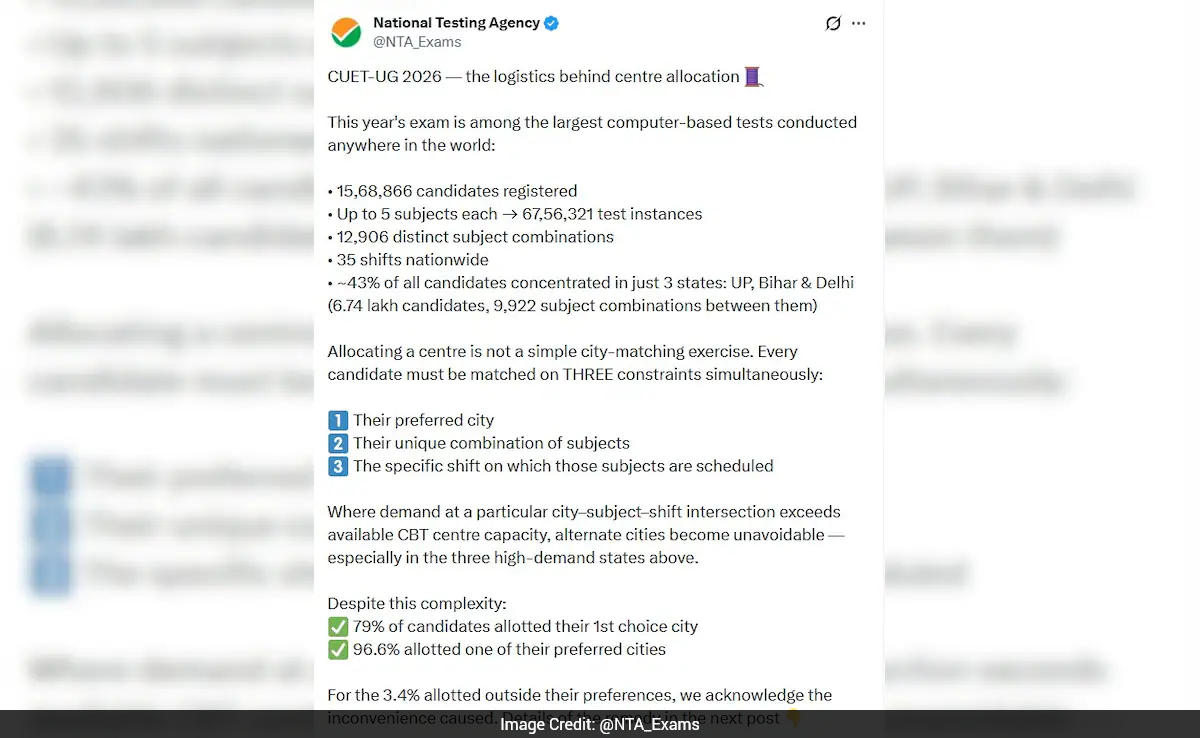

Following complaints over non-allocation of preferred examination centres, the National Testing Agency (NTA) opened a re-allocation window for those who did not get their preferred locations.
It released official data stating that out of the 15,68,866 candidates registered, 96.6 per cent have been allotted one of their preferred cities, and 79 per cent have received their first choice of city. The remaining 3.4% have been allotted centres outside their selected preferences, mainly in areas where registration numbers were much higher than the available CBT centre capacity.
CUET-UG 2026 — the logistics behind centre allocation 🧵
— National Testing Agency (@NTA_Exams) May 5, 2026
This year's exam is among the largest computer-based tests conducted anywhere in the world:
• 15,68,866 candidates registered
• Up to 5 subjects each → 67,56,321 test instances
• 12,906 distinct subject combinations…
The agency added that the remaining 3.4 oer cent of candidates, who could not be accommodated within their selected preferences due to capacity constraints in high-demand locations, can now choose from vacant slots in alternate cities. This reallocation window has been opened on Wednesday on a first-come, first-served basis at cuet.nta.nic.in.
Explaining the scale of the examination, NTA said the flexibility of choosing up to five subjects has led to around 67,56,321 test instances, with candidates opting for an average of 4.31 subjects. "The subject selection patterns reflect a high degree of variability - 12,906 distinct subject combinations have been recorded across the candidate pool."
To manage this large and diverse scale while maintaining the integrity of the exam, the test is being conducted across 35 shifts nationwide.
NTA also highlighted the challenge in centre allocation, stating that around 6,74,352 registrations, about 43 per cent of total candidates, are from just three states - Uttar Pradesh, Bihar, and Delhi. These account for 29,93,554 effective test instances across 9,922 subject combinations.
"The available computer-based testing (CBT) infrastructure in these states, while substantial, is finite, and concentrated demand in specific cities has placed significant pressure on existing test centres," the notice states.
The agency further explained that three factors must be considered while allocating centres - a candidate's chosen city, their unique combination of subjects, and the specific shift on which those subjects are scheduled.
"When demand for a particular city-subject-shift intersection exceeds available capacity, and allocation in nearby or alternate cities becomes unavoidable," the notice adds.
