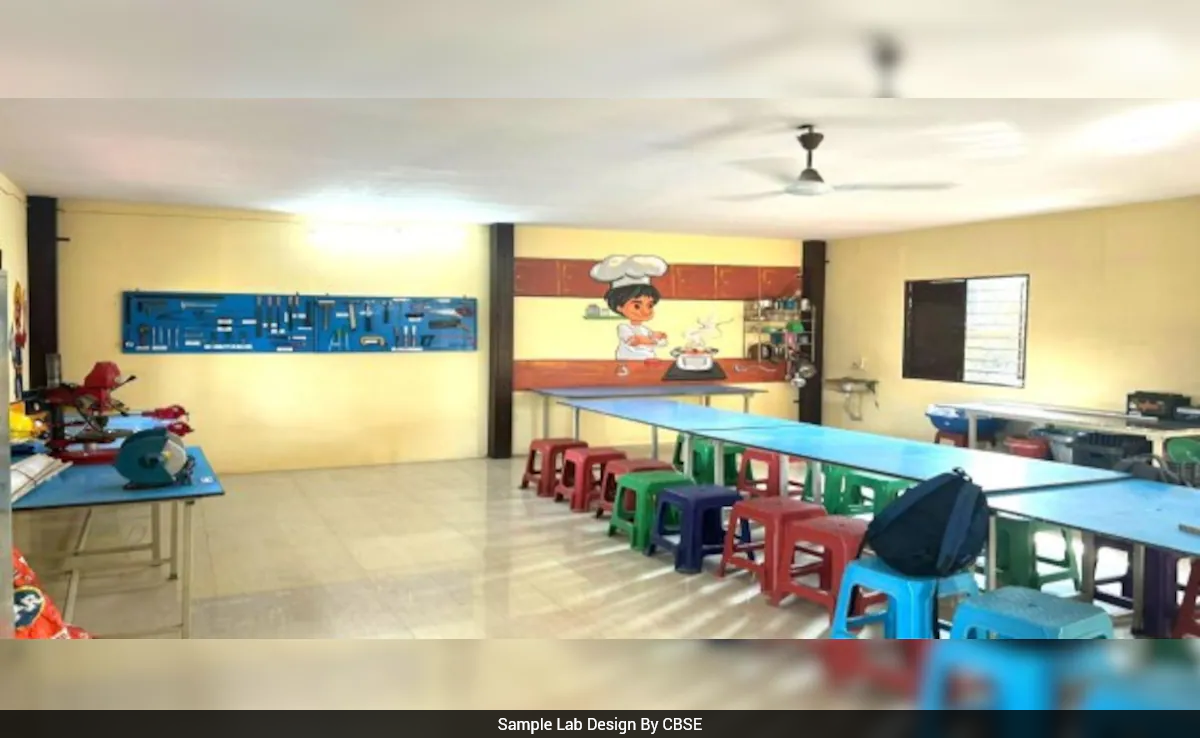
CBSE Composite Skill Labs: The Central Board of Secondary Education (CBSE) has introduced Composite Skill Labs in schools to promote hands-on, experiential learning among students. Aligned with the National Education Policy (NEP) 2020 and the National Curriculum Framework for School Education (NCF-SE) 2023, these labs will offer skill- and vocational-based education across all affiliated schools from August 22, 2027.
Schools have been advised to set up either one composite lab of 600 square feet for Classes 6 to 12 or two separate labs of 400 square feet each - one for Classes 6 to 10 and the other for Classes 11 and 12.
The board has made these composite labs mandatory for all schools, including those applying for fresh affiliation with CBSE.
Skill Subjects
The skill subjects, activities, and sectors introduced in these labs should represent three broad areas of work - life forms, machines and materials, and human services. Schools have been advised to select subjects based on local context, resource availability, and potential industry linkages.
CBSE introduces Composite Skill Labs in schools to strengthen skill-based education in alignment with NEP 2020 and NCF-SE 2023.
— CBSE HQ (@cbseindia29) April 17, 2026
These labs will support hands-on, experiential learning and help students build practical competencies alongside academic knowledge.
All schools are… pic.twitter.com/qBPFfphheB
Integration of Artificial Intelligence
According to the World Economic Forum's Future of Jobs Report 2025, nearly 86 per cent of employers expect AI and information processing technologies to transform their businesses by 2030. Fields such as Big Data, Artificial Intelligence, and FinTech are among the fastest-growing job sectors.
In alignment with the NEP 2020 and the Government of India's AI vision to foster AI literacy, CBSE has encouraged schools to develop the necessary infrastructure to make students AI-ready. Institutions may also utilise existing Atal Tinkering Labs (ATL) and mechatronics labs to integrate technology-driven learning and problem-solving into the curriculum.
Additionally, schools are being guided to provide students with access to AI tools, enabling them to explore technology-integrated business ideas and innovative models. This approach aims to foster entrepreneurial thinking, support self-employment opportunities, and equip students to generate employment in the future.
