

Artificial intelligence (AI) is transforming workplaces across industries, prompting concerns among students and young professionals about the future of employment. From customer support and data analysis to software development, tasks traditionally performed by humans are increasingly being assisted by AI-powered tools. However, experts say the technology is more likely to reshape jobs than eliminate the need for human workers.
Simrean Bajwa, Assistant Professor of Law and Lead International Partnerships at BITS Law School, said concerns about AI-driven unemployment are understandable, particularly among those preparing to enter the workforce.
"Studies have shown us not to ring the alarm bells early, as it is more likely to reshape jobs, rather than replace them," she said.
According to Bajwa, routine and repetitive tasks such as data entry, data processing and some basic coding and design functions are increasingly being automated. Companies are also adopting AI-assisted customer support tools to improve efficiency and reduce costs.
However, she believes professions that rely heavily on human judgement, creativity and interpersonal skills will continue to require people. These include fields such as law, healthcare and psychology, as well as occupations involving physical work and manual dexterity.
Bajwa said students should continuously update their skills and understand how AI can complement their existing abilities. She also emphasised the need for educational institutions and organisations to provide practical learning opportunities that prepare students for an evolving job market.
Dr Rashmi Soni, Associate Dean of Academic Programs at K J Somaiya Institute of Management, said students need to rethink how they prepare for their careers in an AI-enabled world.
"Employers will need people who can think critically, solve complex problems, exercise sound judgement and communicate effectively," she said.
Soni noted that AI is already being used across industries. Marketing professionals use it to analyse consumer behaviour, finance teams rely on it for forecasting and risk assessment, while human resources departments increasingly deploy AI tools to streamline recruitment and talent management.
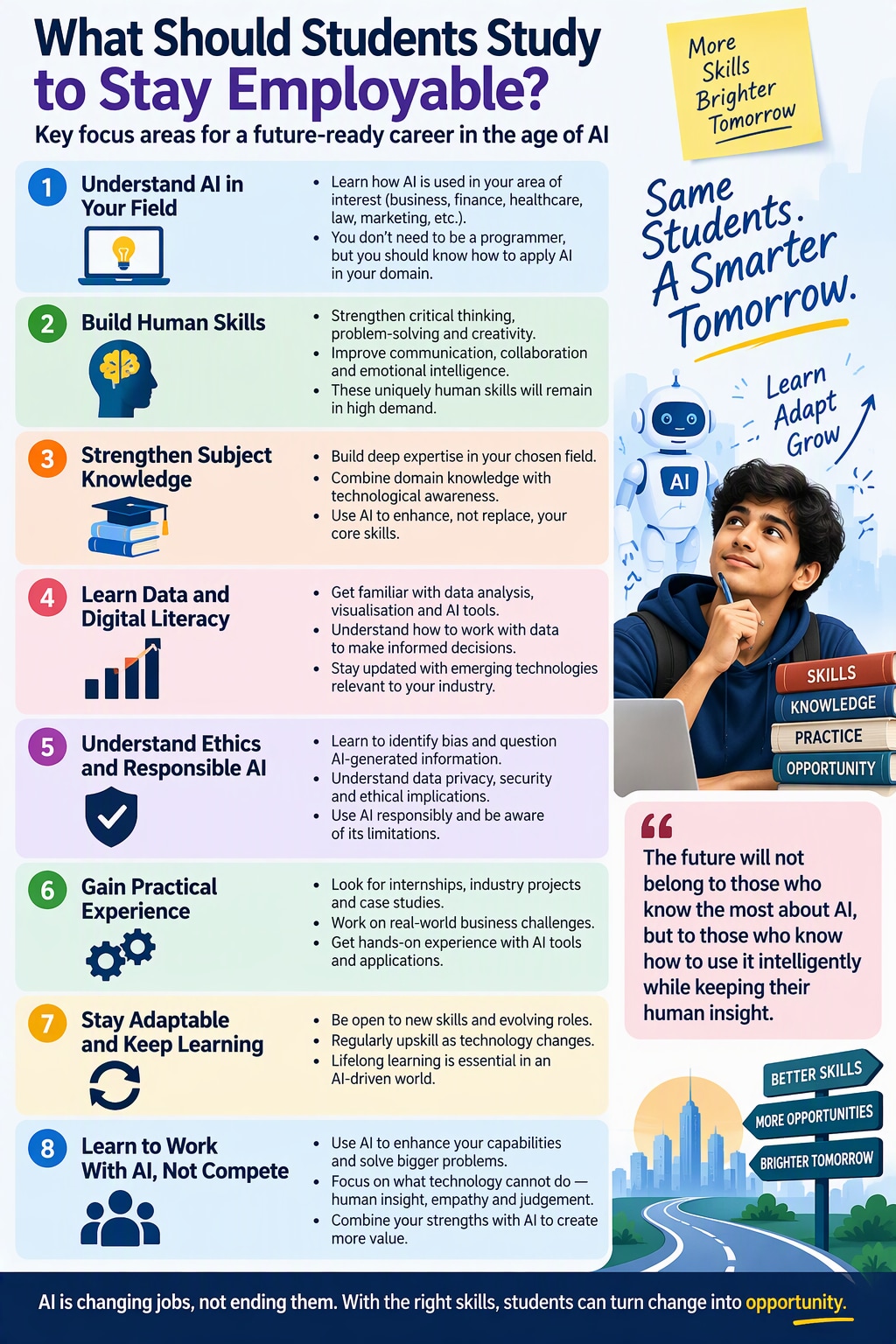
She said students do not necessarily need to become programmers or technology specialists. Instead, they should learn how AI can be applied within their chosen fields. For example, management students should understand its role in market research and business strategy, while finance students should become familiar with AI-powered analytics and forecasting tools.
Soni also highlighted the importance of developing AI literacy, including the ability to identify inaccurate information, recognise bias, protect sensitive data and understand the ethical implications of emerging technologies.
"Merely introducing an AI course or adding a few technology-related modules to the curriculum will not be sufficient," she said. Students also need practical exposure through internships, industry projects, case studies and real-world business challenges.
Both experts agree that future employability will depend on a combination of subject expertise, technological awareness and distinctly human capabilities.
As AI continues to reshape workplaces, students may need to focus less on competing with technology and more on learning how to use it effectively while strengthening skills that machines still struggle to replicate, including critical thinking, communication, creativity and sound judgement.
