





- Women’s bank account ownership in India rose from 26% in 2011 to over 89% in 2024
- The National Rural Livelihood Mission has empowered 100 million women into self-help groups
- Women face higher expenditure on essentials, limiting asset-building and savings capacity
Women in India are earning more, saving more and participating in the financial system like never before. Yet a large number continue to struggle with a bigger challenge -- turning income into long-term wealth.
According to Priti Rathi Gupta, Founder and CEO of Lxme, India has made significant progress in improving women's access to financial services, but the journey from financial independence to financial security remains incomplete.
"The real story is not that women have arrived, it is what happens to their money once they do," Gupta said.
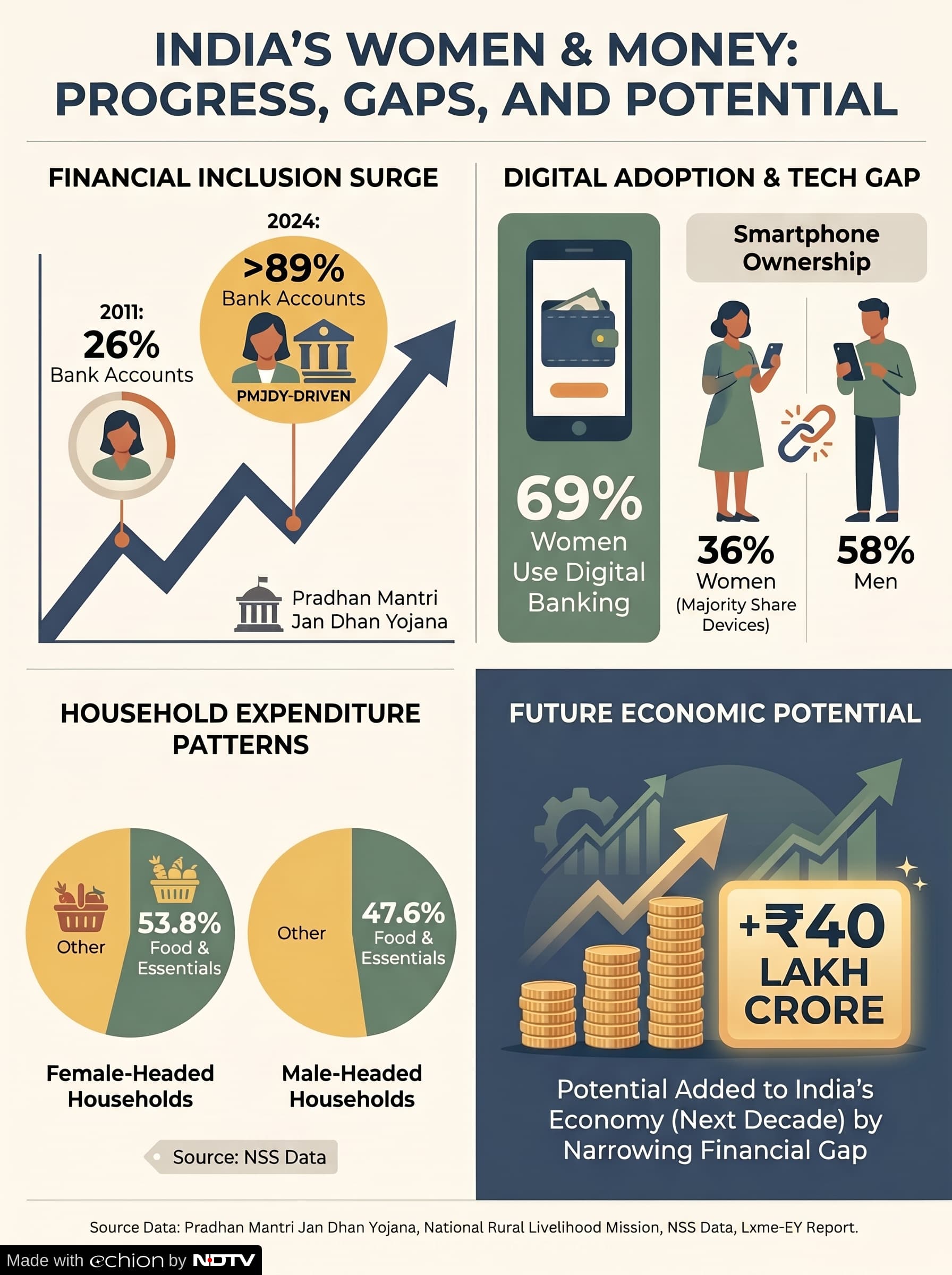
Over the past decade, government initiatives and rapid digitisation have transformed financial access for women. Data cited by Gupta shows the share of Indian women with bank accounts has jumped from 26 per cent in 2011 to more than 89 per cent in 2024, driven largely by the Pradhan Mantri Jan Dhan Yojana.
The push towards inclusion has also been strengthened by grassroots programmes. Jayatri Dasgupta, CMO, PayNearby and Program Director, Digital Naari, said the National Rural Livelihood Mission (NRLM) has emerged as one of the strongest vehicles for women-led development in the country.
According to Dasgupta, the programme has brought more than 100 million women into self-help groups and institutional networks, helping them gain confidence, build livelihoods and play a greater role in household and community decision-making. She said the next phase of growth must focus on moving women from financial access to meaningful financial participation, where they actively use formal financial services for savings, entrepreneurship, credit and long-term financial stability.
The observations align with a broader shift taking place across India. More women today are entering the financial system, but the challenge is ensuring that access translates into ownership and wealth creation.
Many accounts, Priti Rathi Gupta noted, are still used mainly for receiving government transfers or cash withdrawals. "Access is no longer the binding constraint. What happens after the account is opened is what matters now," she said.
A key hurdle remains the disproportionate financial burden carried by women. According to National Sample Survey (NSS) data highlighted by Gupta, female-headed households spend 53.8 per cent of their expenditure on food and essentials, compared with 47.6 per cent in male-headed households.
This leaves women with less room to build assets through investments, retirement savings or wealth-generating instruments. Quoting findings from the Lxme-EY report, Gupta said women's earnings are often "consumed before they can be converted into assets."
Despite these challenges, signs of progress are emerging. The report also says that women earn Rs 73 for every Rs 100 earned by men. Its adds that women contribute 18 per cent to India's GDP.
Women now account for nearly a quarter of India's mutual fund investors and 28 per cent of registered SIP accounts, according to industry data referenced by Gupta. While women tend to start investing later and with smaller amounts than men, participation is steadily increasing.
"The direction is unmistakable," Gupta said, adding that women often spend considerable time learning and understanding investments before taking the plunge. "Confidence, not capability, was the missing ingredient," she said.
The rapid growth of fintech platforms has played a major role in accelerating this shift. With nearly 900 million internet users and widespread adoption of digital payments, investing has become more accessible than ever.
Gupta pointed out that around 69 per cent of women now use some form of digital banking, helping reduce traditional barriers such as complex processes, lack of access and financial jargon.
Technology, she said, has allowed women to begin their investment journeys independently and on their own terms.
Yet significant gaps remain.
Only 36 per cent of women own a smartphone compared with 58 per cent of men, while a majority still share devices with family members. Usage is also limited, with many women relying on smartphones primarily for basic banking transactions rather than wealth-building activities.
These disparities are reflected in the Lxme-EY Women's Financial Prosperity Index, which stands at 28.1 per cent. "More than two-thirds of the journey from access to durable wealth remains structurally blocked," Gupta said, highlighting that ownership continues to lag behind access.
The economic stakes are substantial. The Lxme-EY report estimates that narrowing the financial prosperity gap for women could add as much as Rs 40 lakh crore to India's economy over the next decade.
But Gupta believes the issue goes beyond economics.
"When a woman actively manages her money and knows exactly where it is, she gains the ability to make choices with confidence and dignity," she said.
As women's participation in India's financial ecosystem continues to rise, Gupta argues that the next phase of growth must focus on helping them build assets, strengthen ownership and achieve lasting financial security.
"The question is no longer whether women will shape India's financial future. They already are. The challenge now is turning participation into ownership and access into assets," she said.
Track Latest News Live on NDTV.com and get news updates from India and around the world

