





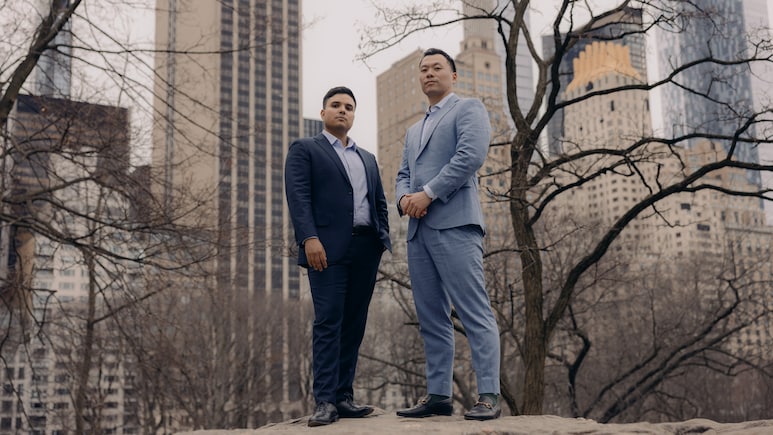
Felipe Sinisterra and Dave Wang cash big checks telling Wall Street bankers what's missing from their AI plans.
On a March afternoon, the two highly sought-after trainers in finance addressed employees of a venture capital fund in New York. Wang, 31, showed how Gemini, the AI model developed by Alphabet Inc.'s Google, could be used to analyze founders' pitch videos. He demonstrated how a web application incorporating behavioral analysis methods used by the FBI could help compare a transcript with visual cues such as body language and facial expressions to spot potential red flags.
Sinisterra, 30, then walked the class through how to scan transcripts from earnings calls with OpenAI's ChatGPT and Anthropic's Claude to find the most market-moving statements. The machine ran sentiment analysis and translated management's spoken remarks into numerical spreadsheet inputs to forecast future financials. Participants could see how AI could help streamline some of the most labor-intensive parts of their jobs.
Also Read | Layoffs Are Rising In Tech, But These Skills Are Helping People Unlock Better Pay
The bill for the day? $25,000. And they are backlogged for two months.
"What is happening now is that people are seeing AI as a source of edge, a source of offense," said Sinisterra. "What we'll see in the future is that people will see it as a necessity."
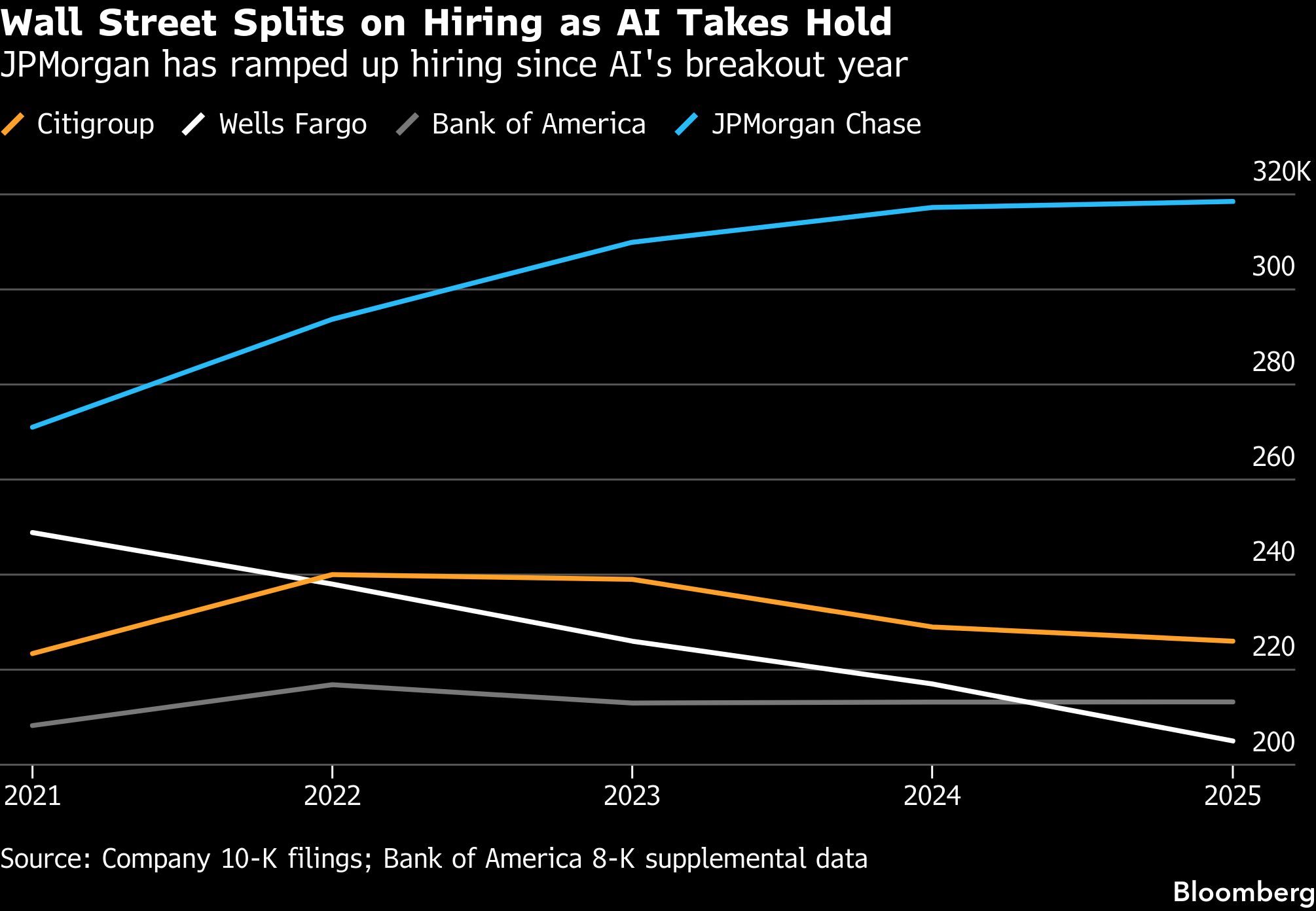
Big banks, caught up in AI angst, are looking to hire more AI specialists and shrink traditional banking roles. Standard Chartered Plc is preparing to axe thousands of support positions over the next four years. Citigroup Inc., Wells Fargo & Co. and Bank of America Corp. have collectively cut more than 5,000 jobs in the first quarter of 2026, despite having a record earnings season.
Top executives, willing to spend top dollar to deploy the technology beyond basic tasks, are experimenting with AI tools themselves, building pressure to embed the technology across the ranks. Sinisterra and Wang, former SoftBank fund managers, are selling confidence and fluency to firms hungry for that transformation.
Wall Street Prompt, the company they founded in July 2025, has worked with T. Rowe Price Group Inc., Citigroup and Bank of America, according to people familiar with the matter. T. Rowe Price has brought the pair in to train its investment professionals, the people said. Citigroup and Bank of America have used them to run sessions for their external fund clients. Wall Street Prompt, bound by non-disclosure agreements, declined to confirm its client list. T. Rowe Price, Citigroup and Bank of America also declined to comment on vendor-specific training.
The Rising Skill Bar
Financial institutions weren't always enthusiastic about AI. In 2022, when ChatGPT was launched, major global banks restricted the chatbot's access on internal networks over fears of security lapses.
Since then, JPMorgan has rolled out LLM Suite, a generative AI tool used by most of its employees. Goldman Sachs is working with Anthropic to develop AI agents. Bank of America says its 18,000 developers are 20% to 25% more productive after using AI.
"What is happening now is that people are seeing AI as a source of edge, a source of offense."
Still, many bankers lack the training to use AI tools effectively, while others are stuck on outdated models, a mismatch that's created a need for trainers who are able to get the most out of these AI systems.
"The biggest challenge inside a large bank isn't the technology, it's the people," said Jake Bridge, APAC managing director at Evolution, a UK-based tech recruitment firm. "The scale of Luddite to AI super adopter is very broad; the biggest challenge in a bank is, well, how do you cater for both."
Asia leads in embedding AI into banking and finance, where payments, lending and customer service are increasingly automated.
Particularly in Singapore, AI fluency is increasingly becoming a prerequisite for anyone seeking a career in the sector. The city-state ranks first among 174 countries on the International Monetary Fund's AI Preparedness Index, and 64% of its financial institutions are deploying AI across key business functions, according to a 2026 survey by London-based financial software firm Finastra.
Wang and Sinisterra are now considering moving there to tap demand from banks and finance professionals fighting to safeguard their positions and remain employable.
Duncan, a 55-year-old in Singapore who declined to give his full name, spent his evenings and weekends last year in a class backed by Nanyang Technological University, practicing how to use AI. His employer, a major bank, previously moved its Singapore operations to a lower-cost center abroad.
After being jobless for nine months, he landed a job last month as a back-office worker at a Singaporean bank and feels hopeful about his new skills.

While several executives have credited AI for the productivity gains, concerns are deepening that strong balance sheets may no longer be enough to keep jobs safe. The analyst role will not disappear but it will thin from the bottom up, says Igor Sydorenko, chief executive officer of Neurons Lab, an AI consultancy whose clients include HSBC and AXA. "Highly skilled people, with AI tools, will be able to do 10, 20 times more, much better, much faster," he said. "They will not need any junior financial analysts, any associates. They will just do it by themselves."
Justin Tang, in Singapore, knows the anxiety of trying to bridge that gap. The buy-side analyst at hedge fund Regal Funds Management spent three years trying to teach himself AI in the margins of his day, during bus rides, between meetings and in the quiet minutes when most people scroll. Then, last year, he met Wang and Sinisterra. "It was like a lightbulb moment," said Tang. "It used to take me hours to analyze a company. Now I plug in a prompt, and in 90 seconds, I get the key points: what the company does, its core earnings drivers, the narrative."
Since then, Tang has attended several Wall Street Prompt training sessions, including one hosted by Bank of America. Each class typically runs 20 to 30 people, he said, with seats covered by the host bank.
"I wasn't surprised when the top banks started offering classes from Wall Street Prompt to clients like us," said Tang. "It was more of a question of when rather than if."
Tang mainly uses the techniques he's learned for personal purposes, but he also draws on it for his day job. At Regal, he restricts the tools to publicly available material like filings and earnings transcripts. Client data isn't fed in.
Children Of Immigrants
Sinisterra and Wang were both involved in finance from their formative years, with an early penchant for technology. Sinisterra moved to the US from Colombia with his parents at age 6, while Wang was born in New York City, though his parents emigrated from China in the 1980s.
Wang said he sold scripts for the online game RuneScape around the time he moved to Ohio at age 8. As a Harvard undergraduate, Wang said he was one of five students Lyft Inc recruited to promote its Boston expansion by handing out business cards on the street. Rather than stick to that, he said, he scraped student email addresses from local universities, ran mail-merge campaigns and built targeted coupon codes, generating enough referrals to pay his tuition.
After interning at Blackstone Inc. in 2016 and working with Morgan Stanley for over two years in 2017, he joined SoftBank's Latin America Fund in 2019, where he led crypto investing. He left roughly two and a half years later, and founded 99 Capital, a digital assets fund. He sold the fund's general partnership and walked away after it raked in returns for investors.
"It was just very obvious to me," Wang said. "If I'm spending about 30% of my time on developing AI playbooks and this is clearly the best returning year I've ever had, this is where I should be spending 100% of my time."
Sinisterra joined Facebook as a software engineer out of college, and says his desk was 20 feet from Mark Zuckerberg's. After working at Goldman Sachs and Bank of America, he joined SoftBank as head of fintech in 2019, where he helped deploy more than $1.5 billion in investments.
"The scale of Luddite to AI super adopter is very broad; the biggest challenge in a bank is, well, how do you cater for both."
Working alongside each other at the Japanese tech investment company, the pair chatted constantly, each developing his own AI playbook.
Wang left SoftBank in 2022 and Sinisterra in 2023. In the summer of 2025, they spent a month in San Francisco, sharing an apartment and working out of a co-working space, while publishing newsletters and posts on AI and finance. The readers who kept coming back were hedge fund managers and financial analysts. The original plan was to build a data business, but the education opportunity proved more compelling, they said.
"People kept telling us we have the tools, we just don't know how to use them the way you do," Sinisterra said. "They wanted to learn, not buy more software."
Within two months of founding Wall Street Prompt in July 2025, a major investment firm reached out and the duo took a two-hour train journey from New York to the firm's headquarters, where they trained the staff across equities, fixed income and macro teams, people familiar with the matter said. Attendees ranged from senior strategists to junior analysts.
Almost all clients have returned for additional sessions, Sinisterra said, including a fund with more than $50 billion in assets currently finalizing a contract. He declined to name it.
Wang and Sinisterra are also iterating to maintain their edge. They have built a library of AI agents trained to grasp how a financial firm thinks. The goal, they said, is for AI to handle 90% of the logistical and technical work, freeing people to focus on relationships, judgment and the decisions that drive returns.
The field is getting crowded. Multiverse, the London-based upskilling platform founded by Euan Blair, the eldest son of former UK prime minister Tony Blair, has committed to training 15,000 AI apprentices over two years with clients including Citigroup, Microsoft and KPMG. Rogo Technologies Inc., a New York startup whose founders include former Lazard and JPMorgan bankers, raised $160 million in a Series D round this year at a $2 billion valuation for software that automates the research and diligence work that once filled an analyst's day.
Sinisterra and Wang are now building a live-webinar product for financial professionals who are feeling inadequately trained in AI and willing to pay around $1,500 each.
"What people are really paying for is transformation, not just prompts or templates," Sinisterra said. "What we do is come in and spark that shift. Everyone is already thinking about these changes. They just don't know which direction to take."
(Except for the headline, this story has not been edited by NDTV staff and is published from a syndicated feed.)
Track Latest News Live on NDTV.com and get news updates from India and around the world

