






China's long anticipated demographic downturn is now colliding with markets, with one prominent U.S. investor arguing that the world's second largest economy has crossed a point of no return. Rod D. Martin, founder and CEO of Martin Capital, says China's population crisis is "mathematically irreversible" and will, over time, weaken its growth model, consumer base and great power ambitions.
Births slump as population peaks
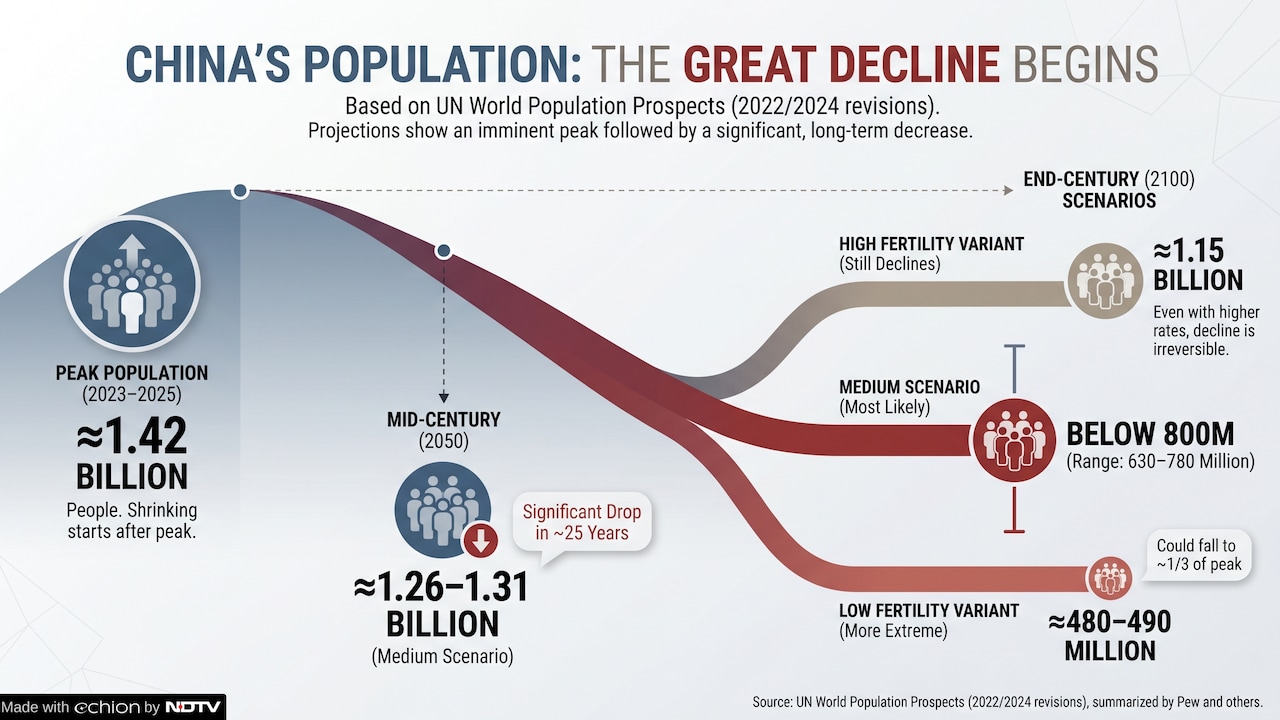
Official data show China's population has already begun to shrink after peaking at around 1.4 billion, with deaths now outnumbering births annually. The fall in births has been steep. In the mid 2010s, China recorded close to 18 million births a year. Recent tallies have slipped into single digit millions, marking the lowest levels since the early years of the People's Republic.
Also Read | Layoffs Are Rising In Tech, But These Skills Are Helping People Unlock Better Pay
Analysts expect the decline to accelerate. The latest United Nations World Population Prospects indicate that China's population could roughly halve by 2100 under baseline assumptions.
Martin frames this as a structural break, not a cyclical dip. "China's population collapse is now mathematically irreversible," he argues in a recent note shared on social media. "There simply aren't enough women left of child-bearing age." He highlights the speed of the reversal as a key risk for investors, contrasting it with the slower demographic shifts seen in Europe and Japan.
The one child legacy and "not enough women"
At the core of Martin's thesis is the long shadow of Beijing's One Child Policy, which ran from 1980 to 2016. Demographers have long warned that the policy accelerated fertility decline, shrank younger cohorts and distorted the sex ratio through selective abortions and a strong preference for sons. Those distortions are now feeding directly into the labour force, marriage market and household formation.
"The cohorts now entering prime child-bearing years are themselves the children of the one-child policy, already a drastically smaller group," Martin writes. "Each generation compounds the previous deficit. You can't subsidise women who were never born into existence."
That view echoes recent work from institutes that describe China as having joined the ranks of "ultra-low fertility" East Asian economies, with little sign of a meaningful rebound.
Mainstream projections differ on the scale of the fall, but not the direction. Pew Research Center, summarising UN data, notes that China's population is expected to decline sharply to around 633 million by 2100 in the medium scenario, even without assuming a prolonged fertility depression. More pessimistic analysts, including those cited by Martin, put potential end century figures closer to 300 million, implying a decline of up to three quarters from the peak.
From demographic dividend to demographic drag
For markets, the key question is how this shift hits growth, consumption and the state's fiscal position. China's earlier boom was powered by a large, youthful workforce and a relatively low dependency ratio. That combination allowed rapid capital accumulation, large scale manufacturing and aggressive infrastructure expansion. Those conditions are now reversing.
The working age population, those between 15 and 64, has already peaked and is shrinking. At the same time, the share of people aged 65 and above is rising rapidly.
"A shrinking workforce, collapsing taxpayer base, exploding retiree burden, and a hollowed-out consumer market," is how Martin sums up the macro consequences. In his view, the demographic turn "is not just a demographic crisis. It's the end of China's superpower dream."
That aligns with warnings from policy institutes and think tanks that China is moving towards a Japan style age profile at a far lower per capita income and with a much thinner social safety net.
Age dependency data from the World Bank already show China's ratio of dependents to working age people rising from its lows. UN projections suggest that the ratio will climb steeply through the second half of this century. That means higher pension and healthcare burdens on a shrinking base of workers, with consequences for household savings, fiscal balances and long term consumption growth.
Policy push fails to revive births
Beijing has moved quickly in recent years to loosen and then scrap birth limits, encourage larger families and support parents. Authorities have introduced cash bonuses, housing and education subsidies, longer maternity leave and public campaigns urging young people to marry and have children.
So far, these efforts have failed to lift fertility in any meaningful way. Surveys of young urban Chinese point to housing costs, education competition, long working hours, weak childcare support and limited workplace flexibility as key reasons for delaying or avoiding children. That suggests the barrier is no longer just formal policy. It is embedded in the underlying economic and social model, which makes it far harder to fix.
"Xi has pushed marriage, cash bonuses, extended maternity leave even removed tax breaks for contraceptives," Martin notes. "None of it has worked. And there simply aren't enough women."
China population
Market implications: growth, supply chains and relative winners
For investors, the demographic pivot feeds into several medium to long term themes.
First, headline growth. A shrinking labour force and rising dependency ratio are likely to cap potential GDP growth, putting more pressure on productivity gains and capital deepening to sustain current targets. Multilateral projections have already been revised lower for China's long term growth as demographics worsen.
Second, consumption. Slower household formation and fewer births directly affect housing demand, education, fast moving consumer goods and other age sensitive sectors. Companies exposed to mass market growth in China must now price in not only cyclical property and debt stress, but also structural demographic headwinds.
Third, supply chains. A smaller, older workforce and rising wages may accelerate the shift of labour intensive manufacturing to countries such as India, Vietnam, Mexico and parts of Africa. Martin and other macro investors see this as part of a wider rewiring of global production away from China and towards regions with younger populations and more favourable demographics.
Finally, geopolitics. Martin links the demographic story directly to China's long term strategic position against the United States. "Demographics are destiny," he argues. A China that is smaller, older and more fiscally constrained could find it harder to sustain defence spending, project power and maintain the pace of technological investment needed to close the gap with the U.S.
Track Latest News Live on NDTV.com and get news updates from India and around the world

