





For years, UPI has meant one simple thing for Indians: scan a QR code, enter the PIN and pay. There was no separate charge staring back at the customer. That is set to change for a limited set of merchant transactions from October 15, 2026.
The National Payments Corporation of India (NPCI) has introduced a Merchant Discount Rate (MDR) of 0.4 per cent on certain person-to-merchant UPI payments above Rs 2,000. The charge will be capped at Rs 300 for transactions of Rs 75,000 and above.
But there is an important detail that can easily get lost in the headlines. The customer is not being charged.
Also Read | Layoffs Are Rising In Tech, But These Skills Are Helping People Unlock Better Pay
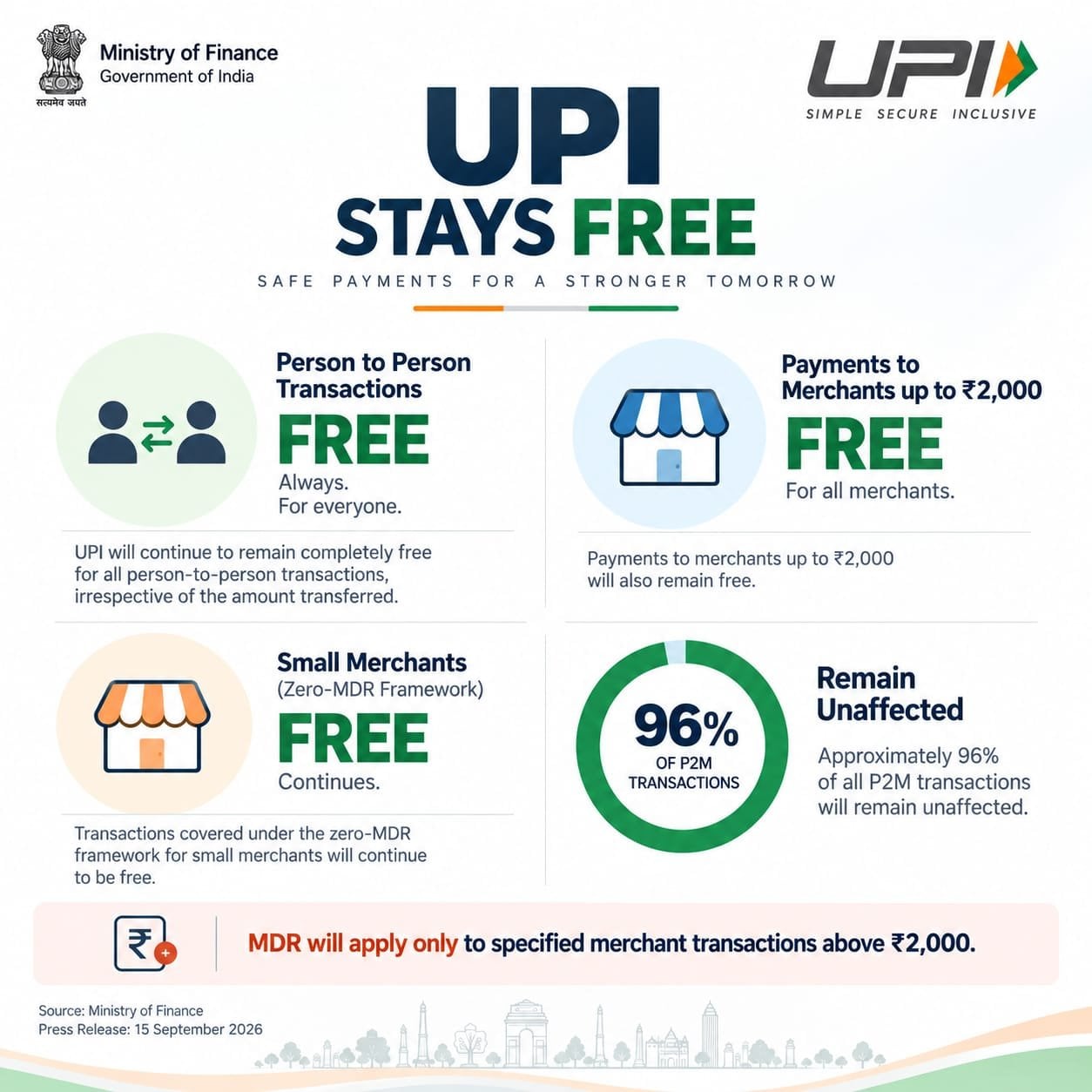
The new MDR is a charge within the merchant payments ecosystem. Person-to-person payments remain free, while small merchants meeting the specified monthly UPI receipt threshold also remain protected.
Here are the key questions UPI users and merchants are likely to have.
1. Will I have to pay a UPI charge from October 15?
No. Consumers will continue to use UPI without paying a transaction charge under the new MDR framework. The restriction also means UPI apps cannot add a separate platform fee or another charge to these UPI payments. So, if you scan a QR code at a shop and pay Rs 3,000 from your bank account, the new MDR does not mean Rs 3,012 will be deducted from your account. The charge applies on the merchant side.
2. What exactly is the new 0.4 per cent MDR?
MDR stands for Merchant Discount Rate. It is a fee associated with accepting a digital payment. From October 15, the standard MDR will be 0.4 per cent for specified person-to-merchant UPI transactions above Rs 2,000. The charge is capped at Rs 300 for transactions of Rs 75,000 and above.
For example:
- Rs 3,000 payment: MDR of Rs 12
- Rs 50,000 payment: MDR of Rs 200
- Rs 1 lakh payment: 0.4 per cent would be Rs 400, but the cap limits it to Rs 300
These are merchant-side charges, not additional amounts that customers have to pay.
3. Will sending money to friends or family attract a charge?
No. Person-to-person, or P2P, UPI transactions remain free. That includes sending money to family members, paying a friend back after dinner, splitting a bill or transferring money between your own linked bank accounts. The new MDR is aimed at the merchant payment ecosystem, not ordinary bank-to-bank transfers between individuals.
4. What happens if I pay a shopkeeper Rs 2,000 or less?
UPI payments up to Rs 2,000 remain outside the standard MDR framework. That means a customer paying Rs 500, Rs 1,000 or Rs 2,000 at a merchant will not suddenly face a UPI transaction fee because of the new rules. The change is focused on higher-value merchant transactions.
5. What about a small shopkeeper who receives more than Rs 2,000 in one payment?
This is where the monthly merchant threshold becomes important. Small merchants receiving up to Rs 1 lakh a month through UPI QR payments will continue to operate under zero MDR, according to the new framework. So a neighbourhood shopkeeper could receive a single payment above Rs 2,000 and still remain outside the standard MDR if the merchant falls within the specified small-merchant category. This is particularly relevant for street vendors, small retailers and micro businesses.
6. Can a shopkeeper add the MDR to my bill?
The framework is designed to prevent merchants from passing the MDR directly to customers. Banks have been advised to ensure that merchants do not transfer the new charge to UPI users. Consumers are expected to pay the listed price of the product or service. So if a product is priced at Rs 5,000, the customer should not be told to pay Rs 5,020 simply because the payment is being made through UPI.
Whether the new cost changes merchant pricing more broadly is a separate question. Retailers' associations have already raised concerns that the additional cost could make some small businesses reconsider digital payments. The Retailers Association of India, for instance, has argued that the MDR could put pressure on small retailers operating with thin margins and potentially encourage some transactions to move back to cash.
7. Will there be a monthly limit on free UPI transactions?
No. There is no new monthly quota under which UPI suddenly becomes chargeable after a certain number of transactions. Consumers can continue making valid P2P and P2M UPI transactions without hitting a monthly commercial fee threshold. This should not be confused with daily transaction limits imposed by banks or NPCI for security and risk-management purposes. Those limits are different from MDR.
8. What happens to UPI AutoPay, SIPs and OTT subscriptions?
This is one of the areas where users may have been worried unnecessarily. UPI AutoPay and recurring UPI mandates do not attract the prescribed MDR under the new framework. That includes recurring payments such as OTT subscriptions, utility bills and recurring investments. There is, however, a separate rate for certain capital-market transactions made through UPI. Payments involving mutual funds, securities, stockbrokers and dealers will attract an MDR of 0.02 per cent, capped at Rs 300 per transaction under the specified framework.
9. Will I pay more for insurance, fuel, railway tickets or utility bills?
Not because of the MDR itself. Several sectors have been given a separate flat-rate structure instead of the standard 0.4 per cent MDR. For transactions above Rs 2,000, categories including railways, telecom, insurance and fuel will attract a flat Rs 5 MDR. Utility payments such as electricity and water bills also have a concessional Rs 5 structure for transactions above Rs 2,000. Again, the Rs 5 is a merchant-side MDR. It is not supposed to become an additional charge on the customer.
10. Why has UPI MDR been introduced now?
This is where the debate gets bigger than a few rupees. UPI has grown into critical digital infrastructure for consumers and businesses. NPCI's statistics show that UPI processed more than 24.5 billion transactions in August 2026, highlighting the enormous scale at which the system now operates. Maintaining that infrastructure requires investment in technology, cybersecurity, fraud prevention, capacity and reliability.
Sarvjeet Singh Virk, CEO of jUMPP, told NDTV that the capped MDR framework could help address the question of how the UPI ecosystem is funded as it grows. "UPI has moved far beyond being just a payment product. It is now critical digital infrastructure," Virk said, adding that the system would need continued investment in areas such as reliability, cybersecurity and fraud prevention.
He also pointed to the protection given to consumers and small merchants. Virk said customers would continue making UPI payments without being charged, while small merchants receiving up to Rs 1 lakh a month through UPI QR codes would remain under zero MDR. He added that a more sustainable payment economics model could eventually allow payment providers to offer merchants services such as credit access, cash-flow management, analytics and business insights.
But there is another side to the argument. The Retailers Association of India has warned that even a merchant-side charge could affect smaller retailers, particularly those operating on thin margins. Its concern is that merchants could have an incentive to prefer cash if digital payments start carrying a cost. This creates the central question around the new UPI framework: can the payment system become financially sustainable without weakening the habit of digital payments among India's smallest businesses?
Track Latest News Live on NDTV.com and get news updates from India and around the world

