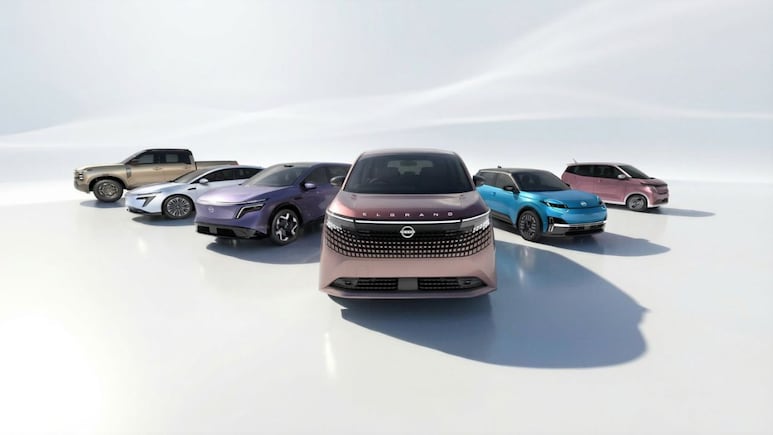
Nissan Motor Co., Ltd. today announced its long-term vision, "Mobility Intelligence for Everyday Life," defining a customer-centric strategic direction. The vision integrates mobility intelligence into everyday life through Nissan's focus on AI-Defined Vehicles (AIDV), offering a choice of electrification technologies to meet diverse customer and market needs.
Ivan Espinosa, President and CEO, said: "This is the right moment to articulate Nissan's long-term vision as we look beyond the Re:Nissan plan and set a clear path for the future. Our vision defines where Nissan is headed, with customer experience as our guiding priority. By advancing mobility intelligence, we will deliver products and technologies that are safer, more intuitive and more accessible with outstanding value and a more rewarding overall experience
-

-
 Is AI Bubble Waiting To Burst? Nikhil Kamath Warns Of Tougher Months Ahead
 -
 "We Don't Have 5 Years": Celebrated American General Sounds Alarm On War
 -
 "There Will Be Issues Between Big Countries": S Jaishankar On India-China
 -
 Neha Goyal Makes Stunning Asian Games Gold Revelation At NDTV World Summit 2026
 -
 Big NDTV Summit Impact: RBI Governor's Tata Sons Listing Remark Makes Top Newspaper Headlines
 -
 "Certainty Is A Problem": Nikhil Kamath On Marriage, Children And Future
 -
 "High Inflation Is Like Tax On Everyone": RBI Governor At NDTV World Summit
 -
 RBI Governor Sanjay Malhotra's Big Hint On Tata Sons Listing Row At NDTV World Summit
 -
 The Mystery Of A Bare Nail In Ashwini Vaishnaw's Office
 -
 To PM Modi's "Failed Product" Jab At Rahul Gandhi, A Shashi Tharoor Counter
As Nissan looks ahead, the Re:Nissan plan remains on track in its final year of execution, delivering a competitive cost base, improved capacity utilization, and strong new-product momentum that lays the groundwork for future growth.
Nissan's new long-term direction, guided by its vision, is designed to drive sustainable competitive advantage across next-generation technologies, a streamlined product portfolio, a redefined global market approach, and an industrial model organized around clearly defined vehicle families.
Next-Generation technologies: AI-led intelligence and Electrification
Artificial Intelligence is central to Nissan's approach to technology innovations, enabling the Nissan AIDV, which will combine Nissan AI Drive Technology and Nissan AI Partner technology to enhance mobility and optimize time spent in transit.
Building on real-world deployment of advanced driver assistance technologies, Nissan is integrating AI with vehicle control and safety systems.
Nissan aims to deploy Nissan AI Drive technology across 90 percent of its lineup over the long term.
The new Nissan Elgrand, scheduled for launch in summer 2026, will adopt next-generation ProPILOT with end-to-end autonomous capability by the end of fiscal 2027.
Alongside the introduction of Nissan AI Drive technology focused on advancing autonomous driving, the company will enhance the customer experience using Nissan AI Partner technology that connects intuitively to support everyday activities and integrate vehicles naturally into everyday life.
Nissan's AI-led experience and the next phase of autonomous mobility will be enabled by increasing electrification. Nissan's breakthrough e-POWER series hybrid technology is extending electrification adoption, providing a core platform that delivers electric-like driving and creating a natural bridge to fully electric vehicles.
Alongside e-POWER, Nissan will offer a broader range of electrified powertrains to meet diverse customer needs across global markets.
This diversified powertrain lineup includes a new hybrid electric vehicle system (HEV) for future frame-based vehicles, serving customers requiring greater capability and long-range confidence. Nissan will complete the spectrum of customer choice by offering plug-in hybrid and range-extender hybrid solutions through partnerships.
Nissan's Streamlined Product Portfolio
Nissan's product strategy is built on clarity of role and faster development. The company will streamline its global lineup from 56 to 45 models, exiting low-performing models and reallocating reinvestment to growth areas. At the same time, Nissan will expand powertrain options for each model, giving customers more choice, increasing volume per model and strengthening our business foundation.
Also Read: New Nissan Skyline Sedan Teased With R34-Inspired Design- But Indians won't Get It
Models categorized by role
As part of its new portfolio approach, Nissan is focusing its model strategy around four categories:
- Heartbeat: Models embodying Nissan's identity, emotional value, and innovation;
- Core: Models that sustain global business with scale and stability;
- Growth: Models targeting expansion where demand is emerging;
- Partner: Models that extend market coverage through disciplined collaboration.
The company today showcased models that embody the next steps from this strategic focus.
New X-Trail and Rogue Hybrid e-POWER: Global Core models featuring Nissan's unique electric-motor-driven system that provides the efficiency of a strong hybrid with the spirited driving character provided by electric motors - all without needing to charge.
- Juke EV: A Europe Core model that combines bold, distinctive design with full electrification and intelligent features.
- Xterra: A Heartbeat model for the US, offering an adventurous spirit, body-on-frame strength and purpose-driven design.
- Skyline: A Heartbeat model for Japan, delivering performance, precision and driver-focused character.
In the premium segment, Infiniti remains critical to Nissan's product strategy. The brand will be revitalized through new and refreshed models, beginning with the all-new 2027 QX65 SUV this spring. This will be followed by four additional models: a new mid-size hybrid SUV, a performance-oriented V6 sedan and two frame-based hybrid SUVs.
Also Read: 2026 Mini Convertible JCW Pre-Bookings Open In India Ahead Of Launch
Industrial Model
As part of the vision, Nissan is transforming its industrial model through the Nissan Product Family strategy.
This will move the company's focus from model-by-model optimization to architecture-led development built on shared vehicle platforms, powertrains and software platform.
Nissan will concentrate development around three product families that will account for more than 80 percent of global volume, increase volume per model by more than 30 percent while accelerating development speed and technology rollout.
By aligning product design and industrial execution from the start, Nissan strengthens quality, improves cost discipline, and enables faster, more competitive product launches at scale.
Track Latest News Live on NDTV.com and get news updates from India and around the world
