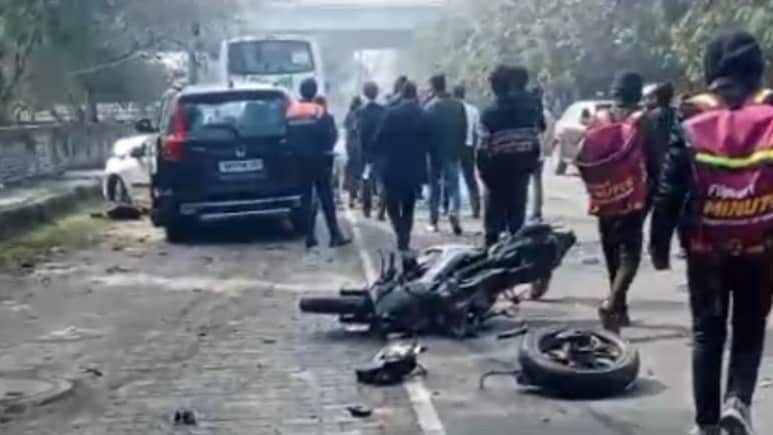
On February 3, near Dwarka in West Delhi, a 23-year-old man, Sahil Dhaneshra, lost his life in a head-on collision. A teenager driving a Mahindra Scorpio SUV rammed Sahil's motorcycle. Sahil died on the spot.
No statistic can reduce the human cost of such an incident. Behind every road accident is a family that receives a call they never imagined. Sahil's mother later shared a video of the crash sequence, stating that it had been trimmed at the end and did not show the moment of impact. Grief, questions, and anger naturally follow such a loss.
But beyond the immediate tragedy lies a broader conversation - about road behaviour, enforcement, infrastructure, and whether a chain of small violations can lead to irreversible consequences.
What the Videos Show
New CCTV footage of the accident shows the SUV narrowly missing a bus moments before the crash. The visuals indicate the underage driver who shouldn't have been behind the wheel without a valid driving license was speeding and not maintaining lane discipline triggered the chain of events. Immediately after avoiding the bus, the SUV swerved and collided head-on with Sahil's motorcycle. He had crossed the solid line that divided the road for traffic heading in opposite directions. The underage driver of the Scorpio had half his vehicle on the other side of the road towards oncoming traffic, before he swerved back to his own lane, avoiding the bus.
Also Read: Maruti Suzuki e Vitara Full Price List Out; Here's What Electric SUV Costs Without BaaS
Another video, filmed from inside the SUV by a passenger seated next to the teen driver, shows the vehicle speeding on a road without a divider. In that recording too, the SUV narrowly avoids a bus before crashing into Sahil's bike.
Sahil, according to the footage, appears to be attempting to overtake the same bus on his motorcycle just before impact.
The crash sequence, as seen in the footage and referenced by police, unfolds in seconds:
- The SUV swerves, breaching the solid white line dividing the road
- The SUV narrowly avoids an oncoming bus
- The SUV swerves back to its lane
- It crashes into Sahil's motorcycle, which is attempting to overtake the bus
- The bike is crushed, Sahil dies on the spot
In road safety terms, this is what experts call a "conflict point collision" - when two vehicles enter the same space from opposite directions with little room or time to react.
The Role of the Solid Line
One of the most important elements in this incident, like many in India when it comes to head-on collisions, is the road marking.
In India, a single solid white or yellow line painted down the centre of a road indicates a strict no-overtaking zone.
Drivers are not allowed to cross it to pass another vehicle or change lanes. These markings are typically placed in areas with less space, poor visibility, curves, hills, or locations where overtaking would significantly increase the risk of head-on collisions.
The rules are clear:
- No overtaking across a solid line
- No lane changing over the solid line
- Crossing allowed only for entering a side road, accessing property, or avoiding a stationary obstruction
Violating these rules is considered a serious traffic offence because it dramatically increases the risk of frontal impact collisions - which are often fatal, and this case is another example of this.
Also Read: 2026 Toyota bZ Woodland SUV Breaks Cover With 375 HP Electric Motors
In this case, the footage shows both vehicles appearing to cross over the solid centre line while attempting to manoeuvre around the bus. The SUV was seen speeding and losing lane discipline. The biker, too, appears to have crossed the solid line while overtaking.
This is not about deciding who was right or wrong. It is about understanding how quickly risk compounds when traffic rules are ignored - especially in no-overtaking zones.
The Question of Road Conditions
Another visible factor in the CCTV images is parked vehicles along the side of the road. Cars appear to be stationed on a road that does not have a divider.
When vehicles are parked on both sides of a narrow undivided road, the effective driving lane becomes smaller. Run-off area - the space available to manoeuvre in an emergency - reduces drastically.
If a driver swerves to avoid a bus, and there is limited shoulder space because of parked cars, recovery becomes harder. Similarly, if a motorcyclist is overtaking and encounters an oncoming vehicle, escape options narrow.
This raises a legitimate infrastructure question:
Why were vehicles allowed to be parked on a single undivided road with a solid centre line?
If illegal parking was present, was it being enforced? Could the presence of clear shoulders or no-parking enforcement have provided additional run-off space that might have prevented or mitigated the collision?
These are not accusations. They are necessary questions in understanding the full chain of events that lead to road fatalities.
Speeding, Stunt Driving and Lane Discipline
Speeding remains one of the leading causes of road deaths in India. When a vehicle is travelling faster than road conditions allow - especially on undivided roads - reaction time reduces. Swerving at high speeds on narrow roads dramatically increases the risk of losing control.
Lane discipline, particularly on roads marked with solid lines, exists precisely to prevent head-on impacts. Crossing into opposing traffic, even briefly, creates a high-risk conflict.
In this case, the CCTV footage reportedly shows the SUV speeding and losing lane discipline before the crash.
This tragedy is not just about one accident. It is about how multiple small decisions - speed, overtaking, crossing a solid line, parking violations - can intersect at the worst possible moment.
Solid centre lines are not decorative paint. They are warnings written in white or yellow, telling motorists: do not cross. The visibility ahead may be limited. There may not be enough time to react. Head-on collisions on undivided roads are among the most fatal types of crashes around the world. The reason is simple: combined speed. When two vehicles collide frontally, the impact force multiplies.
The Human Cost
Sahil Dhaneshra was 23 years old. A young life ended in seconds. A family left grieving. Whatever the legal outcome, the human loss cannot be reversed.
Road safety is not about winning arguments over fault. It is about preventing the next crash.
The Urgent Reminder
For motorists and riders:
- Respect solid centre lines
- Avoid overtaking in no-passing zones
- Maintain lane discipline
- Control speed, especially on undivided roads
- Anticipate limited run-off space
For authorities:
- Enforce no-parking zones on narrow undivided roads
- Ensure clear shoulders where possible
- Monitor high-risk corridors with strict oversight
Every painted line on the road has meaning. Every speed limit exists for a reason. Every violation increases risk - not just for one person, but for everyone sharing that stretch of asphalt.
Understanding road markings and driving within them is not optional. It is survival.
If this tragedy teaches us anything, it is that road rules are written in prevention - but ignored at a human cost.
Track Latest News Live on NDTV.com and get news updates from India and around the world
