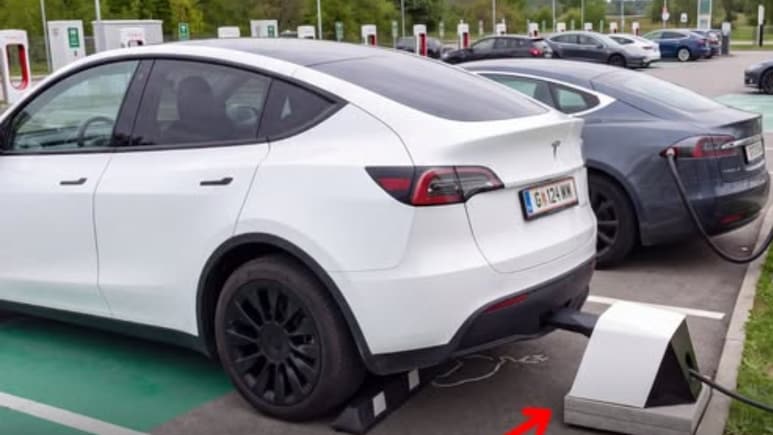
An Austrian company, Volterio, has developed a ground-mounted charging system that allows a Tesla Model Y to charge simply by parking over it. The passive docking solution eliminates the need for cables and manual plug-in, offering a hands-free charging experience that could be particularly useful for autonomous vehicles and fleets. It resembles the charging system used for mobile phones, involving the device being plugged in.
Woah. An Austrian company developed a passive NACS docking system for Teslas.
— Nic Cruz Patane (@niccruzpatane) August 17, 2026
There's a charge port where the tow hook usually is. In a world where wireless charging isn't a thing, I think this would be useful. pic.twitter.com/a21LkrOzgH
How The System Works
As reported by TeslaInsider, Volterio's system consists of two parts: a vehicle unit mounted on the car's underbody and a ground unit installed in the parking space. When the vehicle is parked above the ground unit, the two components communicate via short-range radio and establish a physical conductive connection automatically.
Also Read: Royal Enfield Classic 350 Gorkha Edition Leaked Ahead Of Launch
The design uses a centreing funnel and a protective flap to guide the connector into place, with no actuators or moving parts on the ground unit itself. This reduces the number of components that can wear out, which is important for hardware exposed to all weather conditions, based on TeslaInder's report.
The system has generous alignment tolerance, allowing lateral deviations of up to 200 mm and vertical deviations of 70 mm. This means drivers do not need to park with high precision for the connection to be made. The setup is compatible with existing charging standards, including NACS, and can support charging speeds of up to 500 kW, depending on the infrastructure and vehicle.
Also Read: Hero MotoCorp Patents New Dual-Sport Motorcycle; Impulse Making A Comeback?
Relevance For Robotaxis And Fleets
The most compelling use case for such technology is in autonomous fleets. A robotaxi without a driver cannot plug itself in using conventional chargers, and wireless charging remains relatively inefficient at high power levels. Volterio's conductive, automated solution offers a practical alternative that works the moment a vehicle parks.
The company is also targeting automated guided vehicles in industrial environments, where frequent, hands-free charging can improve operational efficiency. As Tesla and other manufacturers scale their robotaxi networks, infrastructure like this could become an important part of the ecosystem.
Current Status
Volterio has been developing its charging robots for several years, with prototypes capable of both AC and DC charging. While the concept has been demonstrated, widespread commercial deployment will depend on vehicle manufacturers, fleet operators, and charging networks adopting the technology.
Track Latest News Live on NDTV.com and get news updates from India and around the world
