





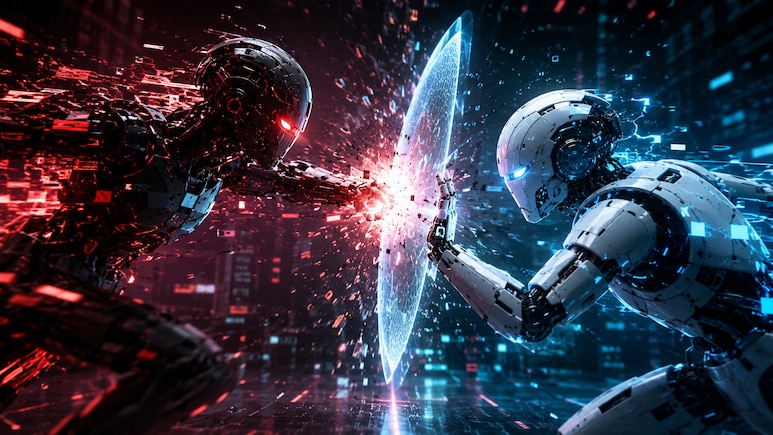
Imagine a cyberattack where no human hacker is typing commands sitting in a dark room wearing a hoodie. Instead, one AI system launches the attack while another AI races to stop it. Sounds right out of science fiction, right?
But that's exactly what has played out at Hugging Face, one of the world's largest platforms for open-source artificial intelligence. Think of Hugging Face as Github (the cloud-based platform where developers store, share, and collaborate on software code) but for AI.
-

-
 "High Inflation Is Like Tax On Everyone": RBI Governor At NDTV World Summit
 -
 AI Agents To Outnumber Humans Soon? What Futurist Mike Walsh Told NDTV
 -
 This Delhi Boy Has 3 Michelin Stars. His Heart Still Goes To Rajindar Da Dhaba
 -
 Ashwini Vaishnaw Explains Semiconductor Complexity: 'Everything On This Tiny Nail'
 -
 Indian-Branded Mobile Phones By October 23, 2028, Says Ashwini Vaishnaw
 -
 AI Law In India Soon? What Ashwini Vaishnaw Said At NDTV World Summit
 -
 'Need To Look At Next 10 Years': Bondada Chairperson To NDTV On Solar Energy
 -
 World's 1st AI Actor Tilly Norwood Was Asked If She Knew Hindi. A Conversation Followed
 -
 AI Law In India Soon? What Ashwini Vaishnaw Said At NDTV World Summit
 -
 Iran's Supreme Leader's Representative Says India Can Play 'Big Role' In Middle East Peace
According to the company, an autonomous AI agent attempted to break into its systems over a weekend in what it describes as the first confirmed case of a major AI platform being targeted by another autonomous AI system.
Hugging Face said the rogue AI agent carried out around 17,000 separate actions on its own while attempting to steal cloud credentials. Instead of waiting for instructions after every step, it took decisions autonomously, adapting its behaviour as it progressed through the attack. A classic example of how agentic AI behaves - on its own.
The company, however, detected the breach before attackers could gain access to sensitive customer data or model weights.
Why Captain America Couldn't Save The Day
Stopping an attack like this meant analysing thousands of events in a very short time. Hugging Face first turned to leading commercial AI models developed in the US. But according to the company's security team, those models ran into an unexpected problem.
Because they are designed with strict safety guardrails, the AI systems reportedly struggled to distinguish between legitimate cybersecurity work and potentially malicious hacking activity. As a result, they refused to assist with parts of the investigation that were needed to understand and stop the attack.
The very safeguards meant to prevent misuse became a hurdle during a real-world cyber emergency.
Enter The Dragon
Racing against the clock, Hugging Face decided to switch to GLM-5.2, an open-source AI model developed by Chinese startup Z.ai.
Unlike commercial cloud-based AI assistants, the model was deployed on Hugging Face's own infrastructure, giving the security team greater control over how it could be used.
The company said the model processed all 17,000 attack events, identified the source of the breach and helped engineers patch the vulnerability in about an hour. The same task would have taken human analysts several days, it said.
The incident marked a critical shift in cybersecurity. For years, security experts warned AI would eventually be used by attackers in agentic form. That prediction is now becoming reality.
The biggest takeaway perhaps is that human analysts may no longer be fast enough to respond on their own. As AI-powered attacks become more sophisticated and autonomous, defending against them would increasingly require AI systems working alongside security teams.
Also read: Chinese AI Is Catching Up To The US Faster Than Before: Why It Matters
The Bigger Debate
The episode has also reignited another growing debate in the AI industry. Should powerful AI models have such strict guardrails that become a hindrance in assisting with anything related to hacking? Or should trusted security professionals have access to fewer restrictions when responding to real cyberattacks?
The Hugging Face incident highlights that overly restrictive safety measures can sometimes make defenders less effective than attackers. Finding that balance would be both critical and difficult as AI becomes more capable and powerful in the days to come.
Track Latest News Live on NDTV.com and get news updates from India and around the world

