





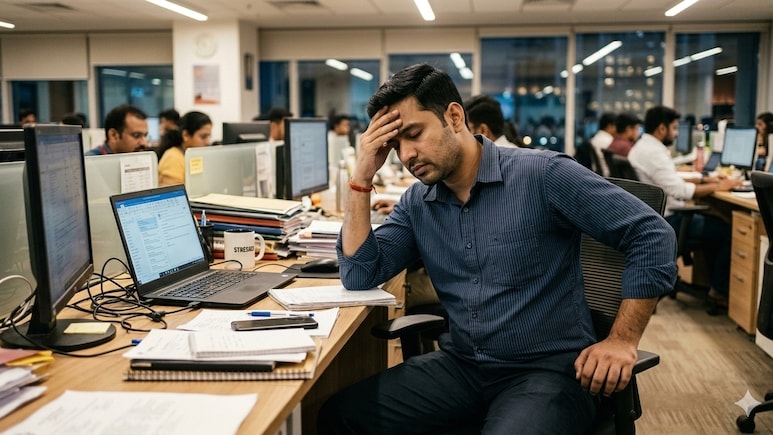
For the past two years, the debate around AI has largely revolved around one question: Will AI take our jobs? Now, some of the very people who warned about massive job disruption appear to be changing their tune. But there's a new concern that's emerging. As AI gets increasingly embedded into workflows, it may latch on to you like a leech, constantly sucking you dry of energy and joy.
Now coming to the U-turn - OpenAI CEO Sam Altman and Anthropic CEO Dario Amodei, who had previously warned that AI could wipe out whole categories of jobs, have recently struck a more optimistic tone saying that AI will actually create more jobs as adoption increases. Whether this shift reflects genuine confidence or has something to do with the fact that they are both looking to go public by listing their companies is open to debate.
-

-
 Is AI Bubble Waiting To Burst? Nikhil Kamath Warns Of Tougher Months Ahead
 -
 "We Don't Have 5 Years": Celebrated American General Sounds Alarm On War
 -
 "There Will Be Issues Between Big Countries": S Jaishankar On India-China
 -
 Neha Goyal Makes Stunning Asian Games Gold Revelation At NDTV World Summit 2026
 -
 Big NDTV Summit Impact: RBI Governor's Tata Sons Listing Remark Makes Top Newspaper Headlines
 -
 "Certainty Is A Problem": Nikhil Kamath On Marriage, Children And Future
 -
 "High Inflation Is Like Tax On Everyone": RBI Governor At NDTV World Summit
 -
 RBI Governor Sanjay Malhotra's Big Hint On Tata Sons Listing Row At NDTV World Summit
 -
 The Mystery Of A Bare Nail In Ashwini Vaishnaw's Office
 -
 To PM Modi's "Failed Product" Jab At Rahul Gandhi, A Shashi Tharoor Counter
Nvidia CEO Jensen Huang, however, has consistently had a more optimistic view around AI. This week, he dismissed fears of widespread AI-driven job loss as "complete nonsense", arguing that the productivity gains unlocked by AI are creating opportunities and pushing companies to hire more engineers.
Huang recently raised another possibility - one that may prove just as unsettling for people who keep their jobs.
"Your AI agents are harassing you, micromanaging you, and you're busier than ever," Huang said during a discussion at Stanford Graduate School of Business.
The remark was partly made in jest; yet it hints at a future that many workers may find deeply disturbing.
"We're already seeing early signs of this," Sagar Vishnoi, co-founder of Future Shift Labs, told NDTV.
"When AI nudges become too frequent, people start tuning them out altogether. AI can boost productivity, but constant nudging risks turning it into a digital micromanager. When every task comes with an AI prompt or reminder, workers face alert fatigue, reduced autonomy and lower morale. The outcome may not be greater efficiency, but greater distraction," he warned.
The Rise Of The Micromanager (Machine)
Today's AI systems can already write code, summarize meetings, manage schedules, draft emails and analyse data. As these tools become more capable, companies are increasingly deploying AI not just as assistants but as systems that monitor workflows, track productivity and recommend actions in real time. Meta for instance was reportedly tracking its "really smart" employees to train AI, before laying off people. This week, however, in an internal memo it reportedly said that it will allow employees to pause the data collection for "up to 30 minutes at a time" as well as request exemptions from the initiative altogether.
Paramdeep Singh, president and co-founder of ShortHills AI believes even the ones enjoying the AI co-pilots currently may eventually feel overwhelmed by it.
"Right now people are enjoying the co-pilot or buddy AI. But this buddy is relentless and is becoming smarter by the day," he told NDTV.
"A human manager would tire at the end of the day and wait for your inputs till the morning. AI copilots and agents do not tire." As AI systems become embedded into workplace software, Singh expects more continuous monitoring, real-time performance tracking and greater transparency around individual productivity.
While that could improve efficiency, it could also potentially increase stress. "Yes, it could lead to micromanagement and an 'always-on' future," Singh said.
The solution may eventually require new workplace protections. "I think you would need something like a 'right to disconnect' in the long run," the IIT Delhi grad said.
And if this trend does indeed pick up steam, it may seriously hit employee morale, believe HR experts.
"The constant AI nudge and monitoring will only be a short term spurt of productivity because of pressure and sometimes fear, but unless we allow employees to make better decisions we will see a drop in morale, " said Rahul Atri, partner at ProEdge Services, an executive search firm.
In his conversations with various HR leaders, founders and business leaders, Atri said he's found two very distinctive approaches. One where the leaders are looking at AI to add efficiency and the other where the leaders are looking at AI to build intelligence in their organisational culture and workflows.
"If one is building only for operational efficiency then they are bound to face overwhelming dominance of AI in day-to-day processes. These are the leaders who are asking 'how can we do it faster, how can we do this with fewer people'," said Atri, who's also the founder of ezOffer.ai.
However if leaders are building to add a layer of intelligence then that is where a mature process comes in, he added. "These leaders ask 'How can we make better decisions using AI'?"
The moment AI goes beyond co-pilot mode is when the stress will really start kicking in, believe some AI experts. "The sweet spot would be if AI was a co-pilot, not a backseat driver," said Dr Srinivas Padmanabhuni, CTO of AiEnsured.
In The Meantime, Layoffs Continue
What's hard to ignore amidst this debate is that despite the rhetoric from AI CEOs now, layoffs linked to AI restructuring continue. Meta, Amazon and LinkedIn have all laid off people while carrying out AI restructuring. On Wednesday, developer platform GitLab let go of 14% of its workforce as part of a broader AI-led restructuring effort.
According to Singh of ShortHills AI, both sides of the jobs debate may ultimately prove correct.
"In the short run, AI would automate a lot of jobs and there would be oversupply. So there would be job losses, as we are seeing today," he said. "In the long run, work would expand and people would find new things to work on. But workers would need to reskill and learn how to use AI effectively to remain relevant."
Despite his very bullish stance, the Nvidia chief too has acknowledged that some jobs would inevitably disappear during the transition but argued that technological revolutions have historically created more work than they destroyed.
"My belief is we're gonna create more jobs in the end," Huang said. "There'll be more people working at the end of this industrial revolution than at the beginning of it."
Adding to his optimism, Huang said, "The fact that we now have AI assistants to help us, we could explore more space, do better work, do things at a greater scale, do things more cost-effectively."
However, as AI strives to make workers dramatically more productive, it could also create new pressures and horrors.
Track Latest News Live on NDTV.com and get news updates from India and around the world

