





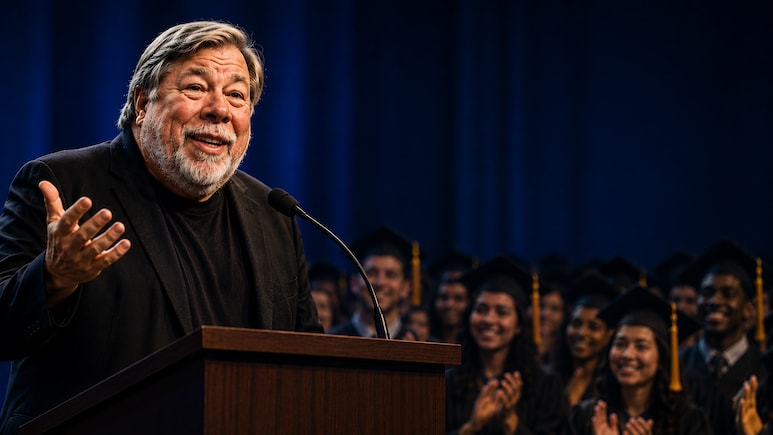
It's become a bit of routine now. Tech titans coming to graduating ceremonies, lecturing on AI and getting heckled and booed by the student crowd. In the backdrop of this something very interesting just unfolded. Steve Wozniak - the co-founder of Apple and long-time friend and business partner of the late Steve Jobs - recently mentioned AI, albeit with a twist and got applauded instead of getting booed.
"You all have AI - actual intelligence," he told the graduating class of Grand Valley State University, drawing cheers and applause from students gathered at the Michigan campus. Then came the punchline.
"My entire life in the technical world, I've been following people who were trying to figure out how to make a brain... and I was at a company where the engineers figured out how to make a brain," he continued, before adding that it "takes nine months." The joke landed, and so did the subtext of human intelligence over artificial intelligence.
At a time when AI has become the tech and corporate world's biggest obsession and one of society's biggest anxieties, Wozniak's remarks felt noticeably different from the apocalyptic predictions, productivity pitches and job replacement warnings that seem to be everywhere. And perhaps that is exactly why students responded the way they did.
Over the past few months, several graduation ceremonies featuring prominent tech leaders have turned unexpectedly tense. Former Google CEO Eric Schmidt, for instance, faced loud boos every time he brought up AI during his commencement speech at the University of Arizona last week.
Also read: Former Google CEO Gets Booed For Talking About AI At Graduation Ceremony
Students already anxious about layoffs, automation and shrinking entry-level opportunities have mostly reacted with anger and disdain every time a commencement speaker has tried to shove AI down their throats. Earlier this month, Gloria Caulfield, Vice President, Strategic Alliances, Tavistock Development Co., was booed after touting AI as the "next industrial revolution." while delivering the commencement speech at the University of Central Florida.
The unease is becoming increasingly visible among younger people entering the workforce at a moment when AI tools are evolving faster than most institutions can adapt. Dr. Debjani Sengupta, professor of English at Delhi University who has closely observed graduating classes for over three decades, says the reaction from young people is far more layered than simple fear of technology.
"What is very interesting is that there is obviously a very complicated reaction to AI among younger people," she tells NDTV. "As far as tech goes they are very savvy, but despite that there are a lot of questions about what AI can actually do to human connection."
According to Sengupta, many students today simultaneously use AI constantly while also questioning its growing role in society. "That anxiety is realising itself more and more," she says. "They can also see the limitations. Ultimately there is a feeling all over the world that emotional intelligence is the most important, no machine can replicate that. That is what makes a society intelligent and functional."
She argues that empathy, emotional connection and human understanding remain central to how societies operate. "You require that empathy, you need that EQ, else how are we going to stay connected?" she says. "Questioning from young people is very valid. This generation is constantly using technology compared to ours, but they are also the ones questioning it and finding its limitations."
This tension is increasingly defining the AI conversation globally. On one side are tech executives promising revolutionary breakthroughs, through AI systems that could transform medicine, science, education and productivity. On the other are students and workers wondering where exactly humans fit into that future.
Dr. Prerana Srimaal, Head of Liberal Arts Department at Christ University, Bengaluru, tells NDTV, "What we're seeing is not resistance to AI, but a more critical engagement with it. Students are questioning the speed and certainty with which their futures are being reshaped. The real concern isn't whether AI will surpass human intelligence, but whether we are still serious about cultivating it." The ability to think independently, build arguments, exercise judgment, hold complexity, and produce original insight will remain key for society and industry to thrive, she stresses.
Even Wozniak himself has historically maintained a more cautious approach toward AI compared to some of Silicon Valley's louder evangelists. Unlike executives openly predicting superhuman intelligence or radical workforce disruption, the Apple co-founder has often spoken about the importance of scepticism, human oversight and the dangers of blindly trusting AI-generated information. "I don't use AI much at all," Wozniak had said in March. "I often read things (that AI produces), and they just sound too dry and too perfect. I want something from a human being, and I'm disappointed a lot."
Track Latest News Live on NDTV.com and get news updates from India and around the world

