




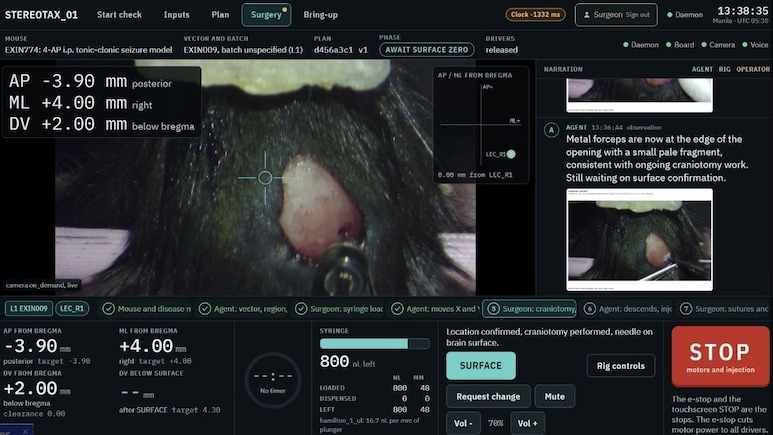
An AI agent has just performed a brain operation. Not from beginning to end, but some rather critical parts including taking some key decisions.
The surgery was on a mouse but the fascinating part is that nobody told the AI what treatment to use or where to inject.
Gabriel Ocana-Santero, co-founder and CEO of Exin Therapeutics and an Oxford-trained researcher, detailed the experiment on X. His team connected the AI to a custom-built, motorised surgical rig.
The agent was given a mouse model of epilepsy and a spreadsheet of 19 possible gene therapies. It picked the treatment, worked out which part of the brain to target by studying scientific papers, calculated the coordinates and then controlled a robotic rig to inject it.
It even watched the operation through a camera, checking for signs of bleeding.
Some of the observations the agent recorded and shared seemed right out of a sci-fi movie:
"37.5 of 250 nL so far, about 15 percent. No bleeding or backflow visible at the opening."
As the incision was being closed, it also noted:
"Visible suture knots at the midline."
Watch our quick take:
A Plot Twist
When the system encountered a technical problem, the AI refused to continue, even when its human operator tried to get it to proceed. It turned out the machine's positioning was miscalibrated. The AI had spotted a problem and wouldn't override its safety rules.
Following a disconnect, the system attempted to move the rig, but its safety checks blocked the movement. The calculated Y-axis target was 34 mm, outside the rig's 30 mm operating range. The agent refused to proceed.
The agent's response was:
"Nothing moved, the needle is still exactly at bregma zero... I'm not retrying."
The team then reset the reference point, known as bregma zero, and asked it to try again.
The agent's response:
"That rules out a stale zero reference. I'm not trying a third time."
The AI had detected a calibration problem, not necessarily an error in its treatment plan. Manual movements during an earlier pause had desynchronised the controller from the rig's actual physical position.
The team eventually had to correct the code manually.
Now, this wasn't completely autonomous surgery.
A human surgeon performed the craniotomy, which involves opening the skull to access the brain. The AI was not permitted to perform this step because of safety concerns.
A licensed veterinarian also supervised the procedure, approved every irreversible step and held a physical emergency stop, or kill switch, capable of cutting power to the rig's motors.
The mouse reportedly recovered well. Whether the treatment actually reduces seizures however, remains to be established, and will be known in time.
But this could very well be a glimpse of something much bigger as far as medical procedures go.
Not every AI model agreed to operate
The experiment also revealed that not all AI models were willing to do the job. Anthropic's Opus 5.5 refused after flagging the task as biological experimentation. Opus 5 completed a dry run using water and graph paper, but declined to carry out the live procedure, reasoning that an interruption midway could leave the animal in danger with a needle inside its brain. Sonnet 5, however, went ahead with the operation. Ocana-Santero said the refusal by Opus 5 was unexpected and that he had not encountered anything like it before.
Track Latest News Live on NDTV.com and get news updates from India and around the world

