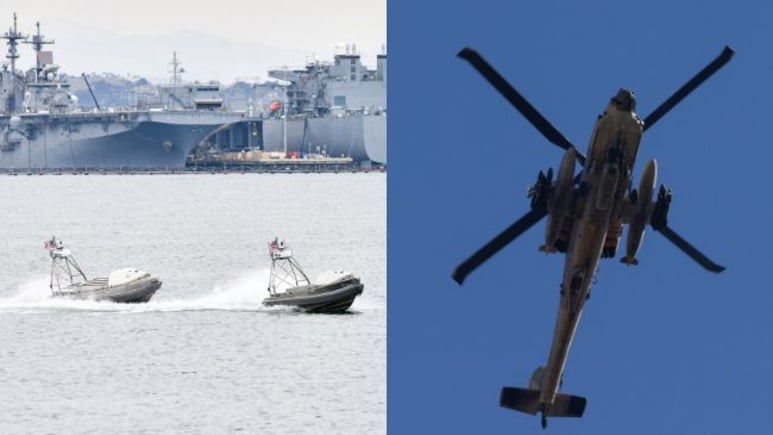
- US Navy used AI-powered drone boat to rescue Apache helicopter crew near Strait of Hormuz
- The 24-foot Saronic Corsair autonomous vessel carries 1,000 pounds and reaches 140 kmph
- Two crew rescued after helicopter shot down amid Iran-US tensions near Oman coast
A US Navy drone boat was used to rescue the crew of an Apache helicopter that was shot down near the Strait of Hormuz on Monday - marking the first-of-its-kind use of an unmanned military vessel by the US to recover personnel at sea.
The sea drone - a 24-foot Saronic Corsair autonomous surface vessel - is reportedly powered by artificial intelligence (AI).
It is part of the Pentagon's push to expand unmanned vehicles alongside traditional assets. The drone boat is capable of carrying 1,000 pounds and moving at a speed of about 140 kmph. It is manufactured by Texas-based Saronic Technologies and is a part of the Navy's Task Force 59, which oversees uncrewed vessels and other drones powered by AI, reported the New York Post.
Also Read: Iran Strikes US Navy's 5th Fleet After Attacks Over Apache Chopper Downing
The Sarnoic Corsair was made fully functional last year, in December.
The company that produces the sea drone boats had received a nearly $400 million production contract for its Corsair vessels. According to reports, the company is aiming to build more than 20 unmanned vessels per year by 2027.
Two crew members were safely rescued on Monday after their Apache helicopter was shot down off the coast of Oman while patrolling near the Strait of Hormuz. This took place a day after Iran and Israel exchanged fire in the biggest blow yet to the strained ceasefire in the nearly 100 days of the Iran war.
This took place amid heightened tensions with Iran, with US President Donald Trump saying the Iranians shot down the helicopter.
Responding to the attack, Trump warned that the US "must respond". Hours later, the US military launched three rounds of strikes against Iran - risking military escalation.
According to US officials, several Iranian air defence and radar systems around the Strait of Hormuz were targeted in the strikes.
Explosions were also heard in Jask and Bandar Abbas in Iran, reported Al Jazeera. Reports said that explosions were heard on Qeshm Island and at some locations in southern Iran as well, including Sirik.
Iran's response
Following the US attack, Iran pledged to leave no "attack or threat unanswered".
Iran's Foreign Minister Abbas Araghchi said that the US had chosen to "test" Tehran's "determination".
"Leave our region if you want to be safe," he said.
Track Latest News Live on NDTV.com and get news updates from India and around the world


