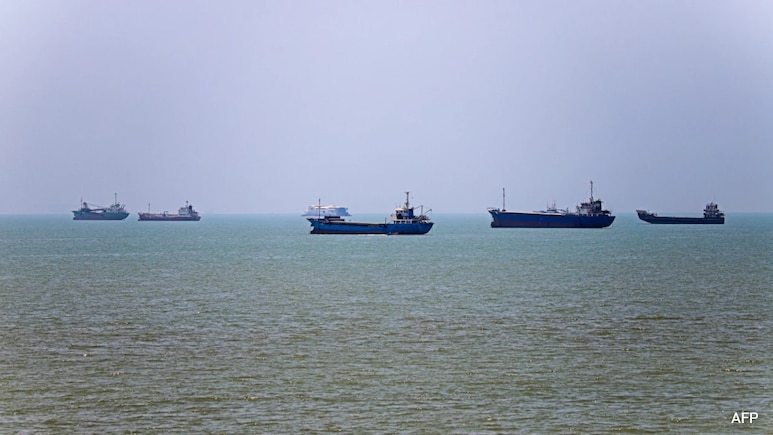
An attack on a ship Thursday in the Strait of Hormuz led the UN to suspend efforts to evacuate trapped mariners as the United States warned against Iran charging fees for passage through the vital waterway.
The New York Times and other US media reported that Iran struck a container ship in the strait, and the Iranian agency that claims to regulate traffic there issued a warning after the incident.
"Any passage through routes outside the framework designated by PGSA will not be covered by safe passage guarantees," Persian Gulf Strait Authority said on X.
PGSA در پاسخ به استعلامهای مکرر اعلام میکند:
— PGSA | نهاد مدیریت آبراه خلیج فارس (@PGSA_IRAN) June 25, 2026
هرگونه تردد از مسیرهای خارج از چارچوب تعیینشده PGSA، مشمول تضمین عبور ایمن نبوده و از پوشش بیمه و مسئولیتهای مرتبط برخوردار نخواهد بود.
تبعات ناشی از تردد از مسیرهای غیرمجاز، برعهده مالک، بهرهبردار و فرمانده شناور خواهدبود.
Iran imposed a blockade of the strait during the war, sparking a global economic shock, and has since said it plans to introduce what it terms maritime service fees.
These developments may complicate negotiations between the US and Iran, which are trying to forge a final agreement after signing a memorandum of understanding to end the conflict that started in late February.
Thursday's attack prompted Arsenio Dominguez, the secretary general of the International Maritime Organisation (IMO), a UN agency responsible for marine safety, to announce the suspension of efforts to evacuate the 600 ships and their crews that were trapped by the war.
Dominguez said in a statement that he had paused the evacuation plan "to reconfirm that the necessary safety guarantees continue to be in place for the ships on our evacuation list."
The vessel that was hit on Thursday was not travelling under the IMO's evacuation framework, which began on Tuesday evening, he said.
The British maritime security agency UKMTO said the cargo ship in the strait was "hit on the starboard side by an unknown projectile, causing damage to the bridge," but reporting no casualties.
It said the incident occurred just 7.5 nautical miles (14 kilometres) off Oman's coast.
The White House said it was aware of the reports and was looking into them. "President Trump has been clear that Iran cannot subvert the free flow of traffic in the Strait," a White House official said.
Not 'at any price'
Secretary of State Marco Rubio -- in Bahrain as part of a regional tour to reassure Gulf partners hit hard by the Middle East war -- acknowledged that while the US wants "a deal, we don't want a deal at any price."
"We want to ensure... that there is no part of this deal that's undertaken that in any way undermines the security, the stability or the prosperity of any of our partners in the Gulf region," he said.
Rubio also dismissed the idea of allowing Tehran to charge fees in the strait, saying it would open the door to "total chaos."
The memorandum of understanding signed last week by Tehran and Washington stipulated that commercial ships may transit the strait free of charge for the next 60 days. It is unclear what arrangements will be in place after that period.
The Strait of Hormuz is a narrow stretch of water between Iran and Oman that leads to the Arabian Sea and the Indian Ocean, making it a chokepoint for crucial energy shipments out of the Gulf.
Negotiations between the US and Iran that kicked off in Switzerland on Sunday are expected to address Tehran's nuclear programme, sanctions relief and global energy flows through the strait, where Iran has repeatedly targeted civilian vessels.
But Gulf countries and Israel also have longstanding concerns about Iran's support for proxies in the region and its missile programme, and it remains unclear whether those topics will be handled in the talks.
Rubio sought to reassure the energy-rich Gulf states that the Strait of Hormuz, which they have relied on for decades to export oil and liquefied natural gas, would remain toll-free.
The Gulf ministers, in their joint statement, insisted that "free, unconditional and unrestricted navigation" of the strait was essential to the region.
New route
Oman had released a map on Wednesday of a new temporary shipping route running close to its coast. It said the path through the strait was coordinated with the IMO.
Iran later appeared to denounce the new corridor in a statement by the Revolutionary Guards, but did not refer to Oman specifically.
Meanwhile in Washington, the State Department said that US-mediated talks between Israel and Lebanon that were slated to end Thursday will go on for another day.
It said this fifth round of discussions that began this week will resume Friday morning. "Israel and Lebanon talks remain ongoing as we continue to facilitate," the department said in a statement.
These talks come amid a fragile ceasefire between Israel and Iran-backed Hezbollah, an offshoot of the Mideast war that the United States and Iran are negotiating to bring to a definitive end.
(Except for the headline, this story has not been edited by NDTV staff and is published from a syndicated feed.)
Track Latest News Live on NDTV.com and get news updates from India and around the world


