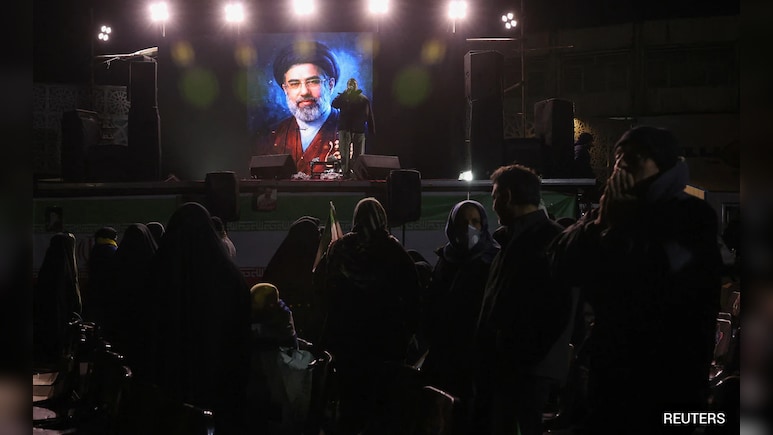
Mojtaba Khamenei has been chosen as Iran's new Supreme Leader after the assassination of his father, Ali Khamenei, by the US and Israel.
Iran's clerical body, the Assembly of Experts, selected him on Sunday to lead the Islamic Republic. This is the first time since the 1979 Iranian Revolution that the country's highest authority has effectively passed from father to son.
In the days after Ali Khamenei's killing on February 28, Iran faced a leadership vacuum while already engaged in a war. Power was temporarily transferred to a three-member interim council consisting of President Masoud Pezeshkian, judiciary chief Gholam-Hossein Mohseni-Ejei, and cleric Alireza Arafi. The council carried out the duties of the Supreme Leader until a permanent successor could be selected. FOLLOW LIVE UPDATES
Under Iran's constitution, only the Assembly of Experts has the authority to appoint the Supreme Leader. Within days, the body convened secret meetings and voted to elevate Mojtaba Khamenei.
Pressure From The Revolutionary Guards
The selection was strongly backed by the Islamic Revolutionary Guard Corps (IRGC), the most powerful security institution in Iran.
According to multiple reports, commanders of the IRGC contacted members of the Assembly of Experts before the vote to secure support for Mojtaba Khamenei. The contacts included phone calls and in-person meetings, urging clerics to back him as the next Supreme Leader.
Some assembly members later described the environment of the meeting as “unnatural” because of the pressure. Opponents were given a limited time to present their arguments before the vote moved forward. A number of members even considered boycotting a follow-up session of the assembly because of what they described as heavy pressure from the IRGC during the vote.
After the decision, the Guards publicly pledged loyalty to the new leader.
Why The IRGC Backed Mojtaba
For the Revolutionary Guards, Mojtaba Khamenei represented continuity.
He developed strong ties with IRGC commanders over decades and acted as a key channel between the security establishment and his father's office.
The Guards reportedly needed two things after Ali Khamenei's death: control and legitimacy within the regime. Mojtaba offered both.
Mojtaba Khamenei has never held elected office and has largely operated behind the scenes in Iran's political structure. His clerical rank, Hojjatoleslam, is below the level traditionally associated with leading the Islamic Republic.
A Powerful Figure Behind The Scenes
Mojtaba has been influential in Iran's politics for decades. His role became visible during the 2005 presidential election, when he was accused by political rivals of helping engineer the rise of Mahmoud Ahmadinejad.
During the protests that followed the 2009 election, he was also linked to efforts by security forces to suppress the opposition movement.
Over time, Mojtaba built strong connections with security agencies, conservative clerics, and political networks around his father's office.
The Hidden Power Of The Supreme Leader's Office
Much of this influence came from the structure surrounding the Supreme Leader's office, known informally as the “Bayt”. This institution links security agencies, religious institutions, economic foundations, and political organisations. Through these networks, the Supreme Leader's office oversees key decisions across the state.
The system reportedly creates a parallel structure of authority that monitors ministries, controls security forces, and influences political appointments.
Because Mojtaba worked closely within this system for years, he entered the succession process with strong support from powerful insiders.
Track Latest News Live on NDTV.com and get news updates from India and around the world


