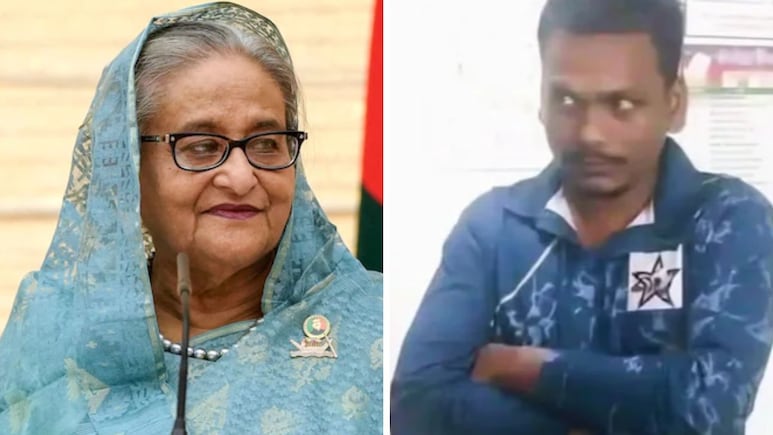
Dipu Chandra Das, a 27-year-old Hindu man, was lynched by a Muslim mob following allegations of blasphemy in Bangladesh's Mymensingh city, where he worked in a factory. They didn't stop there. Dipu's body was hung in a public place and set on fire.
The authorities later said there was no evidence that Dipu Das committed blasphemy. His family also claimed that Dipu was killed over workplace rivalry rather than any alleged "blasphemous" remark.
Ousted Prime Minister Sheikh Hasina has now called it a "barbaric and shameful act" that reflects the "dangerous collapse of law, order and moral authority" under the interim government.
Speaking exclusively to NDTV, Hasina said, "Violence in the name of religion has no place in Bangladesh, yet such acts have become disturbingly frequent. This was not an isolated incident, but part of a broader pattern of communal violence that has been allowed to flourish with impunity."
The former Prime Minister, who is currently in India, said that Bangladesh is becoming "increasingly unsafe for minorities because the state has failed in its most basic duty to protect all citizens equally."
"The perpetrators of these horrific acts of religious violence have never been prosecuted, and their victims have been denied justice, while Yunus himself continues to deny the clearly religious motivations behind these acts. This erosion of security threatens not only minorities, but the secular and democratic foundations of Bangladesh itself."
Also Read | "Burning Minorities Alive": Sheikh Hasina Attacks Yunus Regime In New Address
Violence Against Hindus In Bangladesh
Dipu Das is not alone.
At least 51 incidents of communal violence were recorded in December alone, according to a statement issued today by the Bangladesh Hindu Buddhist Christian Unity Council. These include 10 murders, 23 cases of looting and arson, 10 incidents of robbery and theft, four cases of detention and torture on false blasphemy charges, one attempted rape, and three incidents of physical assault. Homes, temples, and businesses belonging to minority communities have been systematically targeted.
Violence against Hindus in Bangladesh has seen a spike ever since the death of student leader Sharif Osman Hadi on December 12.
Sarat Mani Chakraborty, a 40-year-old grocery store owner, was attacked with sharp weapons on Monday night. He died of his injuries. Hours before he was killed, Rana Pratap, a 45-year-old factory owner, was shot dead in the Jashore district. Seven bullet casings were found beside Pratap's body.
On January 3, a Hindu woman in the Jhenaidah district was raped by two men, who also demanded money from her. When she screamed, they tied her to a tree, cut off her hair, recorded the act, and circulated videos on social media.
Days before that, Khokon Chandra Das, 50, was brutally attacked and set on fire. He ran a medicine and mobile banking business in his village, 150 km from the national capital, Dhaka.
Other victims include Bajendra Biswas, 40, who was killed by a colleague at a garment factory in Bhaluka; Amrit Mondal, 29, who was lynched over alleged extortion in Rajbari; Dipu Chandra Das.
Is Bangladesh Drifting Toward Radical Islamic Extremism?
Speaking to NDTV, Hasina said that "radical Islamic extremism is no longer operating at the margins of society; it has been legitimised and emboldened by the interim government's actions and inaction."
Hasina claimed to have worked to "curb the emergence of domestic terror units" and ensure peaceful coexistence of all religious groups during her regime.
"Under Yunus, convicted terrorists have been released from prison, extremist groups have been rehabilitated into political relevance, and violence against minorities and women has been normalized," she added.
Elaborating on the long-term consequences, Hasina said it would be "devastating."
"Economically, radicalisation will deter investment and reverse decades of progress. Politically, it will isolate Bangladesh from democratic partners and destabilise the wider region. History shows that once extremism is entrenched in state structures, it is far harder to reverse than to prevent," she said.
Also Read | "Baseless": Sheikh Hasina Trashes Dhaka's India Claim Over Leader's Murder
Track Latest News Live on NDTV.com and get news updates from India and around the world


