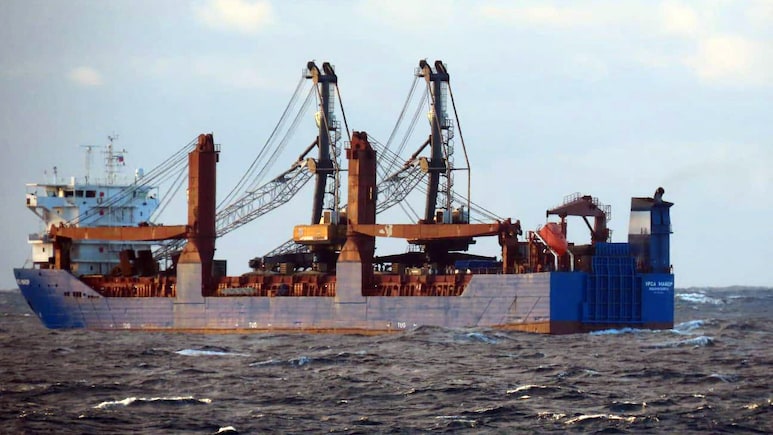
A Russian cargo ship that sank off the Spanish coast on Christmas Eve last year was likely carrying nuclear reactor components destined for North Korea, and may have been deliberately stopped by a Western military force, a CNN investigation has found.
The Ursa Major, also known as Sparta 3, left the Russian fuel port of Ust-Luga in the Gulf of Finland in early December 2024. Its official paperwork declared it was carrying two large "manhole covers," 129 empty containers and two Liebherr cranes, bound for Vladivostok on Russia's Pacific coast.
According to CNN's investigation, that explanation does not hold up. Spain's maritime investigation, carried out by authorities in the southern port of Cartagena, found it deeply improbable that a ship would make such a long sea voyage to carry empty containers and cranes between two Russian ports, given the country's extensive rail network. The investigation concluded that the cranes were likely aboard to assist with the offloading of a far more sensitive cargo at the North Korean port of Rason.
The ship's owner, the state-linked Oboronlogistics, had stated in October 2024 that its vessels had been licensed to carry nuclear material.
Captain's Confession
After the ship sank on 23 December 2024, roughly 60 miles off the Spanish coast, the 14 surviving crew members were brought ashore at Cartagena. There, investigators debriefed the Russian captain, named as Igor Anisimov.
According to a statement the Spanish government later gave to opposition lawmakers, the captain was initially reluctant to speak, fearing for his safety. Under questioning about the "manhole covers" listed on the manifest, he eventually told investigators the truth. He "finally confessed that they were the components of two nuclear reactors similar to those used by submarines," the statement said. "According to his testimony, and without being able to confirm it, they did not contain nuclear fuel."
A Torpedo, A Hole and Unanswered Questions
The three explosions that struck the Ursa Major near its engine room on the morning of 23 December killed two crew members, Second Mechanic Nikitin and Mechanic Yakovlev, whose bodies were never recovered. But CNN's investigation suggests something had already hit the ship roughly 24 hours earlier, causing it to slow sharply in Spanish waters.
A 50cm by 50cm hole was found in the vessel's hull, with the damaged metal facing inwards and the deck reportedly covered in shrapnel, according to the ship's owners.
Spain's maritime investigation suggested the hole was consistent with a Barracuda supercavitating torpedo, a high-speed weapon that fires air ahead of itself to reduce water drag and can pierce a hull without using an explosive charge. Only the United States, a small number of NATO allies, Russia and Iran are believed to possess this type of torpedo.
Russia Returns, And Four More Explosions Follow
What happened after the sinking deepened the mystery further. On the evening of 23 December, while the Ursa Major was still afloat and thought to be stable, one of the two Russian military ships that had escorted it down the European coast, the Ivan Gren, fired a series of red flares over the scene.
Four explosions followed immediately. Spain's National Seismic Network confirmed to CNN that four seismic signatures were registered at that exact time and location, with a pattern resembling underwater mines or quarry blasts.
By 11.10 pm, the Ursa Major was gone.
A week later, according to the CNN report, the Russian vessel Yantar arrived at the scene. The ship is officially described as a research vessel, but has been accused of espionage and sabotage activity in NATO waters. It remained over the wreck for five days, after which four more explosions were detected, possibly targeting what remained of the ship on the seabed.
US Sent 'Nuclear Sniffers'
The interest of the United States military has added another layer to the story. According to the report, a WC-135R aircraft, a rare and highly specialised "nuclear sniffer" plane based in Nebraska, flew over the site of the sinking twice: once on 28 August last year and again on 6 February this year.
The Spanish government has not indicated any radiation threat along its southern coastline, and no evidence of contamination has emerged publicly.
The Bigger Picture: North Korea's Nuclear Ambitions
The alleged destination of the reactors takes on greater significance in the context of events from late 2024. In October that year, North Korea sent an estimated 10,000 troops to Russia to assist with Moscow's war in Ukraine. Two months later, the Ursa Major set sail.
In December 2025, North Korea published photographs of what it described as its first nuclear-powered submarine, featuring leader Kim Jong Un alongside the sealed hull of the vessel. The images showed no evidence of a functioning reactor inside.
Spain's investigation concluded that the reactors aboard the Ursa Major were likely the VM-4SG model, commonly used in Russia's Delta IV class ballistic missile submarines. Though the evidence for this specific claim was limited, it is sure to raise an alarm.
Mike Plunkett, senior naval platforms analyst for Janes, a defence intelligence company, told CNN that any decision by Russia to transfer this kind of technology was not "undertaken lightly, and it's only something that's ever done between very close allies." If the transfer had been attempted, he said, it would represent "a major move by Moscow" and something "very troubling, potentially, particularly if you're South Korea."
Track Latest News Live on NDTV.com and get news updates from India and around the world


