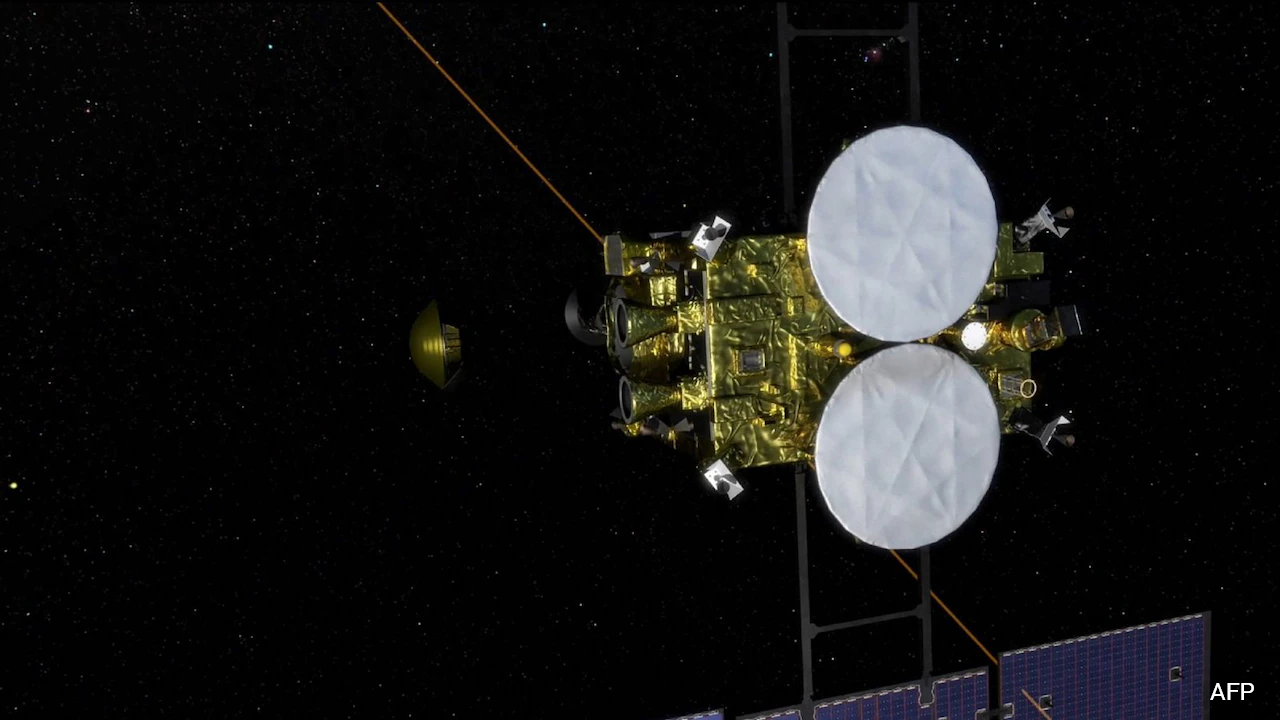
A Japanese space probe performed a flyby of a near-Earth asteroid on Sunday, in a test mission for technology that could help protect the planet from space rocks.
The fridge-sized Hayabusa2 was due to fly within 800 metres (0.5 miles) of asteroid Torifune, Japan Aerospace Exploration Agency (JAXA) scientists said earlier, a trial run to see whether such a probe could deflect a potentially dangerous space rock away from Earth.
The mission comes after NASA deliberately smashed a spacecraft into the 160-metre-wide Dimorphos asteroid in 2022, successfully altering its orbit around a larger space rock.
Moving at a speed of more than 18,000 kilometres (11,185 miles) per hour, Hayabusa2 was not intended to collide with Torifune.
Instead, scientists wanted to assess whether they could precisely control the trajectory of the probe, should it ever need to perform a deflection.
La sonda giapponese #Hayabusa2 ha effettuato oggi il sorvolo dell'asteroide #Torifune passando a 5 km/s a soli 800 m di altitudine.
— Le Storie di Kosmonautika (@LKosmonautika) July 5, 2026
In serata dovrebbero essere diffuse immagini del sorvolo.
(Video animazione) pic.twitter.com/aFIydmm1GD
"At 6:35 pm (0935 GMT)... Hayabusa2 conducted a flyby of Torifune and the spacecraft is working normally," a JAXA spokeswoman told AFP, declining to give her name.
Online footage supplied by JAXA showed scientists applauding in a control room.
"I was nervous, I felt on edge the whole time... But I'm really glad we were able to see it through to the end," one of the scientists told the JAXA broadcast.
If it is confirmed that the space probe indeed came within 800 metres of Torifune, the mission would be one of closest flybys of a near-Earth asteroid ever.
"It's as difficult as trying to shoot through a one-yen coin somewhere within the area stretching from Okinawa to Hokkaido," Yuya Mimasu of JAXA said earlier, referring to Japan's southernmost and northernmost islands.
Bare Rock Or Sand?
Cameras on board Hayabusa2 are also recording data from the asteroid's surface including geographical features, its texture and temperature -- vital information for a potential planetary defence mission.
"Is the surface consisting of bare rock, or cover(ed) by boulder fields or sand beaches? Only images taken by a spacecraft can reveal this information," Patrick Michel, project scientist at the European Space Agency, told AFP prior to the flyby.
"If we want to deflect an asteroid by an impact, the response is not the same if the asteroid is behaving like a sponge or if it behaves like a very solid material," he said.
The space probe's mission is not based on any actual threat to Earth from an asteroid.
Launched in 2014, Hayabusa2 has already thrilled scientists by landing on and gathering material from the asteroid Ryugu, some 300 million kilometres (185 million miles) from our planet.
Six years later, it returned to Earth precious samples from Ryugu -- "dragon palace" in Japanese -- providing scientists with clues about what the solar system was like at its birth some 4.6 billion years ago.
After the Torifune mission, the space probe is expected to attempt in 2031 a "rendezvous" -- a manoeuvre where it flies alongside or touches down on a space rock to gather detailed data -- with another asteroid, called 1998KY26.
Even after the success of NASA's Double Asteroid Redirection Test (DART), Sunday's ambitious flyby is hugely worthwhile, European Space Agency scientist Michel said.
"Given the diversity of near-Earth asteroids in terms of size, shape, surface and internal properties, each new image makes us better prepared."
(Except for the headline, this story has not been edited by NDTV staff and is published from a syndicated feed.)
Track Latest News Live on NDTV.com and get news updates from India and around the world


