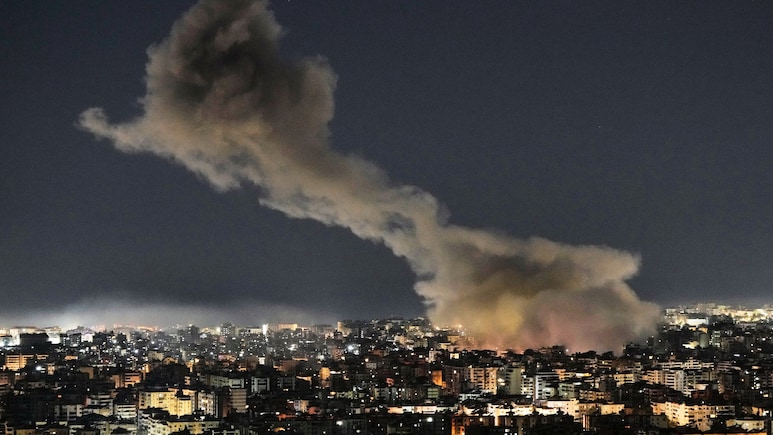
The Middle East is witnessing a sharp military confrontation as tensions between the United States, Israel and Iran intensify. Missile exchanges, air strikes and threats of retaliation have increased uncertainty across the region, raising concerns about a wider conflict.
To understand the ground situation and the possible outcomes of the crisis, NDTV spoke to defence expert Major General AK Siwach (Retd).
Explaining the current scenario, Major General Siwach (Retd) said the United States and Israel are primarily focused on limiting Iran's missile capabilities, preventing it from advancing its nuclear programme and deterring what they describe as regional aggression carried out through proxy groups.
However, he also said that even if the US achieves certain military objectives through targeted strikes, completely dismantling Iran's nuclear infrastructure and its regional influence will not be easy.
According to him, the conflict could settle into a prolonged phase of retaliation and counter-retaliation. Iran is likely to respond indirectly through allied groups such as Hezbollah and the Houthis, in addition to missile and drone attacks targeting strategic assets in the region.
Major General Siwach (Retd) noted that such actions increase the risk of confrontation turning into a broader regional war, especially if more countries are drawn in.
At the same time, Major General Sivach (Retd) assessed that a full-scale world war remains unlikely. He said major global powers would prefer controlled escalation rather than confrontation.
Role Of Regional And Global Powers
Countries like Saudi Arabia, the UAE, Oman, Jordan, Qatar and Bahrain are expected to push for de-escalation to prevent spillover effects. Any expansion of hostilities could directly impact their security and economic interests.
On Russia and China, the expert said both nations are unlikely to provide direct military support to Iran. Instead, they would prioritise safeguarding their own geopolitical and economic interests while avoiding direct conflict with Washington.
Regime Change Difficult Without Ground Troops
Addressing speculation about regime change in Iran, Major General Siwach (Retd) said such an outcome would be extremely difficult without deploying ground forces. Given past US experiences in Iraq and Afghanistan, a large-scale troop deployment inside Iran appears unlikely.
He added that any sustained campaign would rely more on air power, naval operations, sanctions and strategic pressure rather than boots on the ground.
Economic Impact And Global Concerns
The conflict also carries significant economic risks. A disruption in the Strait of Hormuz, a critical global oil transit route, could trigger a spike in international crude prices. This would have a cascading impact on global markets and inflation worldwide.
The United Nations and several countries have called for restraint and dialogue, warning that further escalation could lead to humanitarian crises and deeper regional instability.
Major General Siwach (Retd) concluded that while the situation is serious and fluid, it is more likely to remain a contained regional confrontation rather than spiral into a global war, provided diplomatic efforts continue alongside military posturing.
Track Latest News Live on NDTV.com and get news updates from India and around the world


