- Prime Minister Modi left Israel before US-Israel launched Iran offensive, says envoy
- Israel's strike degraded 70% of Iran's missile-launching capabilities: Reuven Azar to NDTV
- Iran's nuclear stockpile rendered inaccessible by Israeli operations, he said
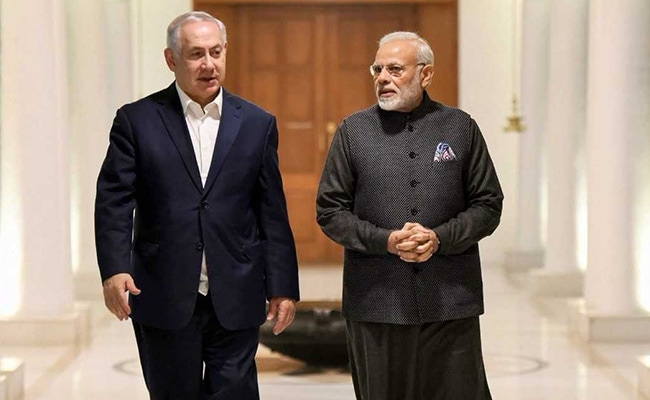
The "operational opportunity" for Israel and the US to launch an offensive on Iran arose after Prime Minister Narendra Modi had left Tel Aviv after his two-day visit, Israel's Ambassador to India Reuven Azar has told NDTV. The envoy's clarification effectively counters the Opposition's political attacks over the timing of the Prime Minister's visit and the US-Israel airstrikes that started the ongoing conflict.
Earlier, the Congress had termed Prime Minister Modi's visit to Israel "shameful" and "ill-timed". Salman Khurshid, chairman of the Congress Foreign Affairs Department, had said the timing of the Prime Minister's trip "creates the perception of a political endorsement of military escalation".
Asked if there was a sense during the Prime Minister's visit that Israel would start a military operation soon, Azar replied, "Well, the region was volatile. However, the operational opportunity came only after Prime Minister Modi left... as you know, that ended in the decapitation of the military leadership of Iran. That operation was approved by our cabinet only two days after Prime Minister Modi left."
To a question on whether Israel has achieved the goals behind its attack on Iran, he said, "Yes, we have created a situation in which the nuclear stockpile is inaccessible. Of course, we have an interest in removing it from Iran and we hope it can be done diplomatically. We are capable at this point of degrading the huge military industry they have built all around the country. It was spread in dozens of locations and at this point, they don't have production capability."
#NDTVExclusive | Israeli Ambassador to India Reuven Azar (@ReuvenAzar) speaks to NDTV's @VishnuNDTV on Iran war which now continues on Day 17 pic.twitter.com/13e9AGgesj
— NDTV (@ndtv) March 16, 2026
Azar said the offensive has degraded about 70 per cent of Iran's launching power.
Asked if Iran can reconstitute its nuclear capability, he said, "Nuclear technology is not very advanced. It's a technology that has existed for a hundred years... But we have deepened our intelligence capabilities inside Iran. They are exposed, and we will keep monitoring the situation until we are sure they are unable to build a nuclear arsenal they were trying to build."
Azar said Israel's goal is not to bring regime change in Iran. "First of all, we didn't say that we are going to bring regime change. What we said is that we are going to give the Iranian people an opportunity to embrace their future, and that means that we are going to help remove some of the oppressive forces there so the Iranians can actually express themselves... they have been oppressed, they have been killed, they have been raped by this regime so we have an interest of helping them because we don't want to engage every year in an attempt to degrade their capabilities. We prefer to have a more permanent change. That's why I think we share a common interest not just with our American friends in the region, but also with the Iranian people," he said.
The Israeli envoy was also asked if this was a battle of attrition, meaning a strategy to wear down the opponent. He said this battle of attrition started more than three decades ago, "when the Iranians decided that they wanted to destroy the state of Israel". "They have been attacking us constantly in different ways through proxies by exporting weapons of mass destruction, by training terrorists and by supporting them financially through their propaganda. So this has been continuing for a long time. You are now seeing the military part of it that we got to because they were trying to create programmes that are immune from future attack that would allow them to actually implement their plan of extermination of our country," he said.
Azar said Iran is attacking civilians in Israel in the Gulf. "So we have to make sure that their capability to do so diminishes and we will continue this campaign until either Iran changes course or we are convinced that we have done enough and we have exhausted our capabilities to keep them weak," he said.
To a question on whether more nations should respond to the US call to send Navy vessels to escort merchant ships through the Strait of Hormuz. The Strait, which is the Persian Gulf's only access to the Arabian Sea, is the transit route for 20 per cent of the global oil and gas supplies. Iran has blocked this route amid the conflict, raising energy security concerns for Asian markets such as India and China.
"I believe that the United States and its partners have the capability to restore movement in the Straits of Hormuz. It might take some time to amass the forces that are required for that, but it's a matter of will, not a matter of if," he said.
Israelis, Azar said, are resilient. "We have the will, not only to survive but also to thrive in our country and will continue to prosper despite the Iranian attempts to destroy our country," he said.
Track Latest News Live on NDTV.com and get news updates from India and around the world


