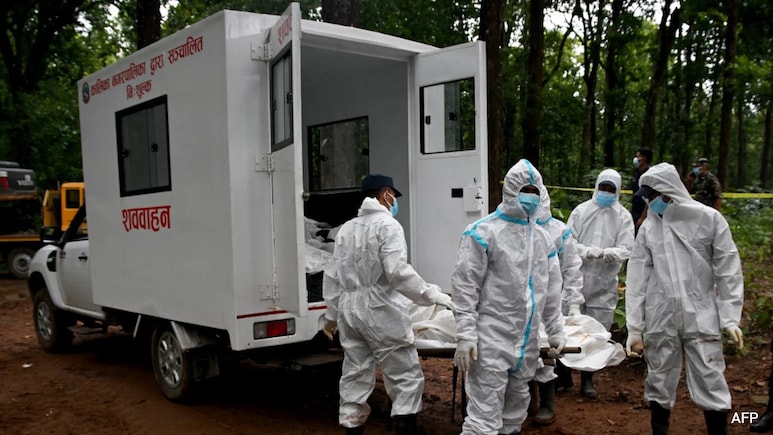
Over 1,000 people have been killed, and 3,916 others remain missing following the deadly floods near Nepal's border with Tibet, with the number of deaths continuing to rise as rescue efforts enter the seventh day. Among those missing are 275 Indian nationals and another 128 people of Indian origin -- most of whom are Kailash Mansarovar Yatra pilgrims -- according to the Foreign Ministry.
With bodies continuing to wash up, the authorities in the Himalayan nation are getting overwhelmed with the identification and storage process as morgues have already run out of room. It remains unclear how many foreigners are among the bodies recovered so far, and the government has established a PowerPoint slideshow for relatives of those missing in an effort to speed up identification of the dead.
How to Claim Bodies of Nepal Flood Victims
Now, the Indian Embassy in Nepal has issued a step-by-step guide to assist Indian families in the identification of the bodies of their loved ones. It noted that the Nepal government has been releasing photographs and descriptions of the dead, which can be accessed through a weblink.
If one is able to identify the body through the photographs, the embassy said it will assist the families in coordination with local authorities for processes related to handing over and repatriation of mortal remains. It also notified that the Nepalese government's nine-step process to claim the remains, which includes:
- Remains documentation
- Recorded photos/details of remains
- Post-mortem examination
- Cause of death verified
- Identification formally established
- Fingerprint/DNA/forensic sample collection
- Passport/ID verified for the dead person
- Embassy/Consular coordination completion
- Handover/release memo and receipt completion
"The government of Nepal has carried out temporary interment of a large number of remains to prevent health risks. The identification of such remains would require DNA matching with first-degree relatives," the embassy said in a statement.
In cases where identification is not possible, or the remains have been temporarily interred, the embassy informed that Nepal authorities will facilitate DNA matching.
Press Release regarding identification of mortal remains of victims of the recent flash flood in Nepal ⬇️
— IndiaInNepal (@IndiaInNepal) September 1, 2026
Link 🔗https://t.co/OZX2CvOqT3@MEAIndia pic.twitter.com/46IS8IHS2u
"Authorities in Nepal are collecting DNA samples from the emains for creating their DNA profiles. For carrying out the matching, first-degree relatives of the dead people can either send DNA profiles through email to dnacodis@nepalpolice.gov.np or give blood samples, along with some preliminary information required by Nepali authorities," the embassy said.
"For facilitation by the Embassy of India, the DNA profiles of first-degree relatives could also be copied to: eoikathmandufloodsupport@gmail.com. The relevant details regarding DNA profiling can be accessed at Nepal Police's website: https://www.nepalpolice.gov.np/ and its helpline number: +977 9841616095," it added.
For any further assistance or inquiry, the embassy said it may be reached via WhatsApp on +977 9851316807, +977 9709107500, or +977 9810326117.
Nepal Begins Burial
Overwhelmed by the task of trying to identify the dead -- many of those mangled beyond recognition -- authorities in Nepal have begun mass burials. They are taking DNA samples from each body before they are wrapped in a plastic bag with a tag and a location number, then placed in a shallow grave.
Authorities are hoping these bodies will eventually be identified by their families through DNA and retrieved for proper funeral rites.
Track Latest News Live on NDTV.com and get news updates from India and around the world


