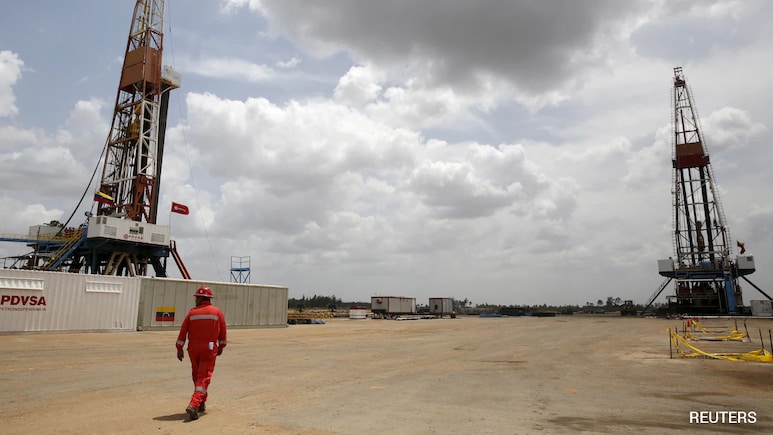
Venezuela's state-run oil company, PDVSA, has been forced to cut crude production as storage facilities near capacity, a result of an ongoing US oil blockade that effectively reduced exports to zero. The situation has added further strain on the country's interim government, which is struggling to retain control amid repeated US threats of more military action.
The political crisis in Caracas deepened after President Nicolas Maduro and his wife were captured by US forces on Saturday, January 3.
Oil exports, the backbone of Venezuela's economy, have now come to a complete halt. According to a Reuters report, US sanctions have blocked oil tankers from loading Venezuelan crude, while two cargoes were seized last month.
Beyond sanctions and politics, Venezuela's oil faces another major hurdle: its quality. The country's vast reserves are dominated by so-called heavy oil, harder to refine and more expensive to process, the BBC reported. This is in contrast to the US, which largely produces light oil, a crude type better suited for making petrol and other high-value fuels.
This difference in crude quality raises a question: what separates heavy, or hard, oil from light crude.
Why Crude Quality Matters
Crude oil is classified by density and viscosity, essentially how heavy or light the product is, using a standard called the American Petroleum Institute (API) gravity. This means their physical characteristics play a big role in determining how easily they can be refined.
Light crude oils, which are less dense and have higher API gravity, contain more light hydrocarbons and can be processed into high-value products using relatively simple distillation.
Heavy, or hard, crude oils are denser and often more sulphur-rich. They require complex, costly refining processes to produce the same valuable fuels. The type of crude oil available, therefore, directly affects both the refining method and the economic value of the final products.
Heavy Oil
Heavy oil is thicker and denser than other types of crude, often with an API gravity below 20 degrees. It contains more complex hydrocarbons, including asphaltenes and resins, as well as higher levels of heavy metals like nickel and vanadium. These characteristics make it harder to extract, transport and refine.
Extracting heavy oil usually requires thermal methods, such as steam injection, to reduce its viscosity so it can be pumped. These methods are energy-intensive and costly. Refining heavy oil is also more complicated, as it demands specialised facilities and processes to produce high-value fuels while managing environmental impacts.
Light Oil
Light oil has an API gravity above 31 degrees, making it less dense and much easier to handle. Its lower viscosity allows it to flow smoothly through pipelines and makes refining simpler. Production of light oil usually uses conventional drilling techniques, which are cheaper and require less energy than methods used for heavy oil. Its ease of transport and processing makes it desirable, especially in regions where refineries are designed for lighter crude.
Venezuela's Hard Oil
Venezuela's vast oil reserves, especially in the Orinoco Belt region, are dominated by heavy and extra-heavy crude oil. Much of this oil has very low API gravity, high sulphur content and significant impurities, making it hard to refine without specialised processing or blending with lighter oil.
Gulf Region's Light Oil
Since 2008, the crude oil processed by US Gulf Coast refineries has steadily become lighter, as refiners shifted away from heavier imported crude towards lighter oil produced in Texas. Home to most of the country's petroleum refineries, the Gulf Coast traditionally handles a wide range of crude types. However, in line with national trends, the overall mix processed in the region has grown noticeably lighter over the past decade.
Track Latest News Live on NDTV.com and get news updates from India and around the world


