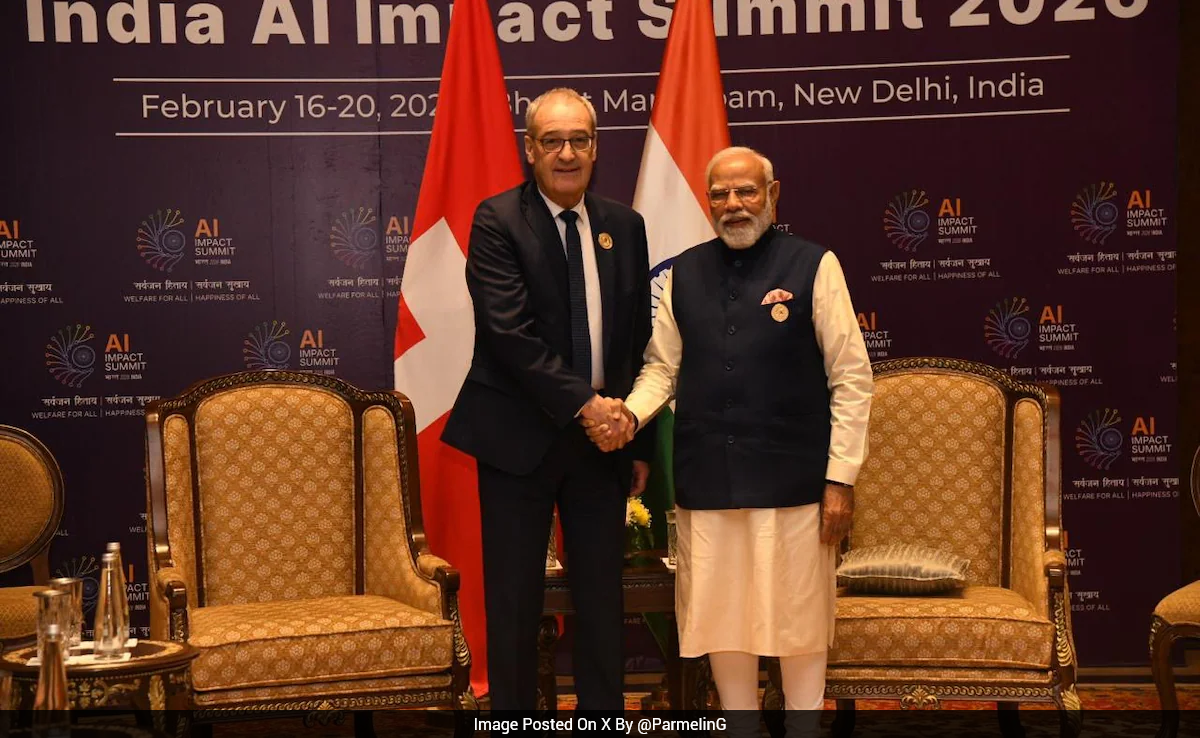
In an exclusive interview with NDTV, Switzerland's President Guy Parmelin extended his support for India's vision of an impactful artificial intelligence (AI) ecosystem. President Parmelin also spoke about the growing trade relations between India and Switzerland, and hoped for more collaborations between the two nations.
1. On the AI Impact Summit: India is positioning itself as a bridge between advanced economies and the Global South on AI governance. How does Switzerland view India's leadership role at this summit, and where do you see common ground with India on AI regulation and ethics?
Switzerland fully shares India's vision that all people in the world should have access to AI and be able to develop and use it for their social and economic benefit, so that no one is left behind. We therefore commend India for its leadership in this regard, and we fully support the objectives and outcomes of the AI Impact Summit. The summit has helped the international community identify key elements needed to achieve these goals, such as accessible and affordable AI, safe and trustworthy AI, inclusive empowerment, and education and reskilling for all.
2. On AI safety vs innovation: Switzerland is known for precision regulation and innovation-friendly policies. How do you strike a balance between AI safety and innovation, and should there be global red lines on AI misuse?
Switzerland is basing its AI governance on the recently established first internationally binding treaty on AI: the Council of Europe's Framework Convention on Artificial Intelligence. This global instrument, negotiated among 55 countries two years ago, sets out principles to ensure that AI fosters innovation while respecting fundamental freedoms, democracy and the rule of law. It defines clear objectives for states, while giving countries considerable flexibility in choosing the instruments they use to regulate private-sector actors.
The Swiss approach to fulfilling these obligations is to rely on sector-specific and industry-driven solutions, wherever possible, and to adapt or introduce legislation only where necessary. In this way, we aim to develop a dynamic and agile governance logic suited to a fast-evolving technology. We would encourage our Indian colleagues to consider engaging in the Council of Europe's work, as this would be mutually beneficial.
3. On India-Switzerland technology ties: India and Switzerland already collaborate in pharmaceuticals, engineering and research. How can this partnership expand into AI, quantum computing and advanced manufacturing?
Collaboration between our two countries is growing across multiple sectors. With the recently concluded free trade agreement between our states, we are confident that this cooperation will increase further. In AI, quantum technologies and advanced manufacturing, cooperation is already expanding. At the same time, we are only at the beginning of what promises to be a very productive joint endeavour. We look forward to sitting together and exploring possible avenues for deeper collaboration.
4. On global fragmentation in AI rules: With the EU, US and China all pursuing different AI regulatory paths, is the world at risk of fragmented AI governance-and can countries like India and Switzerland help build consensus?
Yes, we believe that countries like ours can play a constructive role in creating spaces for dialogue on shared global goals for AI governance. We are already doing so in various fora, including the summits in New Delhi and Geneva, as well as in the UN-led dialogue on AI, which will also take place in Geneva this July.
We also participate in relevant specialised UN agencies such as UNESCO and the ITU, and in initiatives such as the Global Partnership on AI (GPAI), where India has long been active and Switzerland is now a member. In addition, work is under way on technical standards, soft law and other instruments that may not fully harmonise global AI governance, but can make national approaches more interoperable.
5. On economic cooperation and trade: India is negotiating trade agreements with several global partners. Do you see scope for a deeper India-EFTA or India-Switzerland trade framework that prioritises technology and innovation?
Switzerland and its EFTA partners are following India's efforts to expand its network of trade agreements with great interest. The EFTA-India Trade and Economic Partnership Agreement (TEPA) has been in force for only a few months, so it is still too early to consider further deepening. In our view, the agreement already creates a favourable framework for trade and investment, including in technology and innovation.
6. On geopolitics and neutrality in the AI age: Switzerland's tradition of neutrality gives it a unique global voice. In an era where AI is becoming a strategic and security tool, how can neutral countries contribute to global stability and responsible AI use?
In Switzerland, we continue to believe that it is both possible and necessary to find better ways for all people to live and work together peacefully and respectfully. Any new technology, including AI, can bring people closer together or deepen existing divides.
In times of geopolitical tensions and mistrust, it is important that there are actors willing to build bridges and demonstrate that it is better for us all to compete within agreed boundaries and shared rules than to work against one another. We also believe that, despite conflicts and divergent views, there are areas where all countries have a common interest in strengthening stability, security and trust, which are fundamental to our economies. Let us therefore work together to identify and build on this shared ground. The future of our digital societies is not yet written - it will be shaped by the decisions we make today.
Track Latest News Live on NDTV.com and get news updates from India and around the world


