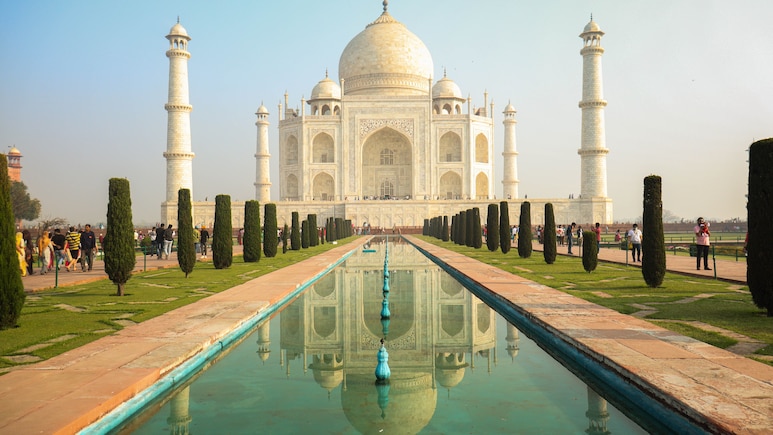
From the snow-capped Himalayas and royal palaces of Rajasthan to Kerala's backwaters and Goa's beaches, India continues to attract millions of travellers each year. For many international visitors, the journey begins long before boarding a flight, with the visa application process.
To make travel easier and more accessible, India introduced its e-Visa programme in 2014, allowing eligible foreign nationals to apply online without visiting an embassy or consulate. The scheme has expanded significantly over the years and now covers travellers from 172 countries.
Recently, the Government of India also increased the number of approved entry points for e-Visa holders, further simplifying arrivals into the country.
India Expands Entry Points For E-Visa Holders
According to the Ministry of Home Affairs (MHA), India has added 11 more international ports through which e-Visa holders can enter the country. These include two airports and nine land ports, among them the Attari border crossing in Punjab along the India-Pakistan border.
- New 9 land ports: Darranga, Gede, Ghojadanga, Haridaspur, Jaigaon, Dawki, Moreh, and Attari (Road)
- New 2 airports: Bhopal and Tirupati
With the latest expansion, e-Visa holders can now enter India through a total of 88 designated immigration checkpoints. These comprise 37 airports, 38 seaports and 13 land ports.
Also Read: Attari Border Reopens For E-Visa Holders: What Travellers Need To Know
Benefit Of E-Visa
The facility allows eligible visitors to apply online, upload documents electronically and receive travel authorisation via email before departure.
Who Can Apply For An Indian E-Visa?
Indian e-Visas are available under the following categories:
- e-Tourist Visa
- e-Business Visa
- e-Medical Visa
- e-Medical Attendant Visa
- e-Student Visa
- e-Family Visa
- e-Transit Visa
- e-Miscellaneous Visa
Citizens of countries including the United Kingdom, United States, Australia, Canada, France, Germany, Japan, Singapore, UAE, New Zealand, South Africa and many others are eligible to apply. The complete list of eligible countries is available on the official Indian e-Visa portal.
What Purposes Of Travel Are Allowed?
According to the official guidelines, travellers may apply for an e-Visa if their visit is for purposes such as:
- Tourism, recreation and sightseeing
- Visiting friends and relatives
- Short-term yoga programmes and non-formal courses in areas such as music, local languages, dance, arts, crafts and cooking
- Short-term voluntary work of up to one month without payment
- Medical treatment, including traditional Indian systems of medicine
- Accompanying an e-Medical Visa holder
- Business activities
- Conferences, seminars and workshops
Eligibility Requirements
Before applying, travellers should ensure they meet the following conditions:
- Their passport must be valid for at least six months from the date of application.
- They must possess a return or onward travel ticket.
- They should have sufficient funds to support their stay in India.
- Each traveller must hold an individual passport.
- Diplomatic and official passport holders are not eligible for the e-Visa facility.
- Pakistani passport holders and persons of Pakistani origin must apply for a regular visa through an Indian mission.
How To Apply For An Indian E-Visa
The application process is entirely online and typically involves four steps:
Step 1: Complete The Online Application
Applicants must fill out the online form and upload a recent photograph along with the passport information page.
Step 2: Pay The Fee
Payment can be made online using a credit card, debit card or payment wallet.
Step 3: Receive Electronic Travel Authorisation
Once approved, the Electronic Travel Authorisation (ETA) is sent to the applicant's registered email address.
Step 4: Travel To India
Travellers should carry a printed copy of the ETA and present it at the designated immigration checkpoint, where the e-Visa will be stamped on the passport.
Documents Required
Applicants must upload:
- A recent front-facing colour photograph with a white background.
- The passport biographical page containing personal details such as name, nationality, date of birth and passport validity.
- Depending on the visa category selected, additional supporting documents may also be required.
Authorities note that applications may be rejected if photographs or documents are unclear or do not meet the prescribed specifications.
How Much Does An Indian E-Visa Cost?
The e-Visa fee varies depending on the applicant's nationality and the visa category. In addition to the applicable fee, a bank transaction charge of 3% is levied.
Applicants should pay the fee at least four days before their intended travel date, as applications will not be processed without successful payment. The Government of India states that all e-Visa fees are non-refundable.
Important Advisory For Travellers
The Government of India has clarified that there is no emergency or express processing fee for e-Visas. Travellers are advised to be cautious of websites or agents claiming to offer faster approvals for additional charges.
Authorities also recommend using only the official e-Visa portal and avoiding unauthorised websites that request personal information.
Where To Apply
Applications can be submitted through the official Indian e-Visa website: https://indianvisaonline.gov.in/evisa/
For immigration-related information, travellers can also refer to the Bureau of Immigration website: https://boi.gov.in
Track Latest News Live on NDTV.com and get news updates from India and around the world


