Early Universe Galaxies
-
{
- All
- News
- Videos
-
Indian Scientist Discovers 12.6-Billion-Year-Old City of Galaxies', Names It After Manipur's Loktak Lake
- Tuesday May 26, 2026
- Science | Edited by Nikhil Pandey
A major international astronomy study led by an Indian scientist has discovered a massive structure of young galaxies in the early universe, naming it after a famous lake in Manipur.
-
www.ndtv.com
-
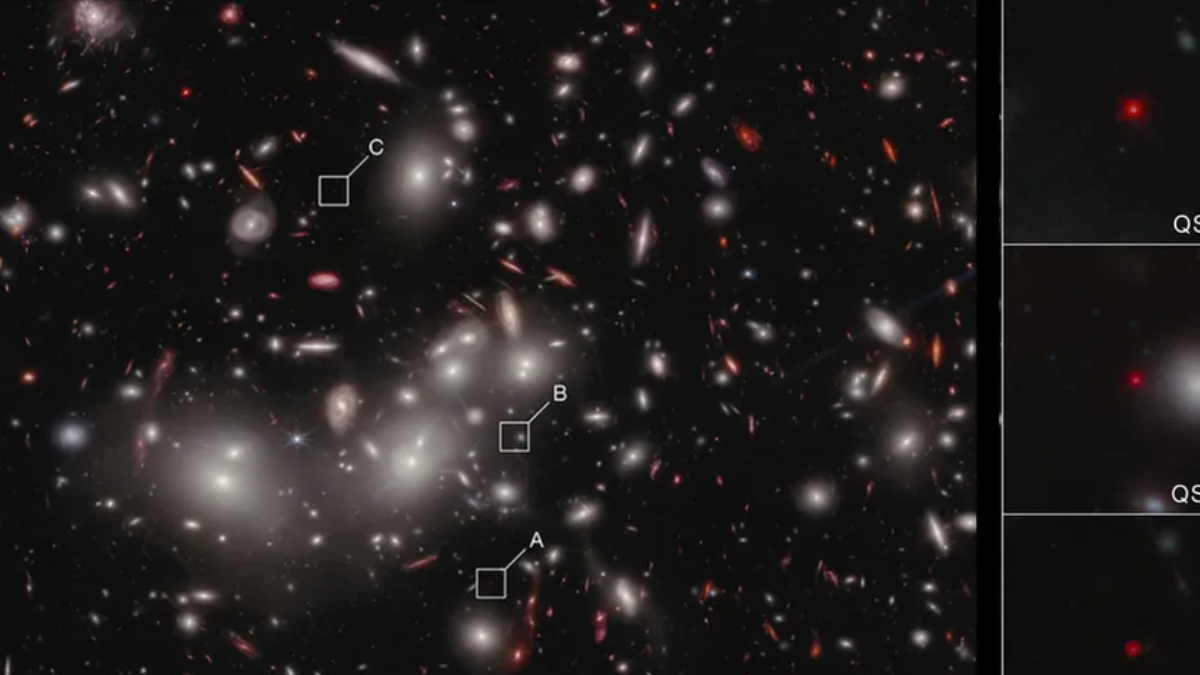
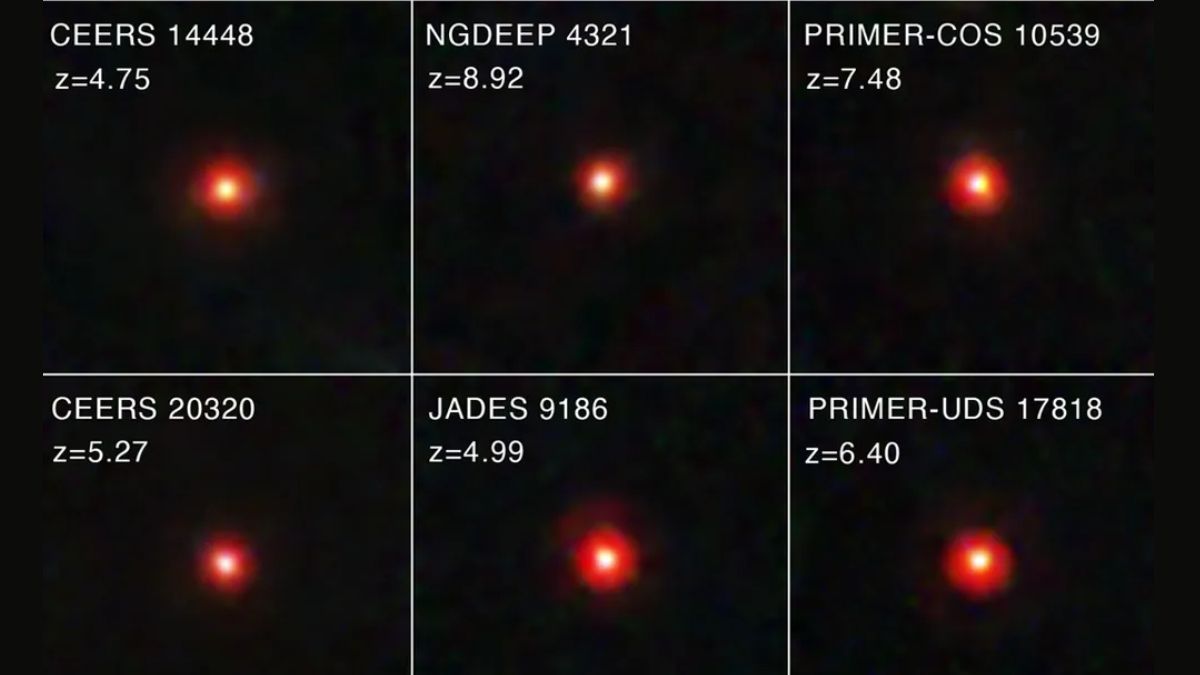
James Webb Space Telescope Little Red Dots May Reveal Birth of Black Holes
- Saturday May 2, 2026
- Reported by Gadgets 360 Staff, Written by Gadgets 360 Staff, Edited by Gadgets 360 Staff
These Tiny Red Objects Could Be How Black Holes Are Born
-
www.gadgets360.com
-
Scientists Just Created the Largest 3D Map of the Universe Ever to Study Dark Energy
- Friday April 17, 2026
- Written by Gadgets 360 Staff
The Dark Energy Spectroscopic Instrument has created the largest 3D map of the Universe, charting millions of galaxies. Early results suggest dark energy may evolve over time, challenging long-held cosmological theories.
-
www.gadgets360.com
-
Andromeda XXXVI Discovery Sheds Light on Dark Matter Rich Dwarf Galaxies
- Thursday April 9, 2026
- Written by Gadgets 360 Staff
Astronomers have discovered Andromeda XXXVI, an ultra-faint, dark matter-rich satellite of Andromeda Galaxy. This ancient system may be a fossil from the early universe, helping scientists study galaxy formation and dark matter.
-
www.gadgets360.com
-
Ancient Star in Pictor II Reveals Secrets of Early Universe
- Sunday March 22, 2026
- Written by Gadgets 360 Staff
Astronomers have discovered one of the oldest known stars, PicII-503, in the Pictor II dwarf galaxy. With extremely low iron content, the star offers rare insight into the second generation of stars and the early chemical evolution of the universe.
-
www.gadgets360.com
-
Astronomers Create the Largest 3D Map of the Early Universe’s Hydrogen Glow
- Saturday March 7, 2026
- Written by Gadgets 360 Staff
Astronomers created the largest 3D map of hydrogen emission from the early universe using data from the Hobby-Eberly Telescope Dark Energy Experiment. The map reveals large cosmic structures during the universe’s peak star-forming era about 9–11 billion years ago.
-
www.gadgets360.com
-
Scientists Identify Rare Black Hole Merger in the Early Universe Using Gravitational Mapping
- Monday February 16, 2026
- Written by Gadgets 360 Staff
Astronomers have identified two merging supermassive black hole systems named Gondor and Rohan using a new method combining quasars and gravitational wave background signals. The discovery offers a fresh way to map black hole mergers and understand galaxy evolution and cosmic gravitational waves in a clearer and more systematic manner.
-
www.gadgets360.com
-
James Webb Telescope Finds Galaxies Nearly as Old as the Early Universe
- Wednesday February 11, 2026
- Written by Gadgets 360 Staff
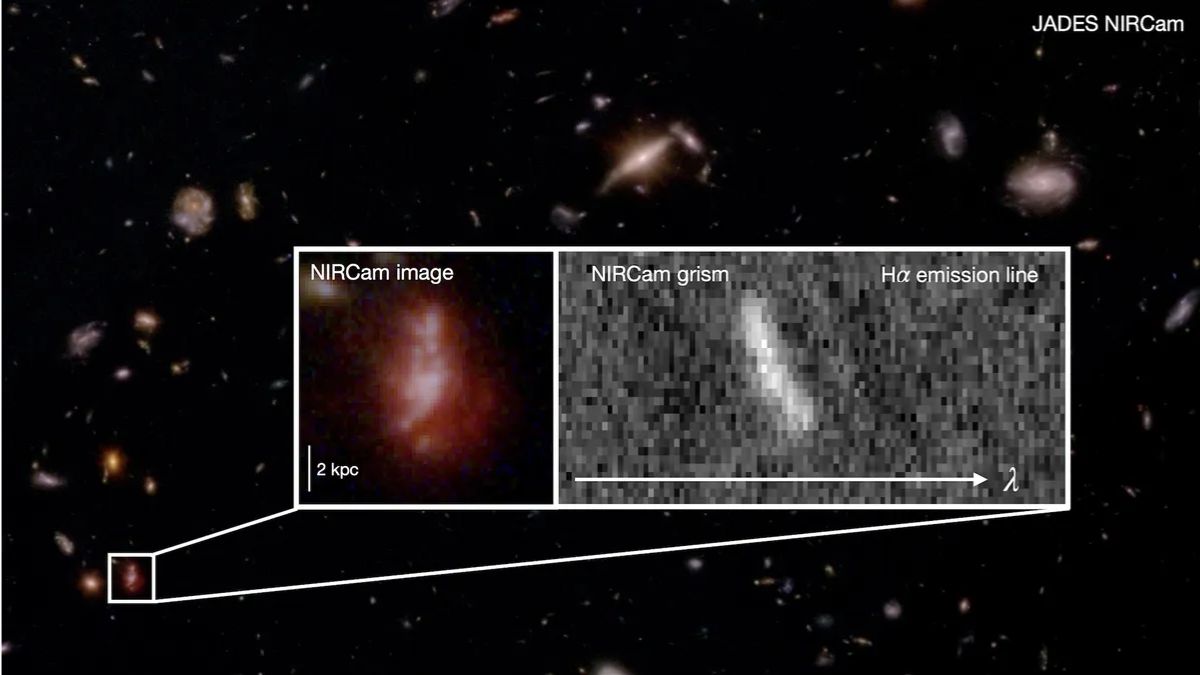
NASA’s James Webb Space Telescope has revealed early galaxies that appear almost as old as the universe itself. By analyzing 31 galaxies at high redshift, researchers estimated stellar ages of around 600 million years—close to the universe’s age at that epoch. One galaxy may even seem older than the universe, posing a potential challenge to t...
-
www.gadgets360.com
-
Dark Matter May Not Exist, Study Suggests Gravity Works Differently at Cosmic Scales
- Monday February 9, 2026
- Written by Gadgets 360 Staff
A new theoretical study suggests dark matter may not exist, proposing instead that gravity behaves differently across vast cosmic distances. By modifying how gravity weakens over scale, the research explains galaxy rotation and lensing effects without unseen particles, raising questions about long-standing cosmological models and inviting a fresh l...
-
www.gadgets360.com
-
James Webb Space Telescope Finds Most Distant Galaxy Ever Detected
- Sunday February 8, 2026
- Written by Gadgets 360 Staff
The James Webb Space Telescope has discovered MoM-z14, the most distant galaxy ever observed, dating to just 280 million years after the Big Bang. The galaxy’s brightness, chemical richness, and structure challenge existing theories of early cosmic evolution. Scientists say the finding highlights a growing gap between models and observations of t...
-
www.gadgets360.com
-
JWST Uncovers the Origins of the Universe’s First Supermassive Black Holes
- Sunday February 1, 2026
- Written by Gadgets 360 Staff
James Webb Space Telescope observations reveal that the earliest supermassive black holes formed from massive gas clouds collapsing directly into heavy seeds. This process bypassed normal star formation, allowing black holes to reach millions of solar masses within just 200–500 million years after the Big Bang, solving a long-standing cosmic myst...
-
www.gadgets360.com
-
James Webb Space Telescope Spots Most Distant Galaxy That Existed 280 Million Years After Big Bang
- Thursday January 29, 2026
- Science | Edited by Srishti Singh Sisodia
MoM-z14's light has travelled over 13.5 billion years to reach Earth, the scientists have revealed.
-
www.ndtv.com
-
NASA’s JWST Uncovers a ‘Feeding Frenzy’ That Births Supermassive Black Holes
- Saturday January 24, 2026
- Written by Gadgets 360 Staff
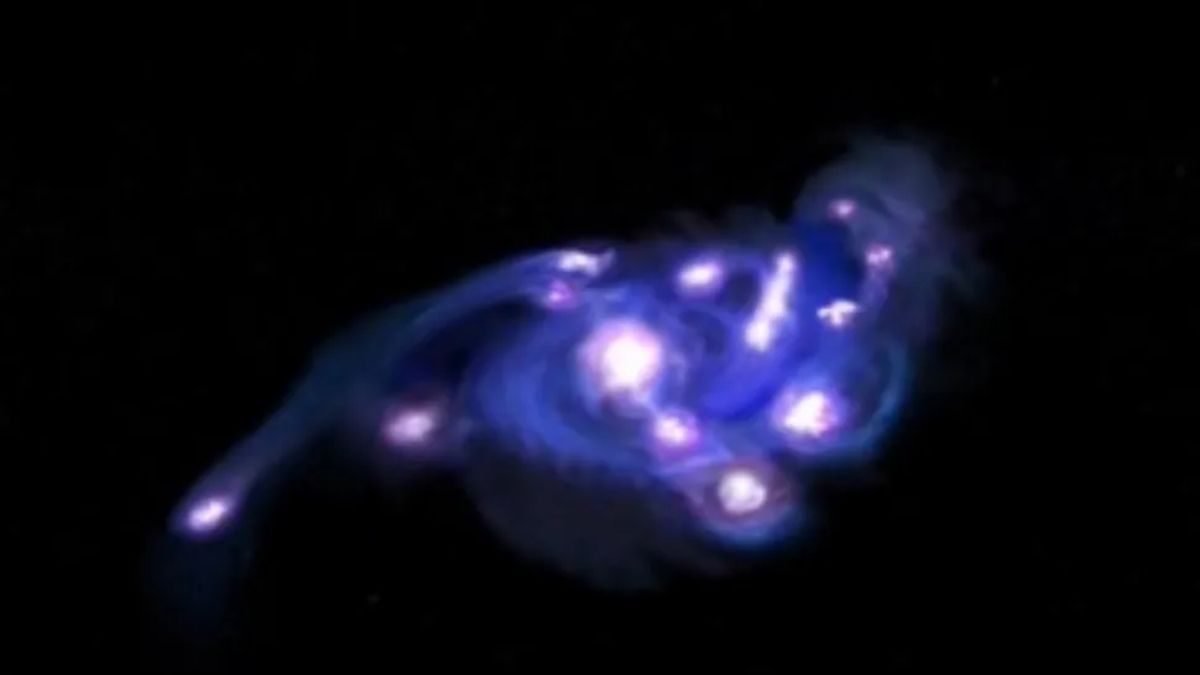
Astronomers may have solved how supermassive black holes formed so soon after the Big Bang. New simulations show that gas-rich, turbulent early galaxies allowed brief super-Eddington feeding bursts, enabling ordinary stellar-mass black holes to grow rapidly into the giants seen by JWST.
-
www.gadgets360.com
-
Hypothetical ‘Dark Stars’ Could Rewrite Early Cosmic History, Research Suggests
- Friday January 16, 2026
- Written by Gadgets 360 Staff
Hypothetical dark stars could explain three early universe mysteries: the abundance of supermassive black holes, dense blue monster galaxies, and compact little red dots. Powered by dark matter rather than fusion, these stars may have formed before normal stars, collapsing to create black hole seeds and influencing early galaxy observations, accord...
-
www.gadgets360.com
-
NASA's James Webb Space Telescope Might Have Spotted Hidden Supermassive Black Holes
- Friday January 16, 2026
- Written by Gadgets 360 Staff
Mysterious “little red dots” spotted by the James Webb Space Telescope may not be tiny galaxies after all. A new study suggests they are supermassive black holes wrapped in dense gas and dust, perfectly disguised in the early universe and shining intensely in infrared light.
-
www.gadgets360.com
-
Indian Scientist Discovers 12.6-Billion-Year-Old City of Galaxies', Names It After Manipur's Loktak Lake
- Tuesday May 26, 2026
- Science | Edited by Nikhil Pandey
A major international astronomy study led by an Indian scientist has discovered a massive structure of young galaxies in the early universe, naming it after a famous lake in Manipur.
-
www.ndtv.com
-
James Webb Space Telescope Little Red Dots May Reveal Birth of Black Holes
- Saturday May 2, 2026
- Reported by Gadgets 360 Staff, Written by Gadgets 360 Staff, Edited by Gadgets 360 Staff
These Tiny Red Objects Could Be How Black Holes Are Born
-
www.gadgets360.com
-
Scientists Just Created the Largest 3D Map of the Universe Ever to Study Dark Energy
- Friday April 17, 2026
- Written by Gadgets 360 Staff
The Dark Energy Spectroscopic Instrument has created the largest 3D map of the Universe, charting millions of galaxies. Early results suggest dark energy may evolve over time, challenging long-held cosmological theories.
-
www.gadgets360.com
-
Andromeda XXXVI Discovery Sheds Light on Dark Matter Rich Dwarf Galaxies
- Thursday April 9, 2026
- Written by Gadgets 360 Staff
Astronomers have discovered Andromeda XXXVI, an ultra-faint, dark matter-rich satellite of Andromeda Galaxy. This ancient system may be a fossil from the early universe, helping scientists study galaxy formation and dark matter.
-
www.gadgets360.com
-
Ancient Star in Pictor II Reveals Secrets of Early Universe
- Sunday March 22, 2026
- Written by Gadgets 360 Staff
Astronomers have discovered one of the oldest known stars, PicII-503, in the Pictor II dwarf galaxy. With extremely low iron content, the star offers rare insight into the second generation of stars and the early chemical evolution of the universe.
-
www.gadgets360.com
-
Astronomers Create the Largest 3D Map of the Early Universe’s Hydrogen Glow
- Saturday March 7, 2026
- Written by Gadgets 360 Staff
Astronomers created the largest 3D map of hydrogen emission from the early universe using data from the Hobby-Eberly Telescope Dark Energy Experiment. The map reveals large cosmic structures during the universe’s peak star-forming era about 9–11 billion years ago.
-
www.gadgets360.com
-
Scientists Identify Rare Black Hole Merger in the Early Universe Using Gravitational Mapping
- Monday February 16, 2026
- Written by Gadgets 360 Staff
Astronomers have identified two merging supermassive black hole systems named Gondor and Rohan using a new method combining quasars and gravitational wave background signals. The discovery offers a fresh way to map black hole mergers and understand galaxy evolution and cosmic gravitational waves in a clearer and more systematic manner.
-
www.gadgets360.com
-
James Webb Telescope Finds Galaxies Nearly as Old as the Early Universe
- Wednesday February 11, 2026
- Written by Gadgets 360 Staff
NASA’s James Webb Space Telescope has revealed early galaxies that appear almost as old as the universe itself. By analyzing 31 galaxies at high redshift, researchers estimated stellar ages of around 600 million years—close to the universe’s age at that epoch. One galaxy may even seem older than the universe, posing a potential challenge to t...
-
www.gadgets360.com
-
Dark Matter May Not Exist, Study Suggests Gravity Works Differently at Cosmic Scales
- Monday February 9, 2026
- Written by Gadgets 360 Staff
A new theoretical study suggests dark matter may not exist, proposing instead that gravity behaves differently across vast cosmic distances. By modifying how gravity weakens over scale, the research explains galaxy rotation and lensing effects without unseen particles, raising questions about long-standing cosmological models and inviting a fresh l...
-
www.gadgets360.com
-
James Webb Space Telescope Finds Most Distant Galaxy Ever Detected
- Sunday February 8, 2026
- Written by Gadgets 360 Staff
The James Webb Space Telescope has discovered MoM-z14, the most distant galaxy ever observed, dating to just 280 million years after the Big Bang. The galaxy’s brightness, chemical richness, and structure challenge existing theories of early cosmic evolution. Scientists say the finding highlights a growing gap between models and observations of t...
-
www.gadgets360.com
-
JWST Uncovers the Origins of the Universe’s First Supermassive Black Holes
- Sunday February 1, 2026
- Written by Gadgets 360 Staff
James Webb Space Telescope observations reveal that the earliest supermassive black holes formed from massive gas clouds collapsing directly into heavy seeds. This process bypassed normal star formation, allowing black holes to reach millions of solar masses within just 200–500 million years after the Big Bang, solving a long-standing cosmic myst...
-
www.gadgets360.com
-
James Webb Space Telescope Spots Most Distant Galaxy That Existed 280 Million Years After Big Bang
- Thursday January 29, 2026
- Science | Edited by Srishti Singh Sisodia
MoM-z14's light has travelled over 13.5 billion years to reach Earth, the scientists have revealed.
-
www.ndtv.com
-
NASA’s JWST Uncovers a ‘Feeding Frenzy’ That Births Supermassive Black Holes
- Saturday January 24, 2026
- Written by Gadgets 360 Staff
Astronomers may have solved how supermassive black holes formed so soon after the Big Bang. New simulations show that gas-rich, turbulent early galaxies allowed brief super-Eddington feeding bursts, enabling ordinary stellar-mass black holes to grow rapidly into the giants seen by JWST.
-
www.gadgets360.com
-
Hypothetical ‘Dark Stars’ Could Rewrite Early Cosmic History, Research Suggests
- Friday January 16, 2026
- Written by Gadgets 360 Staff
Hypothetical dark stars could explain three early universe mysteries: the abundance of supermassive black holes, dense blue monster galaxies, and compact little red dots. Powered by dark matter rather than fusion, these stars may have formed before normal stars, collapsing to create black hole seeds and influencing early galaxy observations, accord...
-
www.gadgets360.com
-
NASA's James Webb Space Telescope Might Have Spotted Hidden Supermassive Black Holes
- Friday January 16, 2026
- Written by Gadgets 360 Staff
Mysterious “little red dots” spotted by the James Webb Space Telescope may not be tiny galaxies after all. A new study suggests they are supermassive black holes wrapped in dense gas and dust, perfectly disguised in the early universe and shining intensely in infrared light.
-
www.gadgets360.com