





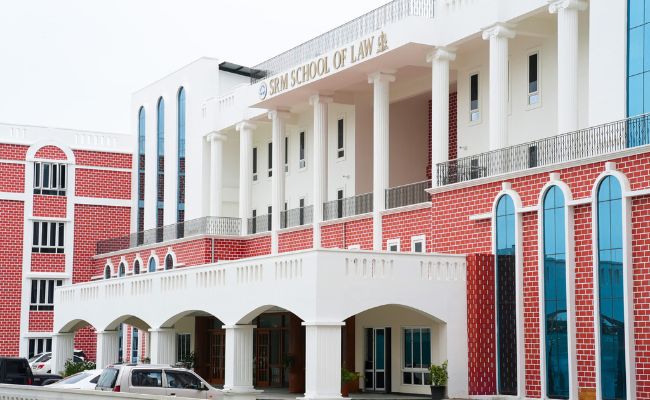
New Delhi: Lexposium 2025, organised in partnership with NDTV at SRM Institute of Science and Technology, brought together an esteemed assembly of legal experts, including former Supreme Court judges, leading advocates, and educators. The event provided a vibrant platform to discuss the future of law in India, covering key topics such as justice, legal reforms, accessibility, and the transformative role of technology in the nation's legal system.
Dr TR Paarivendhar, Chancellor of SRMIST, spoke of the university's four-decade legacy and the commitment of its relatively young School of Law to academic excellence. He highlighted the role of infrastructure, discipline, and quality in shaping the next generation of legal professionals. Dr P Satyanarayanan, Pro-Chancellor (Academics), described the law school as a “crucible for conscience,” where “law is not only learned, but lived.”
He urged students to pursue truth alongside legal victories and encouraged faculty to cultivate both sharp minds and wise souls. Retired Chief Justice of India, Justice NV Ramana, addressed the importance of bridging classroom learning with “grassroots realities,” He said,
"It should be our constant endeavour to bridge the gap between the constitution and the people."
He also emphasised hands-on exposure to prepare students for judicial service. He stressed that legal education should not only impart knowledge of the law but also awareness of societal responsibilities. Justice Dr Anita Sumanth of the Madras High Court spoke on “Justice Beyond the Courtroom,” highlighting accessibility, accountability, and affordability.
She pointed to alternative dispute resolution, virtual courts, and technology-enabled legal services as key tools for ensuring justice, and called for active citizen engagement to guarantee that no individual is denied access to legal remedies. Panel discussions examined challenges arising from technological advancements, including AI bias, safety risks, and capacity constraints within the judiciary.
Former Additional Solicitor General of India, Pinky Anand, highlighted a decade of legal reforms, from constitutional amendments to updates in criminal procedures, aimed at strengthening national integrity and improving access to justice. Supreme Court Justice Sanjay Kharol explored the intersection of law, technology, and ethics in his keynote on “Legal Evolution, AI, and Reforms for a Digital Era.” He urged law schools to cultivate ethical maturity alongside technical knowledge, emphasising access to justice, legal aid, pro bono work, and community outreach.
He also highlighted the potential of AI in law and the importance of equipping future lawyers with technological tools to navigate a rapidly evolving landscape. Lexposium 2025 showed how legal education and practice in India are changing. By combining technology, hands-on learning, and ethical training, it highlighted the role of law students and professionals as not just interpreters of law, but as advocates for justice and the public good. The event reinforced the goal of preparing jurists who can connect everyday realities with the principles of the Constitution.
Track Latest News Live on NDTV.com and get news updates from India and around the world

