





The war in the Middle East is snarling one of the world's most critical energy arteries, and the ripple effects are global. The Strait of Hormuz, the narrow passage between Iran and Oman, normally carries about 20 million barrels of oil per day, about one-fifth of global petroleum liquids consumption and over a quarter of seaborne oil trade.
India imports roughly 88 per cent of its crude. In normal times, about 2.5-2.7 million barrels per day of India's crude imports, close to half transit the Strait of Hormuz, largely from Iraq, Saudi Arabia, the UAE and Kuwait. Disruptions translate into higher delivered costs, potential delays, and heightened LPG and LNG vulnerability.
Recent weeks have seen Indian refiners pivot harder to Russian barrels to replace lost Gulf flows, with March arrivals estimated up about 50 per cent versus February, according to ship-tracking tallies.
Why Crude Disruptions Hit Everything From Petrol To Jet Fuel
Crude oil is a natural hydrocarbon liquid. On its own, it's not directly usable. However, refining it by using fractional distillation separates crude into fractions by boiling point (lighter molecules rise and condense higher in the column, heavier stay lower), which then become petrol (gasoline), diesel, jet fuel, LPG and more.
Each fuel is distilled at a different temperature range. Petrol is separated between 40 degrees Celsius and 205 degrees Celsius. Naphtha comes out between 60 degrees Celsius and 200 degrees Celsius. Kerosene, used for aviation and some household needs, comes out between 150 degrees Celsius and 300 degrees Celsius. Diesel is separated between 250 degrees Celsius and 350 degrees Celsius, and fuel oil between 300 degrees Celsius and 400 degrees Celsius. Lubricating oils need much higher temperatures, between 350 degrees Celsius and 600 degrees Celsius. What is left at the bottom after everything else is removed is bitumen, which is used for roads and roofing, and this comes out above 600 degrees Celsius.
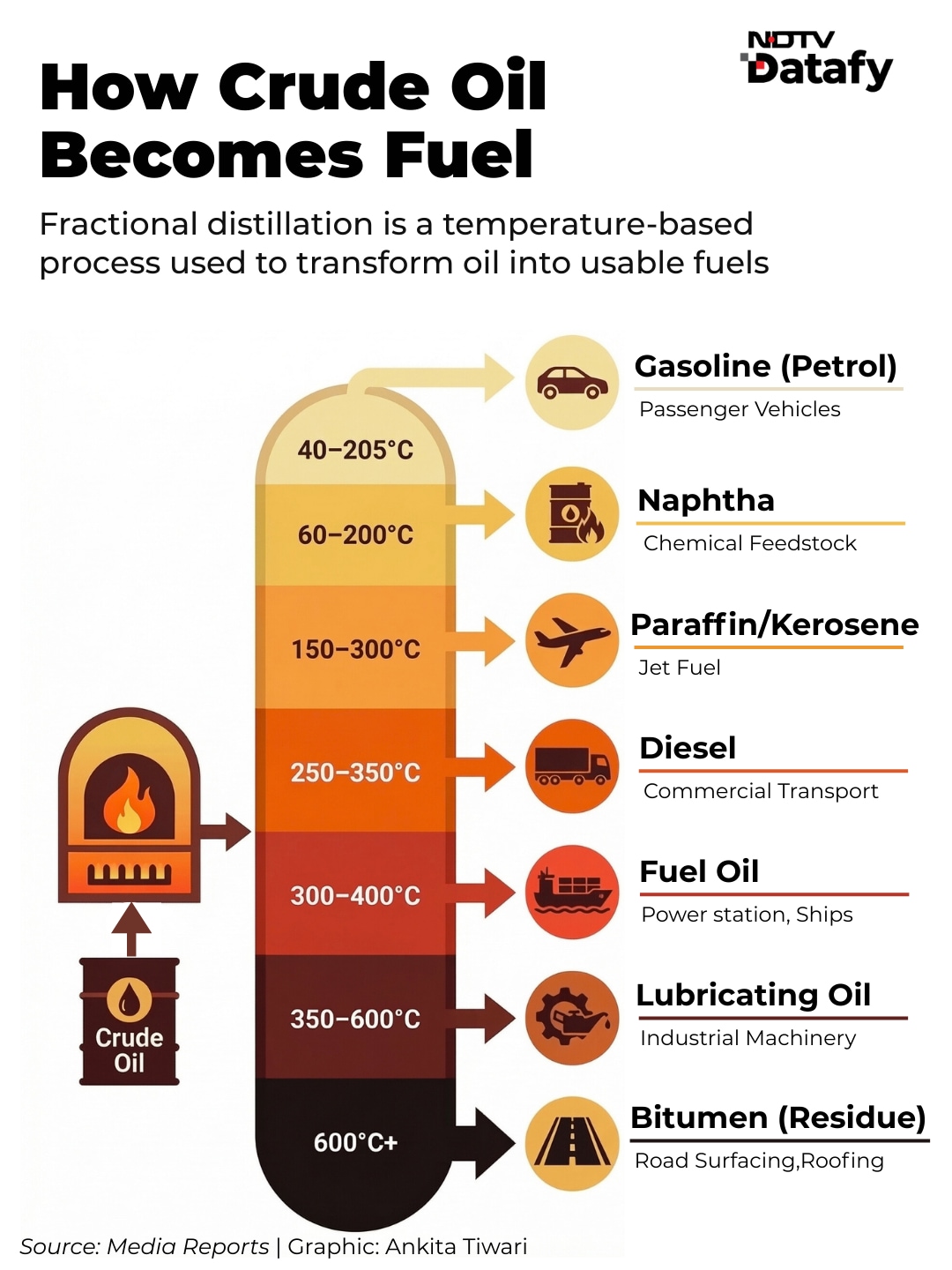
Because one crude stream feeds all these product slates, a chokepoint shock hits petrol, diesel, LPG and jet fuel at once, through both availability and price.
Not All Crudes Are Equal: Light vs Heavy, Sweet vs Sour
Crude varies globally as not all countries produce the same quality. Crude quality is framed by API gravity (light vs heavy) and sulfur (sweet vs sour). A common classification is: Light >31.1 degrees API; Medium 22.3-31.1 degrees; Heavy <22.3 degrees. Lighter, sweeter grades generally yield more petrol/diesel with less processing and command price premiums. Heavy crude gives more residue and needs more processing, so it is less valuable. API also affects colour: lighter crudes are usually clearer, while heavier crudes are darker.
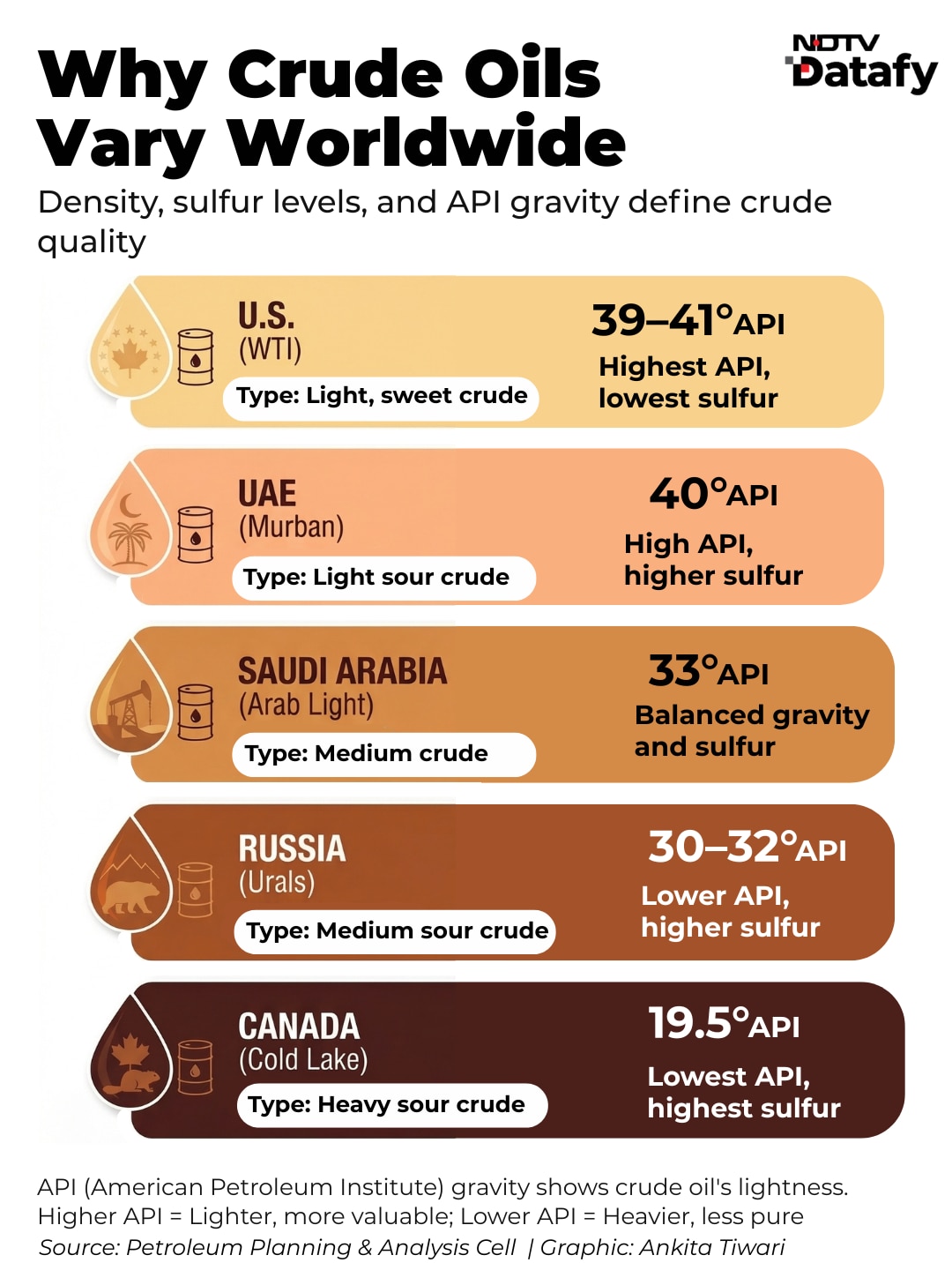
Different nations supply different grades. The U.S. produces WTI, a light sweet crude with API 39-41 degrees. Iran's Iran Light falls between 33 degrees and 36 degrees. Russia's Urals is a medium sour crude at 30-32 degrees. Saudi Arabia's Arab Light is around 33 degrees. Canada's Cold Lake crude is much heavier at about 19.5 degrees. Venezuela produces very heavy crude at around API 15-16 degrees. The UAE's Murban crude has an API of 40 degrees, and India's own Bombay High crude is a light sweet crude with an API of around 39-40 degrees.
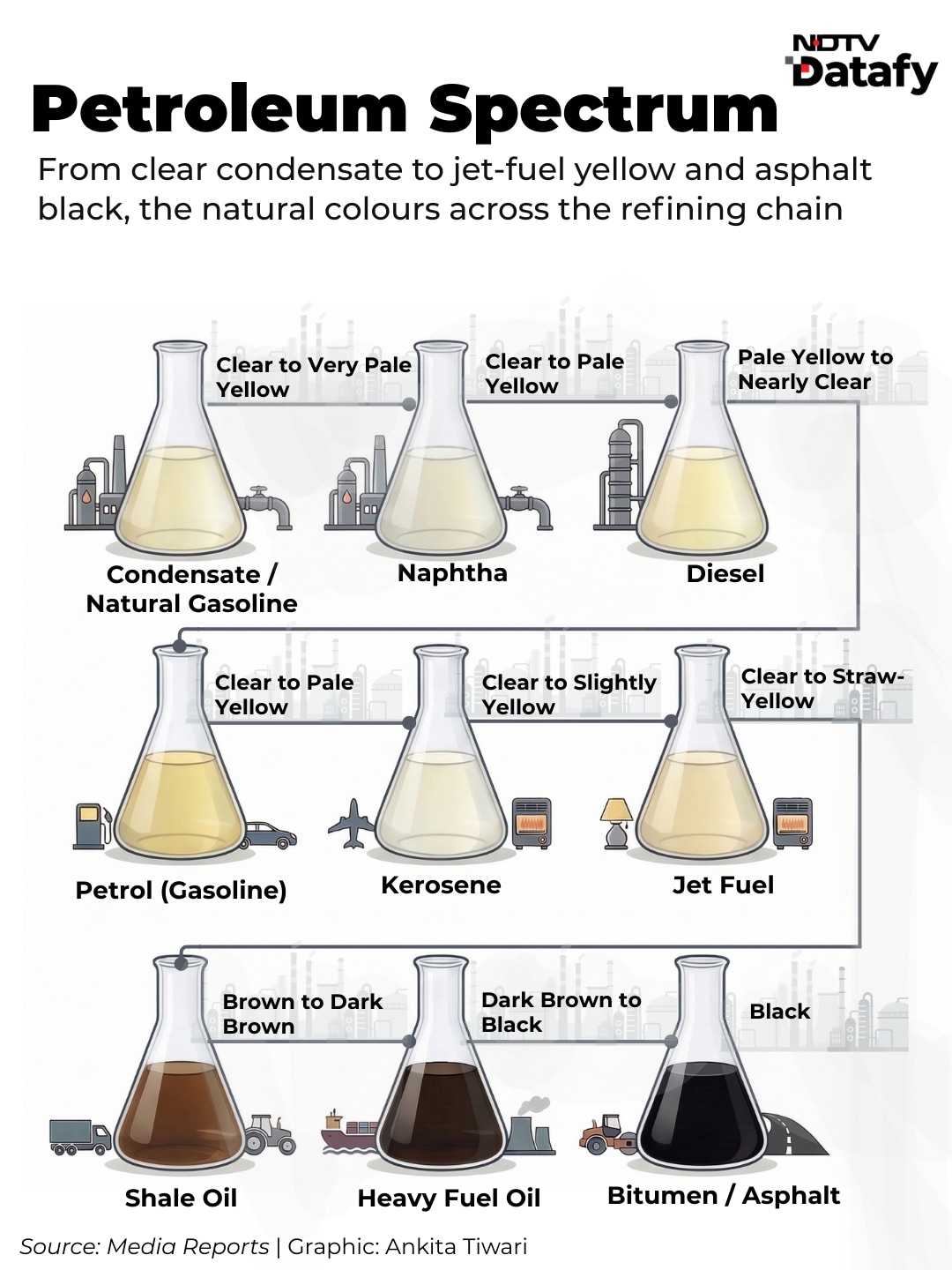
Crude types also look different in their natural form. Shale oil is brown to dark brown. LPG has no colour at all. Condensate is almost clear. Naphtha and petrol are pale yellow. Kerosene-based jet fuels (Jet A/Jet A-1) are clear to straw-coloured. However, blue dye is sometimes applied to Avgas 100LL (piston aviation gasoline) for preventing misfuelling. Kerosene is slightly yellow, sometimes with a blue marker. Diesel ranges from nearly clear to pale yellow. Heavy fuel oil is dark brown to black. Paraffin wax is white or colourless, and bitumen is pitch black.
India's Refinery Muscle
India runs 23 refineries with an installed capacity of about 258 million tonnes per year, dominated by PSUs but anchored by two giant private refineries at Jamnagar (Reliance) and Vadinar (Nayara).
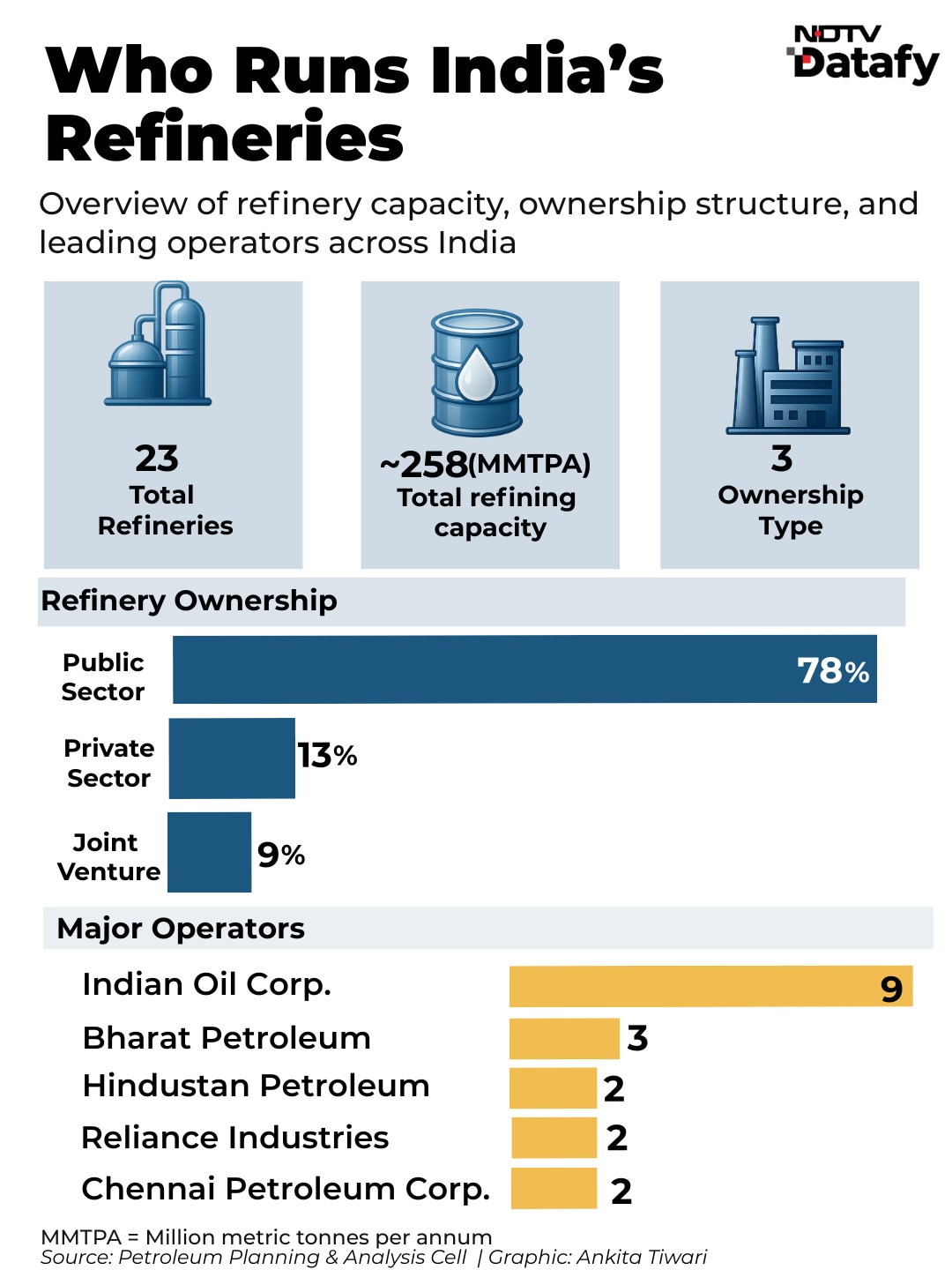
Indian Oil Corporation operates 9 refineries, Bharat Petroleum three, and Hindustan Petroleum two. Reliance runs two major refineries, including Jamnagar, one of the largest in the world. Other refinery operators include Chennai Petroleum, Numaligarh Refinery, Oil India, MRPL and Nayara Energy.
This widespread refinery network helps India manage risks, but disruptions in Middle East still matter because India depends heavily on imported crude.
Track Latest News Live on NDTV.com and get news updates from India and around the world

