




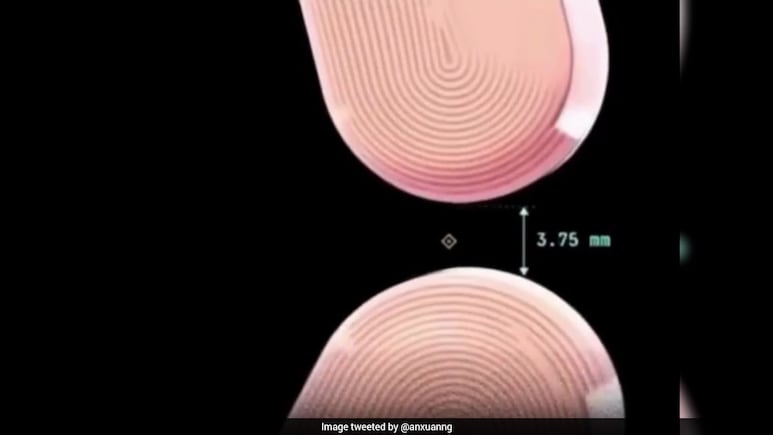
A father has found an interesting way to introduce his daughter to a complex concept in physics. He created an interactive app to explain Zeno's Paradox, a 2,400-year-old philosophical puzzle that questions how objects move and cover distances. The app uses 3D animations to demonstrate what happens when the distance between two fingers is repeatedly divided in half. According to the paradox, before reaching a destination, one must first cover half the distance, then half of what remains, and then half again. This process can theoretically continue forever, making it seem as though the destination can never be reached.
To make the concept easier for his daughter to understand, Japanese creator @kakouton2bro developed an interactive app that allows users to explore the idea themselves. The demonstration begins with a thumb and index finger separated by about 3 cm. With every tap, the distance between them is halved. The app gradually zooms in, moving from fingerprints to cells, keratin fibres and molecules before reaching the atomic scale.
After 27 halvings, the gap is reduced to just 0.332 nanometres. The creator also used Claude Opus 5.5 to help develop the app and shared the prompt used to build it.
Here's the prompt:
"I'd like an app that intuitively represents Zeno's paradox, created using 3D graphics with vectorized finger images and three.js. The gap between the index finger and thumb can be narrowed analogically using pinch-in and sliders, or digitally halved precisely using taps and buttons. The gap can then be enlarged by pinching out. Because the fingers are vectorized, a clear outline will initially appear, revealing a fingerprint. Further narrowing the gap, and then enlarging it with pinch-out and sliders, will reveal cells. The final stage should be at a scale where you can grasp a single atom. I'd like a cool UI using motion graphics, with a well-organized grid size and placement, and consideration of the golden ratio. Android and iOS, and Japanese/English language switching should be considered from the initial stages of development."
Fable 5.2 built a 3D film to explain Zeno's paradox and show why your fingers never really touch https://t.co/KYot5bSV43
— An Xuan (@anxuanng) November 10, 2026
What Is Zeno's Paradox?
First proposed by ancient Greek philosopher Zeno of Elea more than 2,400 years ago, the paradox argues that movement appears impossible because a person must always cover half the remaining distance before reaching a destination.
However, mathematics explains why this does not prevent movement. An infinite series of progressively smaller distances can add up to a finite total. This means an object can cover the entire distance in a finite amount of time.
Why Do Our Fingers Feel Solid?
The app also introduces another fascinating aspect of physics: what actually happens when two objects touch.
At the atomic level, the atoms in our fingers do not make contact in the way we commonly imagine. Instead, the electrons surrounding the atoms repel each other through electromagnetic forces.
This repulsion creates the sensation of touch and makes solid surfaces feel as though they are physically pressing against each other.
Track Latest News Live on NDTV.com and get news updates from India and around the world

