





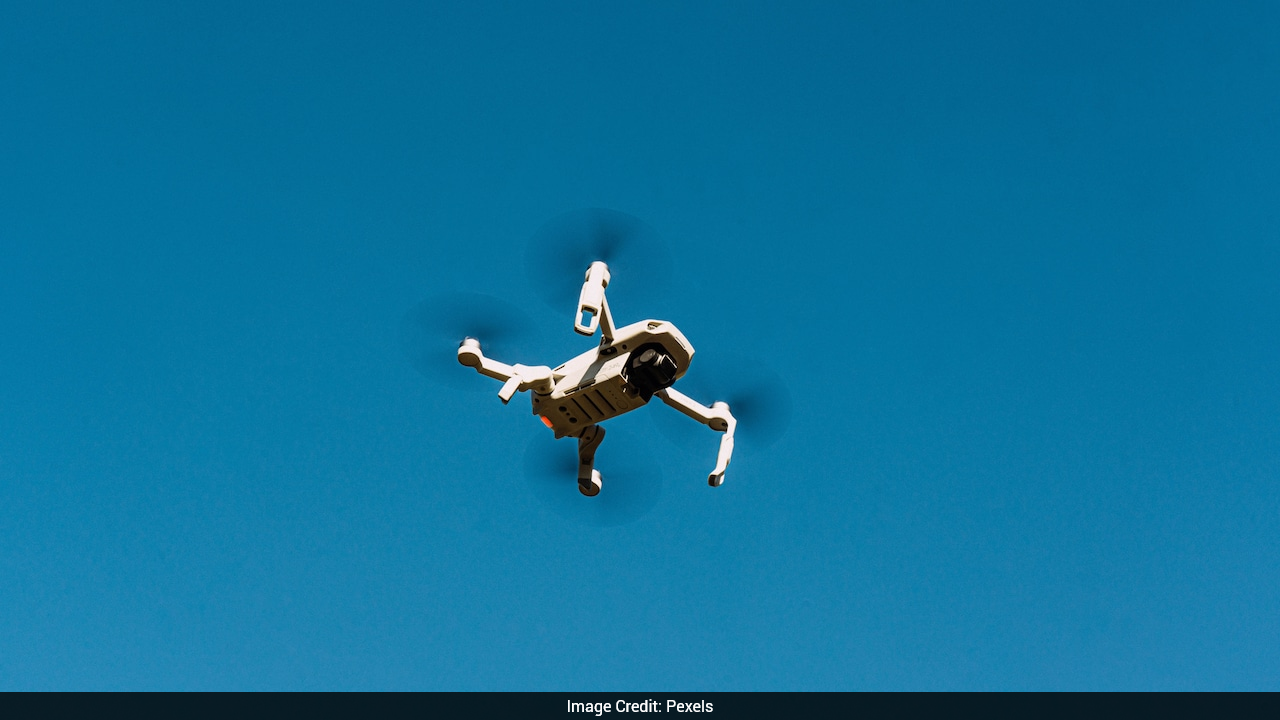
Researchers in Switzerland have found a new way to power tiny drones using sound. Scientists at the Swiss Federal Institute of Technology in Lausanne (EPFL) have invented small drones that use sound waves to move through the air and on water, reported Swiss Info.
The researchers achieved this by giving the tiny vehicles special hollow structures called "cavities". These cavities can turn sound into propulsion. The amount of thrust produced depends on the frequency of the sound.
The MicroBioRobotic Systems Laboratory (Microbs) at EPFL created circular or bell-shaped cavities. When sound waves make the air inside them vibrate, the moving air is pushed out as a concentrated jet. The air coming into the cavity is more spread out. This difference creates thrust that can push the tiny drones forward.
The researchers used a property called Helmholtz resonance. This is a phenomenon that can be understood by gently blowing across the opening of an empty bottle. The air trapped inside the bottle moves and produces a sound.
Microbs also built model boats that were about one centimetre long. These boats had up to three cavities, with each one set to a different frequency. By changing the frequency of sound from a loudspeaker, the researchers could activate different cavities. This allowed the boats to move in different directions, travel around obstacles and even follow programmed paths on their own. Similar experiments were also carried out with flying microdrones.
Since the devices use hollow cavities instead of motors, gears or magnetic parts, they can be made very small and light. In the future, several sound-sensitive structures could be placed in one flexible device.
Selman Sakar, director of the EPFL laboratory, said that this could allow specific parts of a device to move, bend or vibrate in response to different sound frequencies. He added that this could lead to aerodynamic robots that can change their shape when they hear sound.
The technique has also been used to levitate objects in the air using sound waves.
Track Latest News Live on NDTV.com and get news updates from India and around the world

