





- Vela pulsar wind nebula study reveals how particles accelerate at high speeds post-explosion
- IXPE captured first-ever X-ray polarization data, showing magnetic fields and particle jets
- High X-ray polarization suggests highly organized electromagnetic fields in the nebula
A new image and study are helping scientists better understand how some of the most energetic objects in space work. By examining the Vela pulsar wind nebula, researchers have gained fresh insights into how particles can be accelerated to extremely high speeds long after a star has exploded, reported NASA.
About 10,000 years ago, light from the explosion of a giant star in the Vela constellation reached Earth. The explosion left behind a dense object known as a pulsar. As the pulsar spins, it appears to brighten regularly like a cosmic lighthouse. Winds of particles emerge from its surface and travel at nearly the speed of light, creating a chaotic mix of charged particles and magnetic fields that collide with surrounding gas. This phenomenon is known as a pulsar wind nebula.
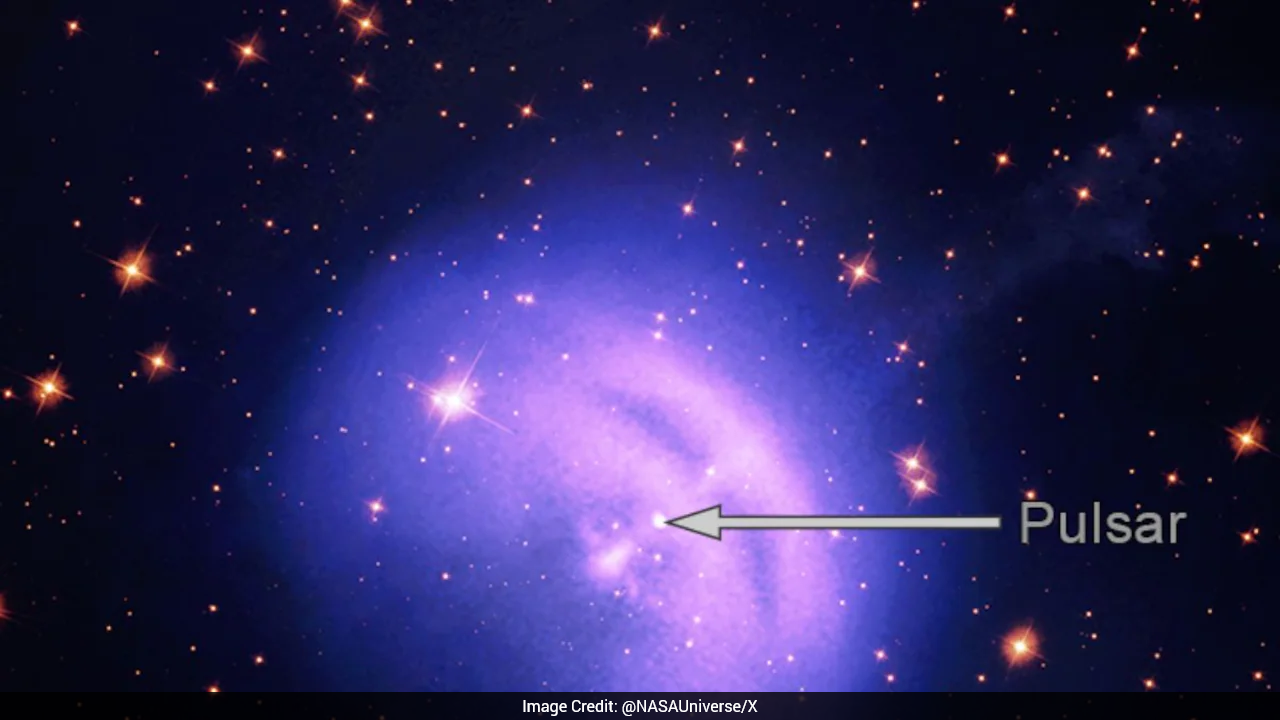
In a newly released image, a hazy light blue halo represents the first-ever X-ray polarisation data for Vela, collected by NASA's Imaging X-ray Polarimetry Explorer (IXPE). A faint blue fuzzy line extending toward the upper right corner shows a jet of high-energy particles being ejected from the pulsar at about half the speed of light. Pink X-ray arcs are believed to mark the edges of donut-shaped regions where the pulsar wind shocks and accelerates high-energy particles. The pulsar itself is shown by a white circle at the center of the image.
Pink and purple colours in the image come from data gathered by NASA's Chandra X-ray Observatory, while the golden stars were captured by NASA's Hubble Space Telescope.
Scientists say that measuring polarisation, which relates to how electromagnetic waves are organised, provides an unprecedented view of how a pulsar accelerates particles to very high speeds.
Phil Kaaret, senior scientist at NASA's Marshall Space Flight Center in Huntsville, Alabama, said that with IXPE, scientists are using extreme objects like Vela as a laboratory to investigate some of the most pressing questions in astrophysics, including how particles get catapulted to near the speed of light long after a star has exploded.
In a recent study, researchers were surprised by the high degree of polarization found in the X-rays from the Vela pulsar wind nebula. The IXPE observations were published in the journal Nature in December.
Fei Xie, lead author of the Nature study, professor at Guangxi University in Nanning, Guangxi, China, and formerly a postdoctoral researcher at Italy's National Institute for Astrophysics/Institute for Space Astrophysics and Planetology in Rome, said that this is the highest degree of polarization measured in a celestial X-ray source to date.
According to the researchers, high polarisation indicates that the electromagnetic fields are highly organised and aligned in specific directions depending on their location within the nebula. The X-rays detected by IXPE are produced by high-energy electrons spiraling through the pulsar wind nebula's magnetic fields, a process known as synchrotron emission. The high polarization of these X-rays suggests that the magnetic fields are also highly organized.
Alessandro Di Marco, a researcher at Italy's National Institute for Astrophysics who contributed to the data analysis, said that the IXPE X-ray polarisation measurement adds a missing piece to the Vela pulsar wind nebula puzzle. He added that by mapping the region with unprecedented resolution, IXPE reveals the magnetic field in the central area and shows agreement with results obtained from radio images of the outer nebula.
The Vela pulsar is located about 1,000 light-years from Earth. It measures about 15 miles (25 kilometres) in diameter and rotates 11 times every second, faster than a helicopter rotor.
Track Latest News Live on NDTV.com and get news updates from India and around the world

