





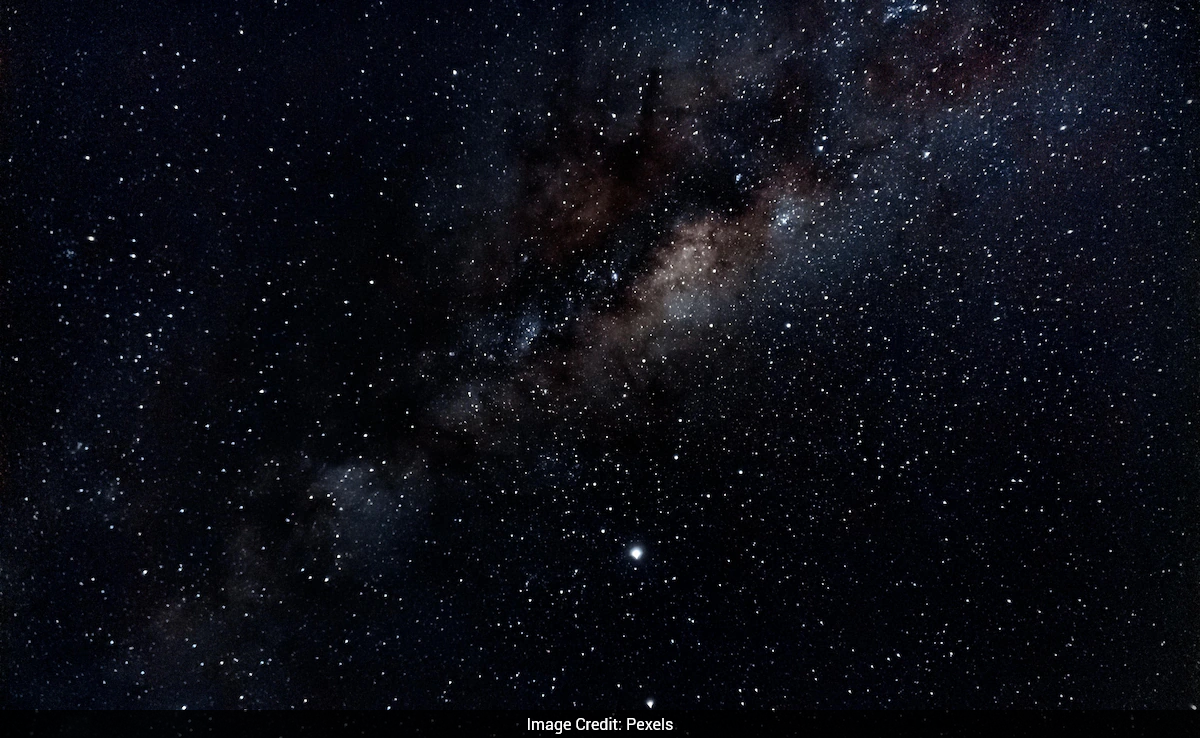
- Researchers suggest dark matter may have been indirectly observed in 2019 gravitational wave data
- Dark matter could leave an imprint on gravitational waves from black hole collisions
- Scientists compared 28 black hole merger signals, finding one possible dark matter indication
Dark matter has remained one of the biggest mysteries in science, but researchers now believe they may have seen a possible sign of it in data collected years ago, reported Daily Mail. A team of scientists has suggested that dark matter may have been indirectly observed in 2019 through the study of gravitational waves from colliding black holes. Although dark matter makes up about 85 per cent of the universe's matter, it cannot be directly seen with telescopes.
The researchers propose that dark matter could leave a subtle trace in the gravitational waves produced when black holes collide. If such collisions happen within a region filled with dark matter, the waves travelling through space may carry a distinct imprint of that environment.
In their new study, scientists reported that they identified such a possible imprint in data from a black hole collision recorded in 2019.
When two black holes orbit each other and eventually merge, they generate powerful gravitational waves. These waves travel across the universe, slightly stretching and compressing space, and can be detected by specialised instruments on Earth.
Dr Katy Clough explained that gravitational waves carry information about the event that created them, similar to how sound waves reflect the characteristics of a musical instrument. This means the signals could appear slightly different if the collision occurred in a region filled with dark matter instead of empty space.
What Scientists Found
To study this idea, researchers developed mathematical models to predict how gravitational waves would look under different conditions. They simulated black hole mergers in empty space and in regions containing dark matter.
These simulations were then compared with 28 recorded signals of black hole mergers detected by the LIGO-Virgo-KAGRA observatory network. Out of these, 27 matched collisions occurring in empty space. However, one signal showed a possible indication of a dark matter imprint.
Dr Katy Clough stated that the evidence found in the data is not strong enough to confirm what is being observed and that other possibilities must be checked. She added that it is an interesting hint that something might be happening, and if it is truly a signature of dark matter, it should appear again as more signals from black hole mergers are observed in the coming years.
Scientists emphasised that more observations and analysis are required before any confirmed detection of dark matter can be claimed. However, the new method could help researchers identify more such signals in the future.
Track Latest News Live on NDTV.com and get news updates from India and around the world

