





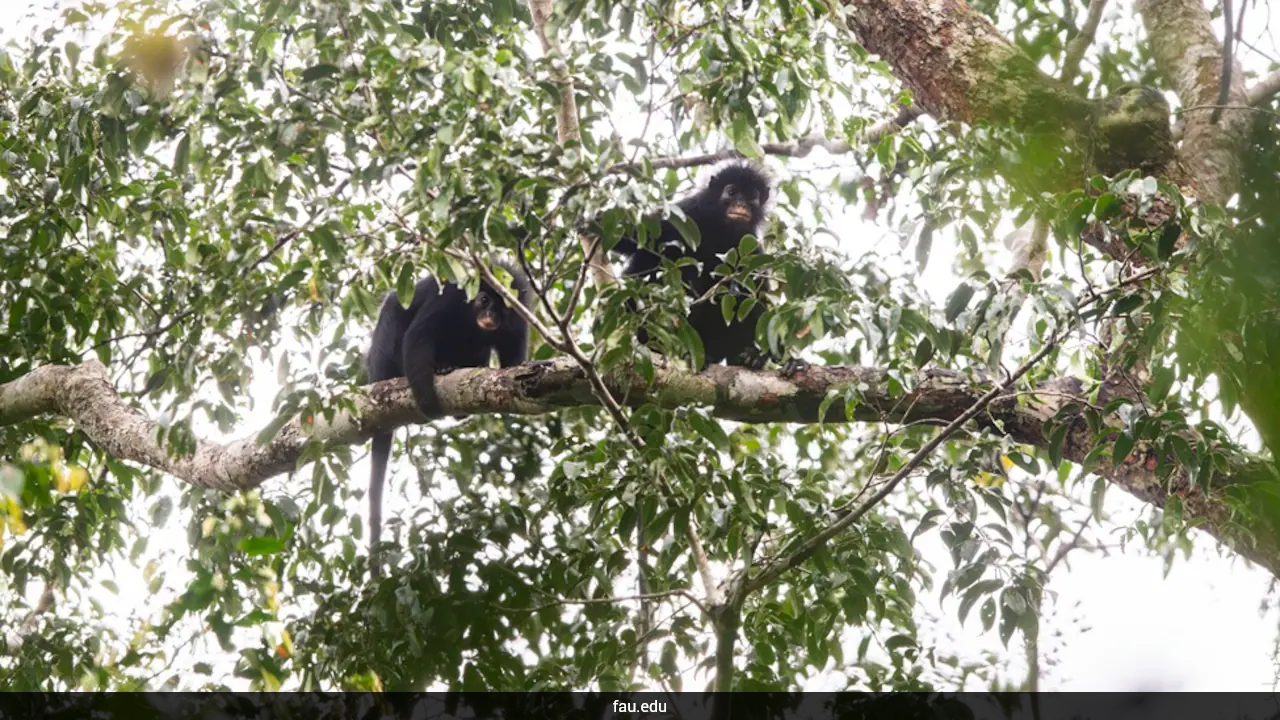
Scientists have found a brand new species of monkey living deep in the rainforests of the Democratic Republic of Congo (DRC). It is only the fifth new monkey species to be identified in Africa in the last 75 years, making the find one of the rarest events in modern primate science.
The monkey has been named Colobus congoensis. Locals call it "Likweli". It is mostly black, with a striking orange patch around its face, a long tail and glossy, light catching fur. Weighing around 15 pounds, it is smaller than its close relatives, and its large folded ears and pale markings near its tail make it easy to tell apart from other colobus monkeys.
The story of its discovery began back in 2008, when researchers took a blurry photograph of an unusual looking monkey in a remote part of the Congo Basin. It took another ten years before scientists managed to get a clear picture of the animal. That second sighting kicked off a much deeper investigation, involving genetic testing, skeleton comparisons and recordings of the monkey's calls.
The research, published in the journal PLOS One, was carried out by an international team, including scientists from Florida Atlantic University (FAU), the Lukuru Wildlife Research Foundation, Yale University, the City University of New York, Lomami National Park and the Frankfurt Zoological Society. The monkey was found in a remote stretch of forest between the Lomami and Congo rivers in east central DRC, an area already known for its rich wildlife.
Junior Amboko, a PhD student at FAU and a National Geographic Explorer, helped name the species and said the find was personal as well as scientific. He said it highlights "the extraordinary biodiversity of my homeland". Amboko believes Colobus congoensis may be the first primate ever named directly after the Democratic Republic of Congo.
John A. Hart, a conservation scientist with the Lukuru Wildlife Research Foundation and the lead author of the study, said the discovery shows there is still much to learn about the region. He explained that "entirely new species are still coming to light" even in places that scientists have studied for years.
Genetic testing turned up a surprising twist. The monkey's closest relative, Colobus satanas, lives more than 1,200 kilometres away in west central Africa. Yet the two species share a common ancestor from around four to five million years ago, one of the oldest splits ever recorded within the colobus family tree.
Kate Detwiler, an associate professor of biological sciences at FAU and the study's senior author, said the finding was changing how scientists understand monkey evolution across the continent. She warned that the discovery was also "a sobering reminder" that some rare animals could disappear before they are even known to science.
That warning is not just for effect. Between 2018 and 2022, researchers recorded only 114 sightings of the monkey, across a range of just 1,700 square kilometres, an unusually small territory for a colobus monkey. Rivers and forest barriers appear to have kept the species isolated, and it depends on scattered patches of upland forest to survive.
Because of its tiny range, small population, habitat loss and hunting pressure, researchers are recommending that Colobus congoensis be listed as Endangered on the IUCN Red List. Most of the monkey's known habitat sits inside Lomami National Park, which means protecting that park could be key to the species' survival.
For now, Colobus congoensis stands as fresh proof that the Congo Basin still holds secrets. As the research team put it, the region remains one of the last great frontiers on Earth for discovering new mammals.
Track Latest News Live on NDTV.com and get news updates from India and around the world

