





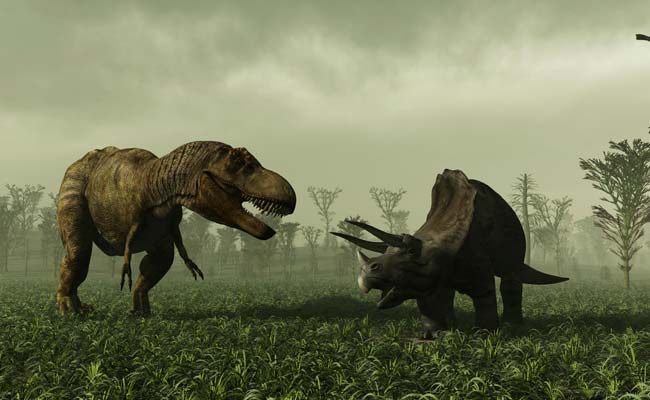
Scientists have determined the type of meteorite that wiped out the dinosaurs 66 million years ago, and found it was a rare CO chondrite, one of the most primitive and least common meteorites in the Solar System. The international team, led by researchers from the University of British Columbia (UBC), Paris, Brussels and Vienna, reached the conclusion after analysing nickel isotopes preserved in a thin layer of clay left behind by the Cretaceous-Paleogene impact. Their findings were published in Science Advances.
"Sixty-six million years ago, non-avian dinosaurs and other taxa went extinct during one of the largest mass extinctions in the history of life on Earth. The extinction was likely caused by an asteroid of unknown origin, responsible for the Chicxulub impact structure. Existing evidence identifies the impactor as an asteroid, similar to carbonaceous chondrites," the study notes.
Scientists have long known that a 10-kilometre-wide asteroid struck Earth's Yucatán Peninsula, creating the Chicxulub crater and triggering the extinction of around 75% of all species, including every non-avian dinosaur. The impact unleashed massive earthquakes and tsunamis, started wildfires and sent huge amounts of dust and gas into the atmosphere, blocking sunlight and causing a global climate collapse.
-

-
 NDTV World Summit 2026: What Nikhil Kamath Said On Inheritance Tax
-
 Not Another News Platform: What Nikhil Kamath Wants To Build Next
-
 'Groww Did Well': What Zerodha Co-Founder Nikhil Kamath Said On Rival
-
 Nikhil Kamath Tells NDTV One Thing India Can Learn From China At NDTV World Summit
-
 AI Can Be Intelligent Without Being Conscious: Swami Sarvapriyananda
-
 Groww vs Zerodha: Nikhil Kamath On Groww Overtaking Zerodha In Active Clients | Nikhil Kamath
-
 Nikhil Kamath On Marriage, Kids And Why He Avoids 'Certainty'
-
 What India Can Learn From China's AI Ecosystem: Nikhil Kamath Explains
-
 Can Code Be Conscious? Rethinking The Mind In The Age Of AI | Swami Sarvapriyananda Interview
-
 Nikhil Kamath On What Indian Entrepreneurs Can Learn From 'Tech Bros' In West
The new study identifies the impactor as a carbonaceous CO chondrite, a meteorite that makes up only about 5% of meteorites found on Earth. Researchers believe it likely originated from the outer asteroid belt near Jupiter or another debris-rich region of the outer Solar System.
The discovery also sheds new light on why the impact was so devastating. Since CO chondrites contain relatively little sulfur, researchers say the mass extinction was likely driven less by sulfur released from the asteroid and more by the enormous amount of fine debris blasted into the atmosphere, which blocked sunlight and disrupted Earth's climate for years.
"A CO contains much less volatile elements -- like carbon, zinc, water and particularly sulfur -- than other classes of meteorites we've discovered so far on Earth. It doesn't alter our theory of what caused the extinction event -- but it makes it less likely that sulfur contained in the impactor was the smoking gun. The fine debris thrown into the atmosphere would have the primary factor," the scientists explained.
Researchers say the finding highlights just how extraordinary the event was, with Earth being struck by one of the rarest types of meteorites known.
Track Latest News Live on NDTV.com and get news updates from India and around the world

