





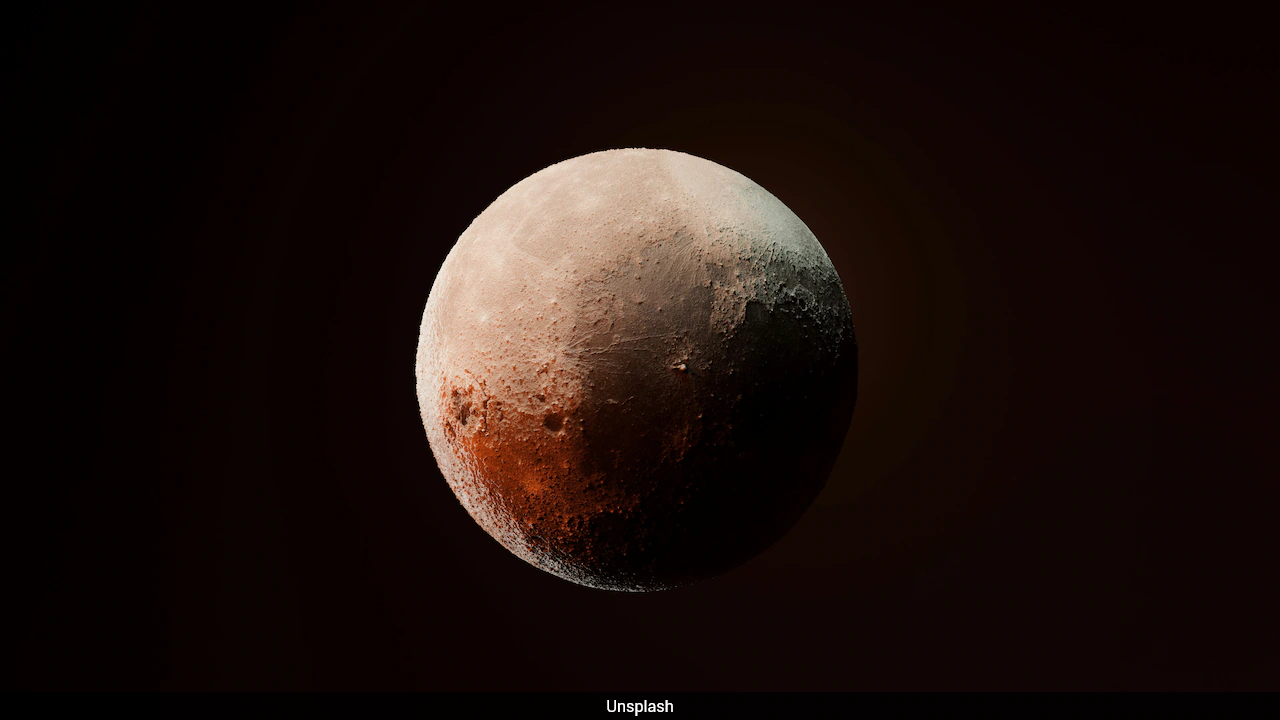
Astronomers have detected a mysterious chemical signature on the surfaces of Pluto and Titan, Saturn's largest moon, that does not match any known substance in existing scientific databases.The discovery was made using NASA's James Webb Space Telescope (JWST) and has left researchers searching for the identity of what could be a previously unknown compound or an unusual combination of known materials.
The findings have been accepted for publication in the journal Astronomy & Astrophysics.
The researchers found an unusual absorption band at a wavelength of 5.113 micrometres on both Pluto and Titan. The same signal was detected by two different instruments on the James Webb Space Telescope, allowing the team to rule out the possibility of an instrument error.
Scientists identify chemicals in distant worlds using spectroscopy, a technique that studies how molecules absorb light. Every chemical has its own unique light signature, much like a fingerprint. However, the newly detected signal did not match any known chemical recorded in spectroscopic databases.
The research team compared the signal with several organic compounds and frozen materials that could exist on Pluto and Titan, including acetylene, benzene, ketene and alenes. None proved to be a perfect match.
According to the researchers, the mysterious signature may belong to a known compound that behaves differently under the extreme conditions found on these icy worlds. Another possibility is that it comes from a material whose chemistry has not yet been identified.
The finding is particularly surprising because Pluto and Titan are very different worlds. Titan has a thick atmosphere rich in nitrogen and methane, along with lakes and rivers of liquid methane. Pluto, in contrast, has an extremely thin atmosphere and a frozen surface covered with nitrogen, methane and carbon monoxide ice.
Despite these differences, both worlds experience complex organic chemistry driven by sunlight and cosmic rays, which may explain why the same mysterious chemical signature appears on their surfaces.
The researchers say further laboratory experiments and additional observations with the James Webb Space Telescope will be needed to solve the mystery. They also hope NASA's Dragonfly mission, which will explore Titan, could help identify the unknown compound in the future.
Track Latest News Live on NDTV.com and get news updates from India and around the world

