





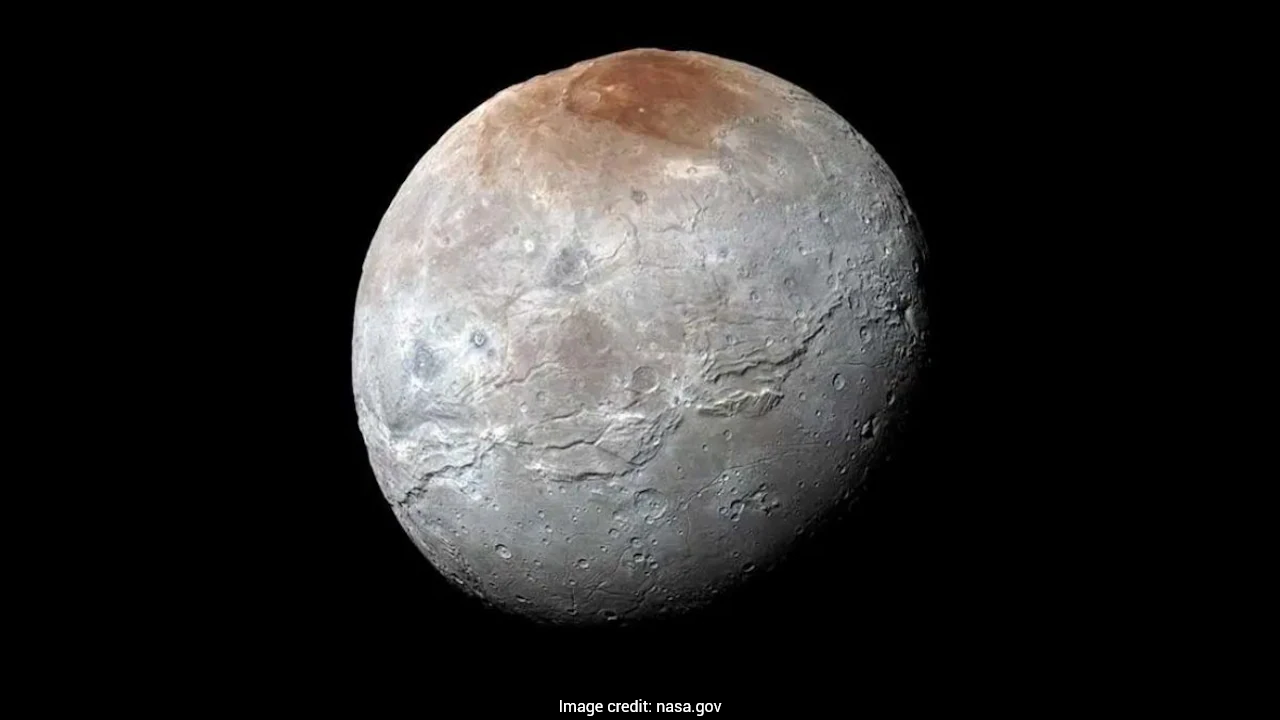
- Charon once spun much faster, with a day lasting about 14.3 hours
- Surface ridges and faults indicate a dramatic slowdown in rotation
- Despinning caused compressional faults and crust shortening near the equator
New research reveals that Pluto's largest moon, Charon, once spun far faster than it does today. Scientists have found a pattern of ridges and faults stretching across its frozen surface. A study published in Nature Communications analysed images from NASA's New Horizons flyby and found that Charon's geology preserves a record of a dramatic slowdown in its rotation.
The team, led by Hanzhang Chen of the University of California, Los Angeles, focused on Oz Terra, a region in Charon's northern hemisphere.
They found that there, mountain ranges more than 200 km long show asymmetric slopes and compressional ridges running north-south, along with east-west extensional features near the poles.
Also read | Dramatic Video Captures Wildfire Surrounding Freight Train In Canada: "Could Overtake Us Here"
That combination isn't random. Modelling indicates it was caused by "despinning", the gradual slowing of Charon's spin due to tidal forces from Pluto.
"This study drastically changed our understanding of the geologic history of Charon," Hanzhang Chen, the study's first author, told Gizmodo.
As a body spins down, it becomes less flattened at the equator. The crust shortens and buckles, creating compressional faults. On Charon, the crust near the equator shortened by about 1% during this process.
The models suggest Charon once rotated about once every 14.3 hours. Today, it's tidally locked with Pluto, meaning one rotation takes 153.3 hours, the same as its orbital period. In other words, Charon's day was once more than 10 times shorter than it is now.
Also read | First Human X-Rays Captured In Space Mark Major Breakthrough For Astronaut Health
Why Charon is a perfect record keeper
Charon is uniquely suited for this kind of detective work. It has no atmosphere, limited resurfacing, and craters more than 4 billion years old. Unlike active moons like Europa or Enceladus, Charon's surface hasn't been heavily reworked by volcanism or tectonics. That means ancient tectonic patterns survive.
"Our work suggests that Charon's surface presents an example that records the planetary despinning history, which predates the proposed global extension and cryovolcanism on Charon. The coevolution of despinning and global contraction favors a cold start for Charon, offering insights into the early thermal evolution of icy satellites in the outer Solar System," the authors wrote.

