




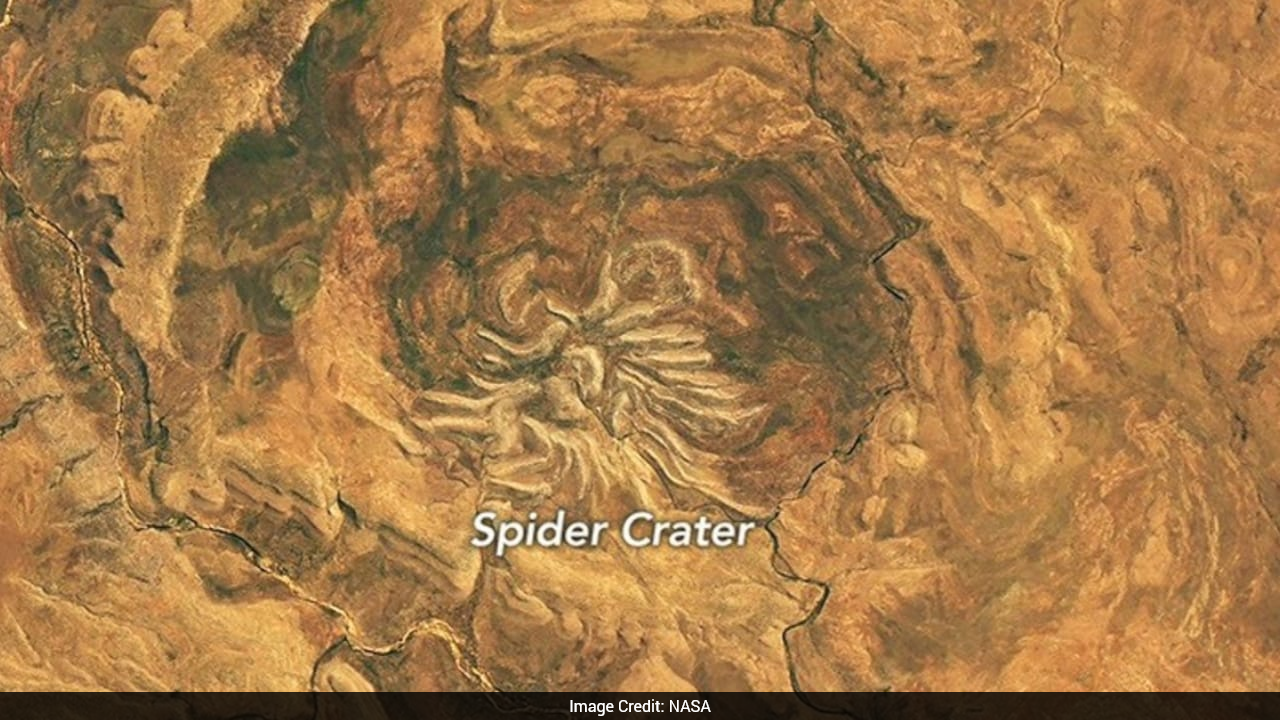
A strange spider-shaped landform in Western Australia has caught attention because of its unusual appearance. Known as Spider Crater, this geological feature was formed by a meteorite impact and shaped by hundreds of millions of years of erosion, according to NASA.
The Operational Land Imager (OLI) on the NASA-USGS Landsat 9 satellite captured an image of Spider Crater on September 20, 2026. The crater is located in the Kimberley region of Western Australia.
The entire impact structure is oval-shaped and measures about 13 kilometres long and 11 kilometres wide. Its spider-like central section measures around 4 kilometres across.
How Did The Spider-Like Pattern Form
Geologists believe the unusual pattern is the remains of a central uplift. This is the raised part of a crater floor that forms when the ground rebounds after the powerful shock of an impact.
The light-coloured, leg-like structures are sandstone ridges. They have remained while other layers of rock in the area have gradually worn away through erosion.
For decades, scientists tried to understand how Spider Crater formed. Some believed that it had a volcanic origin.
However, field studies helped geologists identify signs of an ancient meteorite impact. These included fan-shaped fractures known as shatter cones, which form when powerful shock waves travel through rocks. Such fractures are found throughout the crater's central dome.
Scientists have also studied shocked quartz and zircon crystals found in the sandstone. Laboratory analysis of these minerals may help them understand the angle at which the meteorite struck the ground. The exact date of the impact remains unknown.
Track Latest News Live on NDTV.com and get news updates from India and around the world

