





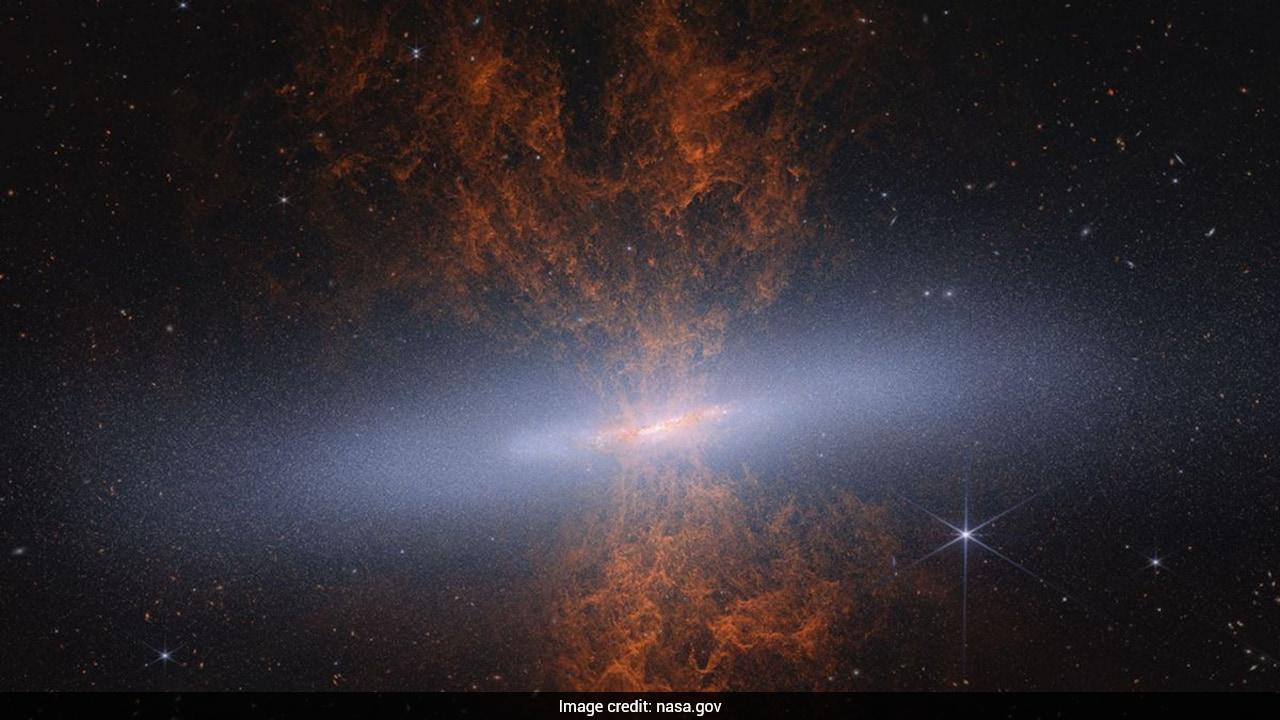
- James Webb Telescope captured detailed infrared images of starburst galaxy Messier 82
- Messier 82 is 12 million light-years away and undergoing rapid star formation after interaction
- Infrared view reveals star-forming regions hidden by dust in visible light by Hubble Telescope
The James Webb Space Telescope (JWST) has captured stunning new views of Messier 82, a starburst galaxy nicknamed the "Cigar Galaxy" due to its long, narrow shape when viewed edge-on. According to NASA, Webb's infrared capabilities have revealed unprecedented details of star-forming regions previously hidden behind thick clouds of dust and gas. Located roughly 12 million light-years from Earth, Messier 82 is undergoing a period of rapid star formation triggered by a past gravitational interaction with its neighbouring galaxy, M81.
Webb's latest images add immense value to the archival data from the Hubble Space Telescope, providing a more complete picture of this chaotic environment. Previously, many of the galaxy's central features were completely blocked by cosmic dust at visible wavelengths of light.
Because it detects infrared light, the powerful space telescope can peer right through these obscuring shrouds to map the structure of the edge-on disk, resolving dense star clusters that represent only a fraction of the galaxy's total stellar population.
"This extraordinarily high rate of star formation is thought to be the result of an interaction with a nearby galaxy. In a twist of cosmic irony, the extreme star formation in M82 is causing plumes of material to be ejected above and below the disk of the galaxy – and that will disrupt future star birth," NASA wrote on Instagram.
Seeing through the dust
Webb observed M82 for 65 hours using its Near-Infrared Camera (NIRCam). Because infrared light cuts through dust far more effectively than visible light, Webb can see directly into regions that Hubble captures only as dark, opaque lanes.
The resulting composite images combine Webb and Hubble data to show stars as sharp blue-white points, dust grains in vibrant red-orange, and ionised hydrogen gas in glowing yellow. This highly detailed mapping reveals the energetic processes occurring at its heart.
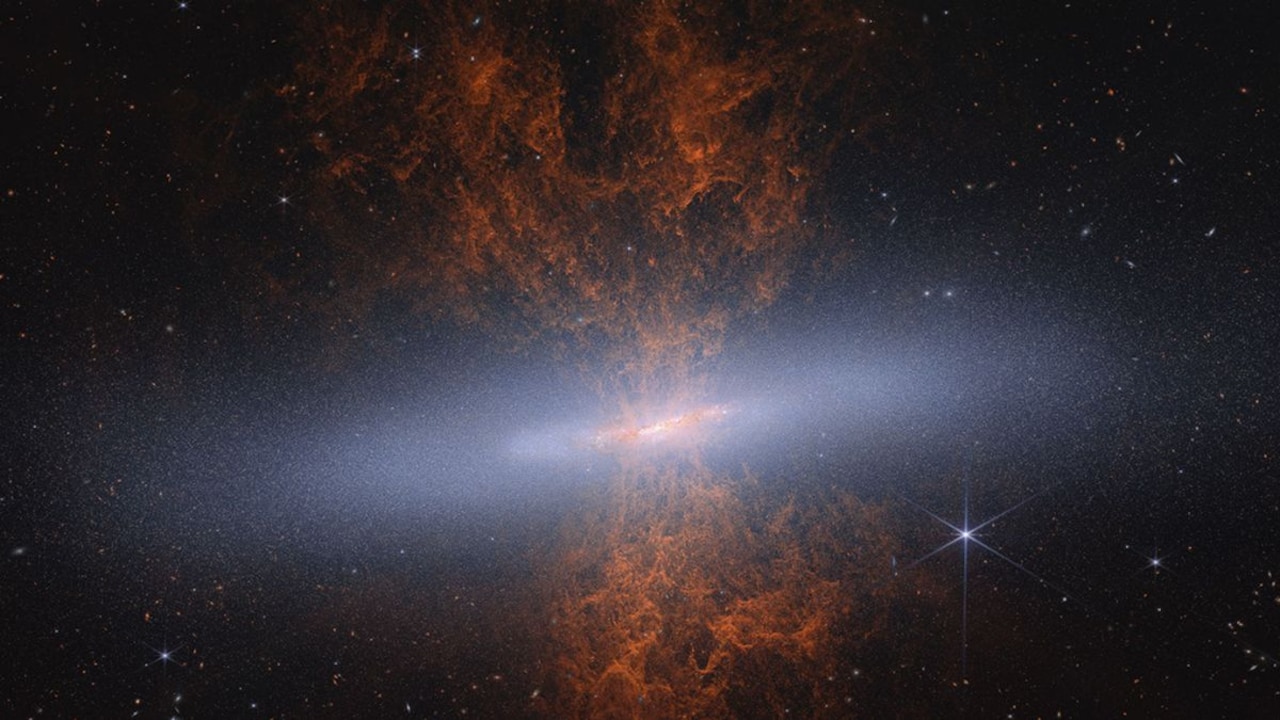
Photo Credit: NASA, ESA, CSA, Adam Smercina (STScI, Tufts), Thomas Williams (University of Manchester); Image Processing: Alyssa Pagan (STScI)
Astronomers note that M82's extreme starburst phase won't last forever. It is expected to continue for only a few hundred million years-a brief moment in cosmic time. The very same intense radiation and supernova explosions that mark this stellar boom are also driving massive galactic winds, blowing material out of the galaxy in giant plumes above and below the disk. These outflows will eventually deplete the gas reservoirs, cutting off the fuel needed for future star birth.
"M82 is a mess, but it's a beautiful mess," said NASA fellow Adam Smercina. "We don't fully understand what's going on, especially concerning its evolutionary history. What could have triggered such an elevated rate of star formation?"
Ultimately, M82 provides researchers with a nearby laboratory to study how galactic encounters drive starbursts and how the resulting feedback shapes a galaxy's future. By comparing Webb's infrared perspective with Hubble's visible-light data, scientists can trace exactly how dust, gas, and stars interact during one of the most energetic phases of galactic evolution.
Track Latest News Live on NDTV.com and get news updates from India and around the world

