





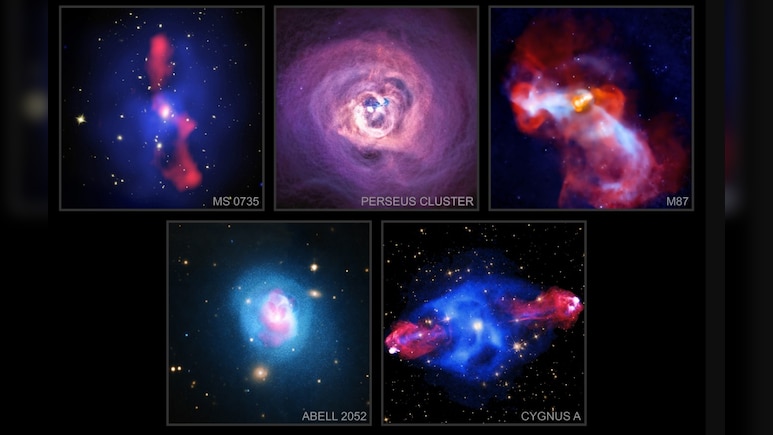
NASA's Chandra X-ray Observatory has revealed fresh insights into how supermassive black holes influence the largest structures in the universe by using a new image-processing method called "X-arithmetic". This technique allows astronomers to distinguish different physical features in the hot gas of galaxy clusters by comparing variations in X-ray energies, offering a clearer picture of the processes that shape these cosmic giants.
Galaxy clusters are among the most massive gravitationally bound objects in the universe, consisting of thousands of galaxies, vast clouds of superheated gas, and dark matter. Many of these clusters host supermassive black holes at their centres, which periodically unleash powerful outbursts. These eruptions generate energetic jets and bubbles that transfer energy into the surrounding gas, forming complex structures like rings, arcs, and bubbles visible in the new X-ray images.
With X-arithmetic, scientists can classify features such as jet-blown bubbles, cooling or slow-moving gas, and shock fronts more precisely, enabling a deeper understanding of the interplay between black hole activity and cluster evolution. The new images, released recently, highlight central regions in clusters such as MS 0735+7421, the Perseus Cluster, M87 in the Virgo Cluster, Abell 2052 and Cygnus A.
Astronomers say this approach improves upon earlier methods by revealing underlying physical processes rather than just surface brightness, helping researchers interpret the turbulent environments where black holes shape cosmic gas over vast scales.
Track Latest News Live on NDTV.com and get news updates from India and around the world

