





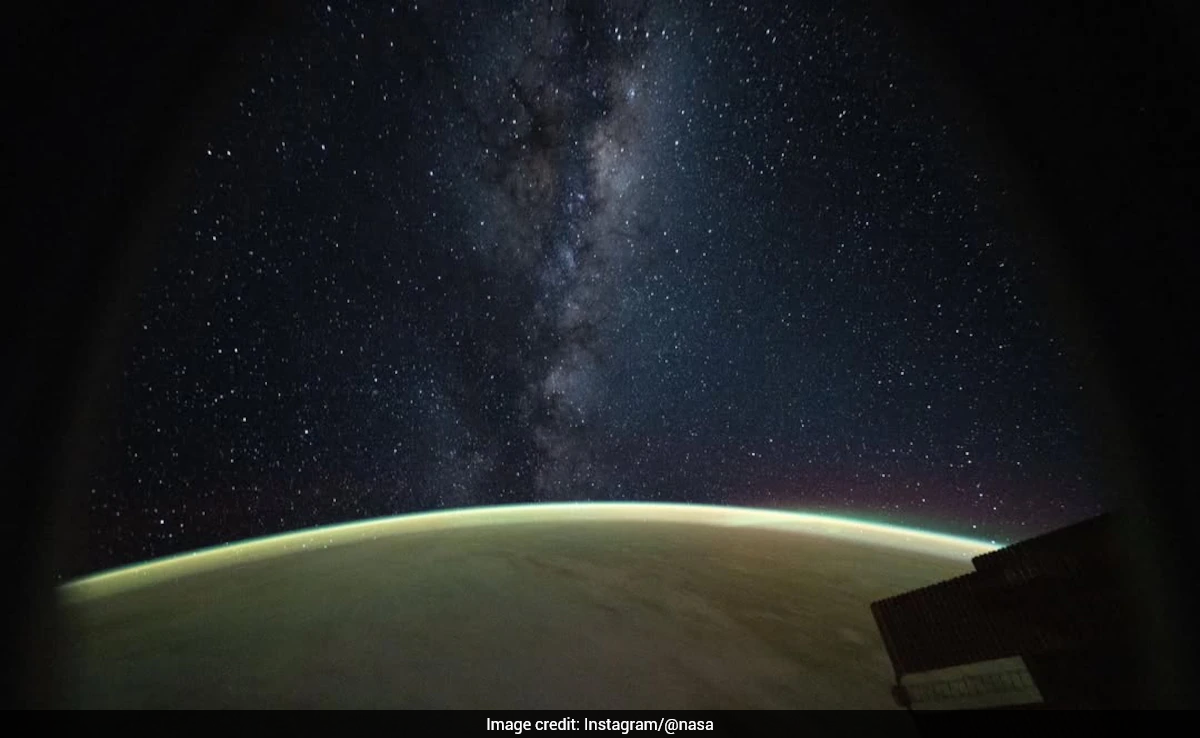
- NASA astronaut Chris Williams photographed the Milky Way from a SpaceX Dragon docked to the ISS
- The Milky Way appears brighter and wider from orbit without atmospheric interference or city lights
- NASA described the image showing the Milky Way’s central band vertically across the center with stars
NASA astronaut Chris Williams captured a breathtaking view of our galaxy, the Milky Way, as seen from a SpaceX Dragon spacecraft docked to the International Space Station (ISS). From the ground, the Milky Way is a faint band of light stretching across the night sky. From orbit, it looks like something else entirely. Astronauts aboard the ISS regularly photograph the galaxy from above. Without city lights, atmospheric haze, or dust scattering the light, the Milky Way appears brighter and wider.
Describing the image, NASA wrote, "The bright, central band of the Milky Way stretches vertically across the center of this image, with stars surrounding it." "The dark Earth takes up most of the image's bottom half. The oval window that this image was taken through hazily frames the corners," it added.
Also read | NASA's MAVEN Detects First Zwan-Wolf Effect Deep In Mars' Atmosphere
See the post here:
With over 88,500 likes, the online users were left mesmerised by the image. "Absolutely wonderful and spectacular," one user commented. "It's also quite amazing that we get to see this at some places on earth. It's truly a gift," another user added.
"Thank you so much for taking this picture, Chris Williams. Thanks so much, NASA, for posting it. I have dreamed of being in space and seeing the Milky Way for so long. Many thanks," a third user noted.
Also read | Astronomer Captures Stunning Aurora Australis From Space Above Indian Ocean
Milky Way, our home galaxy, contains hundreds of billions of stars, enough gas and dust to make billions more, and at least ten times as much dark matter as everything we can see. The band we see is the edge, on view of the Milky Way's disk, we're inside it, about 26,000 light-years from the centre.
The world will know more about the galaxy when telescopes like NASA's Nancy Grace Roman Space Telescope, which is launching no later than May 2027, will study the gas and dust between stars in detail. But for now, the most striking views still come from astronauts who can point a camera straight out the window and catch the galaxy.
Track Latest News Live on NDTV.com and get news updates from India and around the world

