





- Scientists found ammonia compounds on Europa using old Galileo spacecraft data
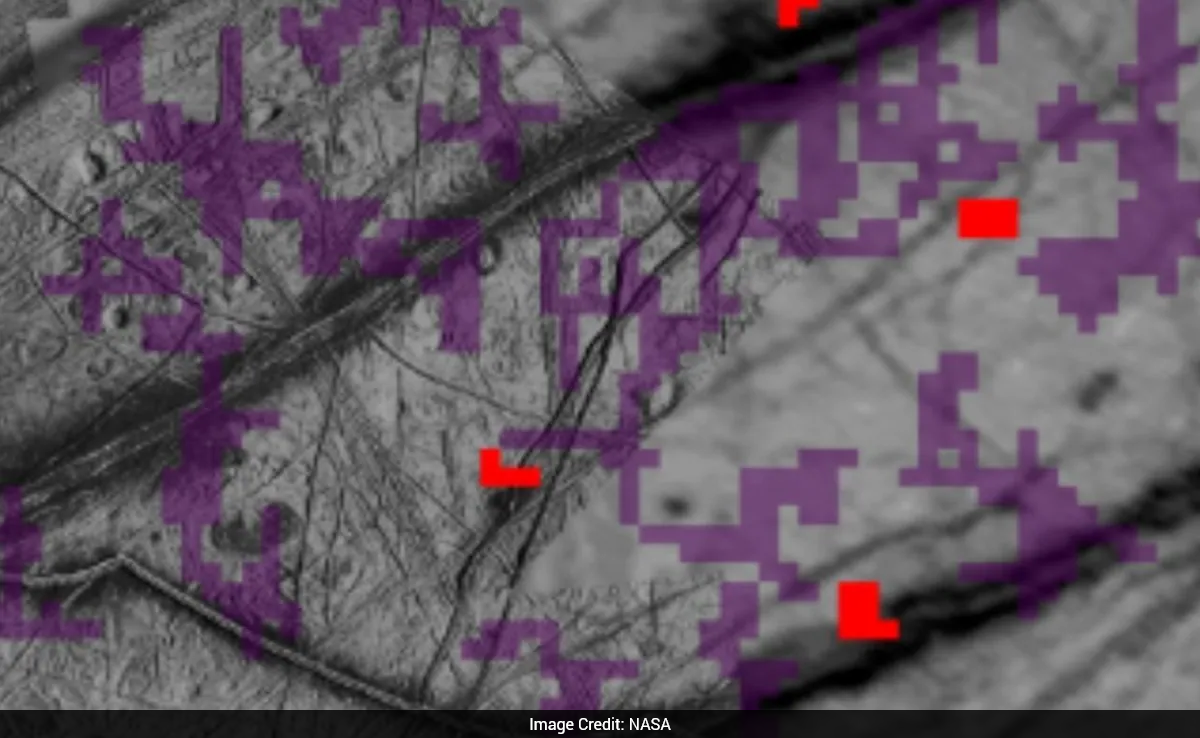
- The discovery was made with a composite image from Galileo's solid-state camera
- Near-Infrared Mapping Spectrometer data showed ammonia near surface cracks
Scientists have taken a fresh look at very old space data and made an exciting discovery on Jupiter's moon Europa. By studying information collected decades ago by NASA's Galileo spacecraft, researchers have found signs of ammonia-bearing compounds on Europa's surface. This new analysis helps scientists understand what may be happening beneath the moon's thick ice, reported NASA.
The discovery was made through a composite image created from data collected by the Galileo spacecraft. The close-up view of an area approximately 250 miles (400 kilometers) wide shows a black-and-white mosaic created by combining multiple images taken by Galileo's solid-state imaging camera.
Scientists also overlaid data from the spacecraft's Near-Infrared Mapping Spectrometer (NIMS). Red pixels in this overlay indicate locations where ammonia-containing compounds were detected, while purple pixels indicate areas where these compounds were not. The NIMS data used in this study was collected during Galileo's 11th orbit of Jupiter in 1997.
Cracks on Europa's Icy Surface
The image also shows dark, crossing bands on Europa's surface, indicating cracks in the moon's icy crust. Scientists say the presence of ammonia-rich compounds near these fractured sites could indicate that the material was brought there by cryovolcanic activity. This process could have brought up liquid water from the vast ocean beneath Europa's ice.
NASA's Galileo mission launched in 1989 and was operated by the Jet Propulsion Laboratory in Southern California. The mission studied the Jupiter system for several years and officially concluded in September 2003. The Jet Propulsion Laboratory is managed for NASA by Caltech.
Track Latest News Live on NDTV.com and get news updates from India and around the world

