Budget 2026: Is 'Invisible Kerala' Paying The Price For Being 'Unaligned'?
What Kerala needs is not just sympathy or slogans. We need an alternative that commands respect in Delhi and delivers development in Kerala. Right now, we have neither.
The Union Budget 2026-27 has landed with a thud in Kerala - not because of what it contains, but because of what it omits. For a state that contributes richly to India's skilled workforce, tourism brand, and foreign exchange reserves, the silence is deafening. No AIIMS. No high-speed rail. No last-mile connectivity to Vizhinjam port. No special packages, despite this being an election year. The Finance Minister's speech might as well have skipped us entirely.
As the Member of Parliament for Kerala's capital, I watched our State Budget unfold with hope - hope that the Centre would match our aspirations with support. Instead, we've been handed a reality check. The State Budget was built on a fantasy of central funds that the Union Budget has now explicitly failed to deliver. The result? A fiscal mirage evaporating in the heat of political indifference.
No Vote, No Voice?
The tragedy is not just economic - it's political. The Centre sees no electoral gain in Kerala, so it offers no economic gain. The Bharatiya Janata Party (BJP)-led government has made a cold calculation: why invest in a state that doesn't vote for us? Meanwhile, the Left Democratic Front (LDF) government in Kerala screams "victim" but fails to present bankable projects or negotiate effectively with New Delhi. It proposes paper trains and acronyms - RRTS instead of SilverLine - but lacks the fiscal discipline or strategic clarity to make them real.
Caught in this federal standoff is the common Malayali. We pay the price for a Centre indifferent to our pain and a State in denial of its own profligacy. We welcome headlines about coconut and cashew promotion schemes, but without concrete procurement prices or export support, they remain shell promises.
Many Ironies
We hear of national corridors and maritime ambitions, but Vizhinjam - India's gateway to global trade, our only port that can host the world's largest container ships - is treated as a local afterthought, with no Central support for the road and rail connectivity that is hampering its potential as a world-class transhipment port. Similarly, while 20 new National Waterways are to be operationalised, it remains unclear how many - if any - will benefit Kerala. Ship repair ecosystems are promised in Patna and Varanasi, but not in a state with 44 rivers and a rich inland waterway network!
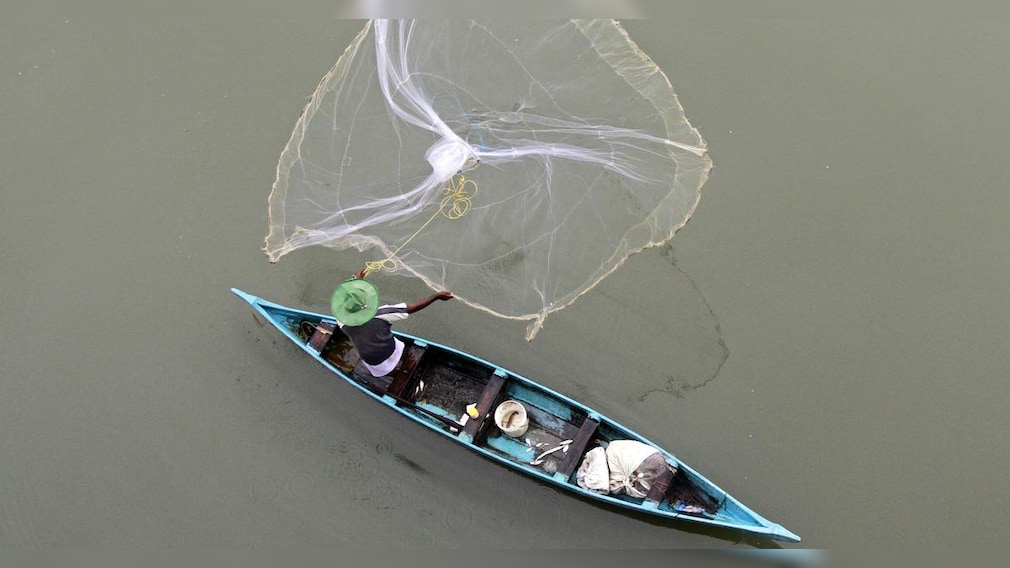
Our coastal communities face the deadly peril of sea erosion that has already leached so much of our territory into the sea, but there is no money for the sea-walls and groynes so essential for coastal protection. The Centre says it's the state's problem, and the State says it has no money, so we continue losing seafront to the marauding ocean. (If we lost an inch of territory to a foreign army, we would spare no expense to mobilise our forces and express outrage, but 64 square kilometres of Bharat Mata's soil have been lost from my constituency alone to the sea, and the government couldn't care less.) The lives and livelihoods of our fisherfolk, mostly living below the poverty line, are apparently of no concern to our budget-makers either.
Even in sectors where Kerala leads, the neglect is striking. Our state accounts for nearly 72% of India's rubber production, yet close to 100,000 hectares of plantations remain untapped due to ageing trees, out-migration of owners, and a shortage of tappers. The Budget offers no targeted support to address these constraints.
The story repeats across sectors. The Budget proposes to develop 15 archaeological sites into vibrant cultural destinations, yet Kerala's extraordinary Muziris-Pattanam excavations are ignored. Even in tourism, the Budget celebrates the Himalayas and the Ghats but forgets Kerala's backwaters and heritage circuits.
The announcement of three new NIPERs (National Institutes of Pharmaceutical Education and Research) omits Kerala, despite its strong public health ecosystem. With multiple NIPERs in northern and eastern India and only one serving the entire South (in Hyderabad), denying Kerala a NIPER, despite its strong public health ecosystem, would deepen regional imbalance - an issue I had already raised as Chairman of the Standing Committee on Chemicals and Fertilisers two years ago.
Turtles, And Little Else
There is, however, one mention of Kerala that I must acknowledge - though it borders on the surreal. The Budget proposes a "Turtle Trail" along key nesting sites, and Kerala is included. That, apparently, is our place in the national development imagination: not as a hub of strategic minerals, maritime trade, or medical excellence, but as a waypoint for turtles!
To be fair, one long-overdue initiative has finally arrived. I had written in this very space advocating a Rare Earths Mission based on Kerala's mineral-rich sands. That mission has now been announced. But the fine print reveals that it will take fifteen years to realise the full range of activities - from mining to refining to processing. It is a welcome step, but it is also a reminder of how slowly the wheels turn when it comes to Kerala's interests. We are rich in resources and talent, but poor in recognition and financing.
What Kerala needs is not just sympathy or slogans. We need an alternative that commands respect in Delhi and delivers development in Kerala. Right now, we have neither. The Congress Party must rise to this challenge - not with rhetoric, but with results. We must be the bridge between aspiration and execution, between regional pride and national purpose.
This Budget may have rendered Kerala invisible. But we are not voiceless. We are the invisible engine of the Indian economy - sending remittances, powering services, enriching culture. It's time we were seen. It's time we were heard. And it's time we were served.
(Shashi Tharoor has been a Member of Parliament from Thiruvananthapuram, Kerala, since 2009. He is a published author and a former diplomat.)
Disclaimer: These are the personal opinions of the author
-
21-Year Tax Holiday, Rs 2,000 Crore Safe Harbour: India's Data Centre Bet

Data centres are infamously capital resources-hungry and require massive amounts of electricity (to run the computers), water (to cool servers), and land (on which to build).
-
Blog | "Hamberder" To "Furniture Of Children", Trump And His 'Unpresidented' English
Time and again, Donald Trump has proven that he possesses the best words. They just aren't always the ones in the dictionary.
-
Opinion | Union Budget 2026-27: Don't Look For Fireworks Here. Continuity Is The Goal
The latest Budget needs to be read as a statement of macroeconomic restraint under external stress. Its defining feature is calibration.
-
Opinion | In Trump's World, Wikipedia's Lesson On Collaboration
Wikipedia founder Jimmy Wales's life's work rests on a proposition that feels almost subversive in 2026: that most people, given the right framework, want to collaborate in good faith.
-
Opinion | Iran Requires a Regime Change, Just Not The Kind America Wants
Trump's dreams of effecting a regime change in Iran need to be considered along two factors related to the power structures within Iran, both of which US seems indifferent to.
-
Opinion | Beyond Ajit Pawar: What Happens To Sharad Pawar's 'Succession' Plan Now?
If Pawar fails to produce one last rabbit from his hat to revive his party after the massive loss of Ajit Pawar, the BJP juggernaut is bound to move in to occupy spaces vacated by the NCP.
-
Opinion | Ajit Pawar: The Politician Who Didn't Pretend
Ajit Pawar bent over backwards to be in power; when there, he commandeered it to work for the public while helping his party, of course.
-
NDTV Exclusive: The Hunters Of Lyman - Inside Ukraine's Deadliest Drone Unit
In an exhaustive interview with NDTV, drone pilots and operators from Ukraine's Signum Batallion go into details about drone warfare and what happens on the frontlines.
-
Ten Minutes From Kanpur, The Plane Crash That Killed Madhavrao Scindia
On September 30, 2001, the Congress lost one of its brightest leaders, Madhavrao Scindia, in a plane crash 10 minutes from Kanpur
-
Ajit Pawar, The No-Nonsense 'Dada' Of Maharashtra Politics
A seasoned politician, Ajit Pawar never hid his ambition he wanted to become Chief Minister of Maharashtra. Only, he never realised that dream, falling a step short an incredible six times.